

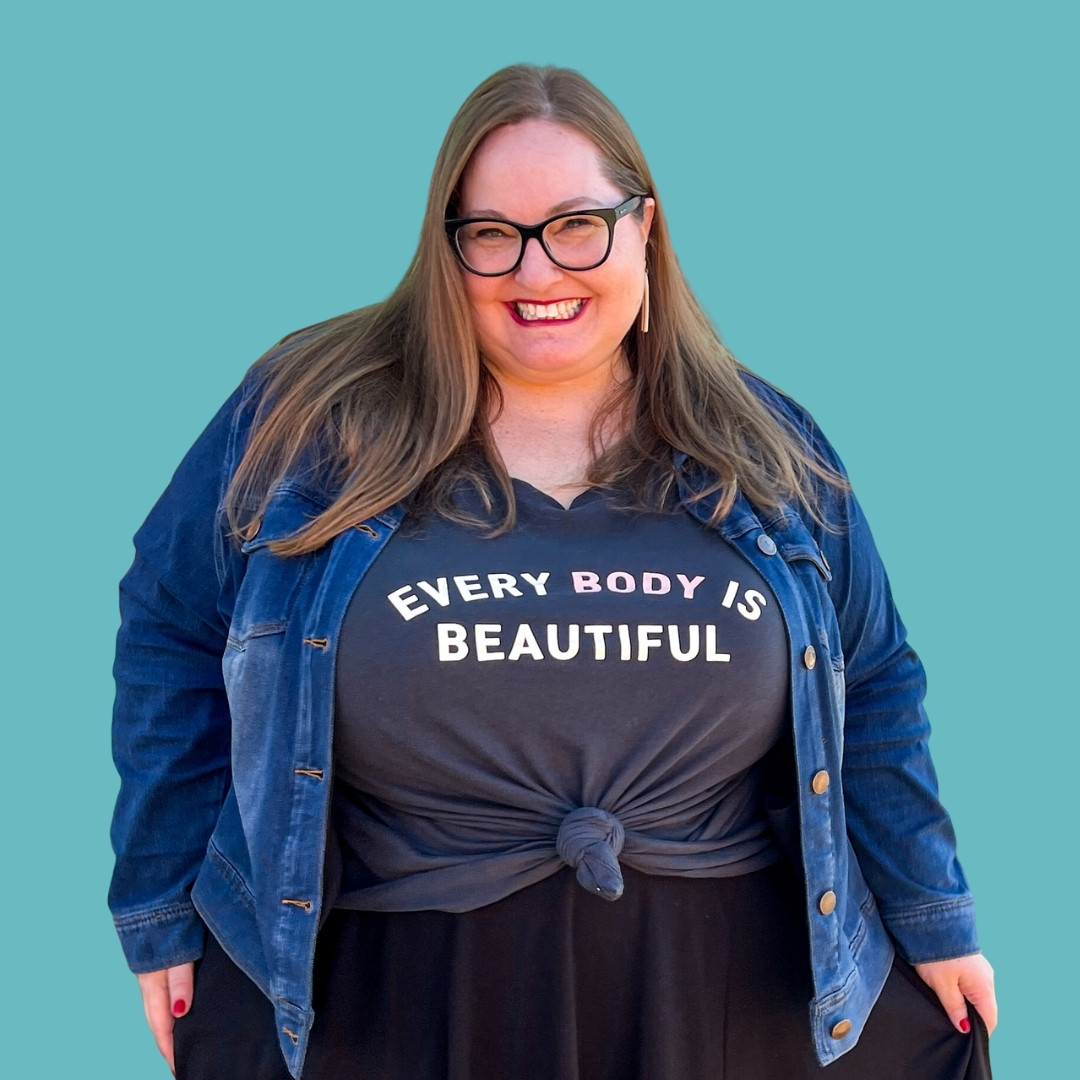


I’m sitting down with Jen McLellan – published author, founder of Plus Size Birth, certified childbirth educator, TED Talk speaker, and host of the Plus Mommy Podcast – for a conversation I truly believe every single person needs to hear, regardless of the body they’re in. We’re diving deep into plus size pregnancy & birth, and Jen is bringing the evidence, the empowerment, and the honesty that so many people in larger bodies have been desperately searching for. We talk about the very real (and very frustrating) assumptions and misconceptions that follow plus size pregnancy & birth – from automatic high-risk labels to the way relative risk gets weaponized in provider conversations – and how to flip that script so you feel informed and empowered rather than defeated before you even get started.
We also get into the practical stuff: how to find a size-friendly care team, what to look for when you walk into a facility, and one of my favorite questions Jen drops in this episode that I think every pregnant woman should be asking their provider: “Do you have any specific guidelines or protocols specifically for my BMI?” Because knowing what your provider already assumes about your pregnancy before anything has even happened? That is gold. Jen also walks us through what to expect during labor, from monitoring challenges to bringing your own belly band, and why so much of what happens in the birth space is about the equipment – not you. This one is full of mic-drop moments, and I’m so grateful Jen trusted me with this conversation.
More from Jen & Plus Size Birth:
- Visitplussizebirth.com& use the code ‘BEHOLD’ for 25% off any ofPlus Size Birth’s offers!
- Follow Jen on Instagram@plussizebirth
- My Plus Size Pregnancy Guide
- Read her blog on advocacy with your provider
- Read her blog on finding a size-friendly provider
Helpful Timestamps:
- 00:00 Plus Size Pregnancy & Birth
- 05:55 Why Plus Size Birth
- 08:16 Creating Missing Resources
- 17:12 Risk Myths and Numbers
- 24:15 Finding Size Friendly Care
- 28:58 BMI Protocol Questions
- 30:56 Spotting Red Flags
- 33:27 Labor Prep Essentials
- 37:15 Postpartum Gear Tips
- 47:20 Plus Size Birth Resources and Discounts
About your host:
🩺🤰🏻Lo Mansfield, MSN, RNC-OB, CLC is a registered nurse, mama of 4, and a birth, baby, and motherhood enthusiast. She is both the host of the Lo & Behold podcast and the founder of The Labor Mama.
For more education, support and “me too” from Lo, please visit her website and check out her online courses and digital guides for birth, breastfeeding, and postpartum/newborns. You can also follow @thelabormama and @loandbehold_thepodcast on Instagram and join her email list here.
For more pregnancy, birth, postpartum and motherhood conversation each week, be sure to subscribe to The Lo & Behold podcast on Apple Podcasts, Spotify, or wherever you prefer to listen!
👉🏼 A request: If this episode meant something to you, would you consider a 5 star rating and leaving us a review? Yes, we read them, and yes, they help keep L & B going! ♥️
Connect with Lo more on: INSTAGRAM | TIK TOK | PINTEREST | FACEBOOK
Disclaimer
Opinions shared by guests of this show are their own, and do not always reflect those of The Labor Mama platform. Additionally, the information you hear on this podcast or that you receive via any linked resources should not be considered medical advice. Please see our full disclaimer here.
Additionally, we may make a small commission from some of the links shared with you. Please know, this comes at no additional cost to you, supports our small biz, and is a way for us to share brands and products with you that we genuinely love.
Produced and Edited by Vaden Podcast Services
Transcript
I gave birth on my knees in a hospital.
Speaker:My husband caught our son, and it was the most transformative and incredible experience.
Speaker:But afterwards, I was like, surely I am not the first fat woman to have a vaginal birth, but why did the internet make me feel that way?
Speaker:Make you feel like
:it
:Motherhood is all-consuming.
:Having babies, nursing, feeling the fear of loving someone that much.
:Then there's this baby on your chest, and boom, your entire life has changed.
:It's a privilege of being your child's safest space and watching your heart walk around outside of your body.
:The truth is, I can be having the best time being a mom one minute, and then the next, I'm questioning all my life choices.
:I'm Lo Mansfield, your host of the Lo and Behold podcast, mama of four littles, former labor and postpartum RN, CLC, and your new best friend in the messy middle space of all the choices you are making in pregnancy, birth, and motherhood.
:If there is one thing I know after years of delivering babies at the bedside, and then having, and now raising those four of my own, it is that there is no such thing as a best way to do any of this, and we're leaning into that truth here.
:With a mix of real life and what the textbook says, expert insights, and practical applications, each week we're making our way towards stories that we participate in, stories that we are honest about, and stories that are ours.
:This is the Lo and Behold podcast.
Lo:We've got a guest today, you guys, and it is a good one.
Lo:I have Jen McClellan here with me today.
Lo:She is a published author, founder of Plus Size Birth, and host of the Plus Mommy podcast, so you guys can check that one out as well when we are done here together.
Lo:Through Jen's work, she empowers people navigating plus size pregnancy in these larger bodies with evidence-based information, compassionate support, how those two work together, which I think is so incredibly important, and honest convos about body image, healthcare, and parenthood.
Lo:Her website, she has millions of page views on plus size birth.
Lo:It has become a trusted leader in education and support for parents and perinatal professionals.
Lo:There's free stuff.
Lo:There's also offers to support you in your pregnancy.
Lo:She has so much on here.
Lo:And then the Plus Mommy podcast has also been named one of the best pregnancy podcasts from The Bump, which is amazing.
Lo:Jen's work has been featured in The New York Times, Glamour, CNN, other major media outlets.
Lo:As a speaker and an advocate, she has presented at the National Institutes of Health, very cool to my geekiness, and she's delivered a TED Talk as well on weight bias in healthcare.
Lo:Jen is also a certified childbirth educator, a wife, and a mother Jen, I am so grateful to have you with me here today.
Lo:Why don't you go ahead and introduce yourself the way you would maybe if we met in the grocery store or coffee shop.
Lo:What would you say to us?
jen:Well, hello, Lo and listeners.
jen:It is so nice to meet you.
jen:I am Jen McClellan.
jen:I am a certified childbirth educator, a speaker, and I am just completely passionate about all things plus-size pregnancy and parenthood and, and body love, and helping to change how the healthcare system as a whole, not even just maternity care, but treats and respects and cares for people in larger bodies.
Lo:Okay.
Lo:And I have to also say, TED Talker, correct?
Lo:You have done a- I did … TED Talk.
Lo:That's a big deal.
jen:Yes, I did.
jen:I just did a TED Talk in the fall.
jen:I, I… Maybe I should lead with that.
jen:I'm, I'm not good at that, that, But yes, I did a, a TED Talk on, how to treat every body with dignity, and it really walked the audience through what it is like being on diets my whole life and only getting bigger and bigger.
jen:And even at one point on stage, I sat in a chair that didn't really fit my body, a chair with arms, to demonstrate what it's like for a larger person just trying to navigate the world, and, it was really scary in many ways, but so awesome and empowering and it was a really, really great experience.
jen:I wanted to challenge myself to really help others understand.
jen:So, thank you, Lo.
Lo:That's amazing.
Lo:I mean, what a little pin in your cap, feather in your cap, feather in your cap.
Lo:I don't know.
Lo:Are TED Talks still cool?
Lo:I think they are.
Lo:Yes, yes.
Lo:So that just feels like such a cool opportunity for you too.
jen:Yeah, it was a real, it was a real honor to be able to talk about a topic that not that many wanna talk about, but I greatly appreciate you for wanting to have me on the show and, and have this conversation.
jen:'Cause we know in the United States specifically, like 70% of people exist in a larger body, have a BMI over 30, and of that, almost 40% of people who can become pregnant have a BMI over 30.
jen:But we don't really talk about the nuances and the challenges, and a lot of people just struggle internally or just deal with, you know, biases and don't really know how to navigate it.
jen:So I, I appreciate this opportunity.
Lo:Yeah, absolutely.
Lo:I'm so glad to have this conversation.
Lo:And I know we mentioned this before we started talking, but I feel like I have some nurse perspectives about when things were or were not done well for our larger bodied patients or like- Yeah … even resources that were or were not available.
Lo:So I wanna get into some of that because a lot of the listeners are going to have a baby, having babies, and so that could be their lived experience as well of knowing what to ask for if it's not offered, or maybe even what types of care to look for as well.
Lo:I know you kinda have alluded to this, like this is obviously a personal journey.
Lo:Is there something specific where it was like also the birth space?
Lo:Like, I really have to lean into this topic of being larger bodied and also having a baby.
Lo:Like, what brought you s- to our birth space and to this birth niche?
jen:Birth.
Lo:Yeah, your own birth.
jen:Pregnancy and birth.
jen:Yeah.
jen:Of course.
jen:I, you know, got pregnant in:jen:I really date myself now when I share my story.
Lo:I know.
jen:But there was no #PlusSizePregnancy.
Lo:That's
jen:right.
jen:And I spent forever on Google just trying to find images of people my size pregnant, and it was really frustrating and hard.
jen:There weren't a lot of resources, or where do you even find cute maternity clothes?
jen:I like to dress cute, you know?
jen:And, and all of these resources and everything I found continuously was negative.
jen:You will incur gestational diabetes.
jen:You will have a cesarean birth.
jen:And I was like, I've been a big girl since puberty, and I've never let that really hold me back.
jen:I'd always struggled with self-esteem, but I was a camp counselor, and I went after my dreams.
jen:I love theater.
jen:And so I was just like, "Why would, why am I gonna let this hold me back now?" And connected with an incredible midwife thanks to a doula, and it was the first time I felt as an adult that a care provider touched my body with compassion.
jen:And every conversation wasn't just about a number on the scale.
jen:It was about my overall health, and it started to change really so much in my self-esteem, in my views on accessing healthcare and being treated with respect.
jen:And I wanted an unmedicated birth.
jen:My mom had an unmedicated birth and always talked about it.
jen:And I, I realize now years later, I also wanted it because I was afraid of people having to move my body for me.
jen:I wanted to be in control.
jen:And I was so fortunate to connect with an incredible midwifery team, and I gave birth on my knees in a hospital.
jen:And, my husband caught our son, and it was the most transformative and incredible experience.
jen:But afterwards, I was like, surely I am not the first fat woman to have a vaginal birth.
jen:But why did the internet make me feel that way?
jen:Make
Lo:you feel like it, yeah.
jen:Right.
jen:Yeah.
jen:And we look at, like, old artifacts.
jen:There's, like, these voluptuous, statuesque bodies that are big and pregnant and small and pregnant.
jen:Like, this isn't a new thing.
jen:Bodies of all sizes give birth.
jen:And so I created all the resources I couldn't find and started blogging.
jen:the mommy blogging era of, of:jen:And it kinda took off and changed my life because this conversation wasn't happening on social media in the way that I brought it.
jen:And so on Facebook, I have, like, over 200,000 followers 'cause it just blew up really quick on Facebook.
jen:And it's been an incredible journey of Really advocating for change, and not only from the consumer perspective, but going out and speaking to care providers, and con- medical conferences, and even collaborating with the National Institutes of Health to really get some change, in what occurs and the harm that occurs for people in larger bodies.
Lo:So good.
Lo:It's interesting to think that the larger majority of our population falls into this BMI, you said, what?
Lo:Above 30.
Lo:But yet it's so hard, or maybe more was especially, when you were looking to find information for you when you are the bigger chunk of people having babies.
Lo:Like, it's just… I guess I'm just, like, fleshing that out verbally for a minute.
Lo:Right.
Lo:It just is kind of… It- you probably were thinking, "This is nonsensical." Like, like you said, "Am I the only fat person to have a vaginal birth?" No, not at all.
Lo:And if anything, probably more of us, like this is you speaking, than the alternative.
Lo:But where's the information?
Lo:Where are the resources?
Lo:Where's the encouragement?
Lo:I just… It's just really interesting to think about that massive gap.
Lo:Mm-hmm.
Lo:And obviously you felt it, saw it, and now you're filling it.
Lo:So I just think that's, that's great.
Lo:And
jen:you said, but also, Lo- Um, you said, like… Let- go
Lo:ahead.
jen:Where are the plus size maternity jeans?
jen:Like, it, it comes down- Yeah … to something so small.
jen:Even to this day, I've been doing this work for 15 years now, it is hard to find anything above a 3X, and even then it's a 2X.
jen:2X and below is now lot more standard.
jen:It, it wasn't, but anything beyond that is still so incredibly difficult to find.
jen:And it, brands have pulled back on their larger extended sizes for maternities, clothes, and then say, "Well, no one was buying them."
jen:And I've worked with brands and I'm like, "Did you advertise that you were size inclusive?" "Oh, well, we didn't put much advertisement beyond, behind it."
Lo:100%, yeah.
jen:Yeah.
Lo:Well, then how would anybody know?
Lo:I know.
Lo:It's, man, it's so interesting.
Lo:Okay, I wanna talk about something maybe small, but in these, you know, eight minutes we've been talking, you have used vocabulary, larger size bodies, plus size bodies, fat bodies.
Lo:Like, is there… I don't wanna say, like, PC terms, but are there terms you think that are or are not appropriate when you're being cared for, or you are the caretaker, or do you think we actually need to be more comfortable with just referring to bodies as they are and not having it be like this stigma, like, this negative connotation?
Lo:Like, what would you say to that?
jen:Love it, and I'm glad you picked up on it.
jen:I intentionally change out the language a lot, but one word that you don't hear me say, or rarely hear me say, is obese.
jen:And we have studies to show that that word is actually really harmful, and the, the Latin root of the word is to, like, have eaten until big.
jen:Like, it just doesn't feel good, and so we have studies to show that people don't like it, and yet it's used and ingrained in our healthcare system.
jen:And I say, well, so were, like, other words, like the R word that we don't use.
jen:So encouraging- care providers, to be just be mindful of that language and know that it can be harmful.
jen:But there might be someone listening that's like, "I don't mind the word," and that's cool.
jen:I say I'm fat, and a lot of people are like,
jen:" Lo: Whoa."
jen:That's a whole nother F word.
jen:So language is nuanced, right?
jen:We all have words that, we identify with and we like to use.
jen:So I have a framework for, and, and this is really for more so providers and stuff about language to use that's inclusive, and it starts with just, you know, listening to the language that people are using when they talk about their bodies.
jen:So for the listeners, if you don't like the word obese or fat and your provider is using that word, say, "Hey, I notice you use this word and, and that makes me a little uncomfortable." And if you feel comfortable saying this, "I prefer to be called plus size or a person in a larger body," or whatever it is for you.
jen:Or more importantly, "Do we even need to talk about my weight?" So part of the framework is also, like, be neutral.
jen:Does everything have to be related back to weight?
jen:Because care providers can talk about nutrition and physical activity without saying, "Well, because you're obese, we need to talk about this," because, well, you talk to everyone about nutrition and physical activity during pregnancy, right?
jen:Mm-hmm.
jen:So it's just how the conversations are framed How you feel when you're being talked to, and are your care providers really listening and making you feel respected?
jen:Because that's actually something that you should be receiving as a patient is respectful care.
jen:That's part of your, you know, your, your patient rights.
jen:And so if you're being made to feel less than, or if words are being used that don't make you feel good, speak up if you're able, and definitely seek out a new provider if you're able.
jen:But I know there are so many barriers to both of those things.
Lo:Yeah.
Lo:It's interesting to think about, like for the reality is, is really what you said is this is personal, right?
Lo:I may be fine with the word fat, but if the person next to me is not, well, then we both have the right to communicate that, you know, to a provider- Mm-hmm … to someone around us.
Lo:And so I know you're saying like, "If you feel comfortable saying so," but my brain is also thinking like, "But, but say so.
Lo:Like tell us."
Lo:Oh, yeah.
Lo:I'm thinking of nurse perspective too.
Lo:Like what a gift if that were maybe on the birth plan or like, I don't know that that would really come up in specific like you're in labor care, but just to like dash that off on your birth plan if there's something like that.
Lo:You know, and then, then your nurse can just be sure to come around you as well-
jen:Yeah
Lo:in another supportive way.
Lo:'Cause vocab- I mean, the things we say matter, right?
Lo:The way we frame things matters, and so the message could be the same, but the, the framework around it is not, or it's not like what, you know, speaks to you or makes you feel safe or heard, well, then the message gets lost, right?
Lo:And so then we have- Oh, yeah … this huge disconnect going on between provider and patient or, or whatever relationship we're talking about.
Lo:So-
jen:Yeah
jen:… Lo: I wanna use that also.
jen:Go ahead.
jen:Yeah, please.
jen:It's not just people in a larger BMI.
jen:We also know people who have a history of disordered eating, seeing the number on the scale or even standing on the scale can actually be directly harmful.
jen:So it, it's also the conversations around the scale of providers saying, "Would you like to be weighed today?" Something as simple as that.
jen:Because as mentally competent adults, we don't have to do anything we don't wanna do, right?
jen:Unless it's an emergent situation and there's, you know, and even then you, you give consent, but if you're unable to give consent.
jen:But, but what I'm saying is- if care providers change their language a little, I feel like as consumers and patients, we're more willing or open to doing things and having certain conversations if it's initially met with respect.
jen:So if you don't feel like being weighed one day at the doctor's office, you have every right to say, "I don't wanna be weighed today," or, "I'm gonna stand backwards on the scale today," or, "I weighed at home.
jen:Here's the number," or, "I wanna be weighed at the end of the appointment." I want you to hear that you have options, and that in and of itself can feel really empowering.
jen:And i- in… I think, I think another thing, especially around people who have a history of disordered eating, is they can say, please don't say my weight out loud," or, "I don't wanna see my weight when being weighed."
jen:But then you get that printout, right?
jen:After your visit, you have a good visit with this care provider that you build a rapport with, and then you see that number on, on the sheet, and it can be really harmful.
jen:So asking your care team, "Is there the ability to not have the numbers shown?" There's just so many little things that you can do to really protect your mental health at the same time as well
Lo:Yeah.
Lo:You've been mentioning like the idea of almost assumptions that care providers make or assumptions related to care.
Lo:Like, "Since you're obese, we better talk about X, Y, Z." And we all know that that's because the provider could then already be thinking, "This is gonna happen to you because of your weight," right?
Lo:So what are some common assumptions, misconceptions that are out there and floating around about someone who is having a larger sized pregnancy and see maybe a provider or even those around you are immediate- immediately gonna say, "Oh, X, Y, Z's gonna happen. You're gonna have GDM." I know you mentioned that.
Lo:What are some of those?
jen:The initial classification of high risk, having a high risk pregnancy.
jen:And ACOG, the American College of Obstetricians and Gynecologists, doesn't state that people with a higher BMI need to be risked out of care, and yet so many providers have BMI restrictions, birth centers have BMI restrictions.
jen:I recently spoke at the National Birth Center Conference trying to massage that out a little bit.
jen:Like, do we really need those blanket restrictions?
jen:Can we work with people on a case by case basis?
jen:The reality is, if you exist in a larger body or if you're advanced maternal age, you're gonna have increased risk.
jen:Across the board, you will have increased risk.
jen:But there's no one thing that only people in larger bodies incur during pregnancy.
jen:And those risks are often framed in a way that makes people feel like it's astronomical or, "I'm doomed to have it." An example I use often is gestational diabetes, because there's another assumption.
jen:People are tested multiple times for gestational diabetes during pregnancy, and they're told that their risk is about, you know, four to five times greater.
jen:And I'm like, "Four to five times greater?
jen:Oh my goodness.
jen:Is that 40%, 50%?
jen:What does that mean?" But if we were just to compare Lo, who exists in a smaller body, and Jen, who exists in a bigger body, we're just comparing our two different risk factors.
jen:That it's relative risk.
jen:So yeah, my risk of incurring gestational diabetes is four at a time greater than Lo's, but what is my actual risk?
jen:Well, it's about 17%, and that number is not fixed.
jen:It could go up or down based on your own health or things that might incur during pregnancy.
jen:But what I encourage people and providers to do is flip the script.
jen:Okay, 17%, that's nowhere near 40 or 50.
jen:Actually, if I flip it, that means I have over an 80- 80% chance of not incurring gestational diabetes, and I know that if I'm proactive with my wellness, that number can drop even more.
jen:So it just empowers people instead of feeling like, "Ugh, my care provider like says I'm going to or I'm destined to," or, you know, my mother-in-law asked if I, if I have it yet, and go and be like, "No, ma'am, I've got like over 80% chance of not incurring it, and I'm working on my wellness, and thank you very much."
jen:So just empowering people.
jen:I'm not afraid to talk about the evidence.
jen:There are increased risks, but these assumptions that just because you exist in a larger body, you will incur these risks is asinine
Lo:You are speaking my language.
Lo:I'm over here like, "Oh, yeah." D- I just, this is so geeky, right?
Lo:But I love the conversation of relative risk versus absolute risk.
Lo:Talk about, like, all the time in my birth class because- Mm-hmm … we focus so specifically on like, " Oh my gosh, I have double the chance of something." And then you look at the number, and it's, goes from like . 5 to 1%, and you're thinking, "Oh, wait, that's not what my brain was doing." 'Cause I think our brains hear those numbers of whatever risk of whatever we're speaking about- and immediately jump to the like, "What?
Lo:Triple?" And then when you look at the actual, this absolute risk idea, and you realize these sometimes, sometimes, you know, these numbers are almost negligible.
Lo:They're real- Oh, yeah … but they're very tiny.
Lo:Mm-hmm.
Lo:And so I just love having that conversation so that when, you know, what do we always say?
Lo:Ask your risk benefit before whatever choice.
Lo:But I'm like, but make sure you understand what risk is being- Yeah … how the risk is being presented to you as well.
Lo:Like, there's a second, a second step to that too.
jen:What is my actual risk is such an important question.
Lo:Mm-hmm.
Lo:Like my person- But- … my body, my pregnancy.
Lo:Yes.
Lo:Yeah.
Lo:Yeah.
jen:But you're often not gonna be told the number, right?
Lo:No.
jen:Because- No … even providers have those relative numbers ingrained in their brains.
Lo:Yeah, which I get that.
Lo:I think probably a lot of the things that pop in my head if someone asks me a question about epidurals or whatever, it's just like that relative risk idea too that pops up.
Lo:Yeah.
Lo:And then I have to, like, go grab the evidence real quick and remember what it is compared to another person and, and even do that own in my head, even though I'm, you know, maybe talking about the same topic the whole t- you know, over and over and over.
Lo:You gotta sometimes remember to dig, yeah, as a provider, dig back down for, "Oh yeah, that's a good question.
Lo:Let me get you that number- Yeah … as well," for sure.
jen:Stillbirth is one we see- Yeah … for people of all sizes, right, Lo?
jen:Like-
Lo:Yeah
Lo:… jen: that is used in a way, that of course, you get to, as you say in your show, and I firmly believe, you get to make your own decisions.
Lo:But, you know, we're looking at low, low, low, low, low, low, low, low, low, low, low, low percentages and low increased risks across the board.
Lo:So if, if you feel, "Yes, I wanna have an induction," or, "Yes, w- I wanna have whatever it is that's being recommended," then that is your choice.
Lo:But really encourage you to ask those questions and, and have those conversations and do the research and take outstanding classes like yours, Lo, because it's so unfortunate that we have to be so empowered and advocate for ourselves so much, but it's critical.
Lo:And, and just going back to the beginning of our conversation when I said, "If you can," I think I put that in there because I know how hard it is I've had a doctor, you know, before even y- touching my body ask me if I've considered weight loss surgery, or even talking to me about anything really.
Lo:I've had some really traumatic medical experiences, so a lot of people in larger bodies go into healthcare with cumulative trauma.
Lo:So it can be, even if you have the most
:Hey friend, quick pause for just a second.
:If you are listening to this podcast because you wanna feel more prepared, more confident, and less freaked out about birth, that is exactly why I created the Your Body Your Birth course.
:This birth course will not tell you what kind of birth you should want, and nobody has the right to do that.
:It is about helping you understand what's happening in your body, what your options actually are, and how to walk into your birth feeling grounded, excited, ready, instead of overwhelmed and scared.
:When you have education like this, everything changes, your mindset, your conversations with your care team, and the birth experience itself.
:No more relying on random opinions, okay?
:Stop scrolling.
:Take intentional action with me and start trusting your body, your voice, and your decisions today.
:Head over to www.thelabormama.com/birth, also linked in your show notes, and be sure to use the code PODCAST at checkout to save 20% and start working towards this better birth for you right now.
:Okay, let's get you back to the episode
jen:amazing care provider, it still can be hard to speak up, and I want you to know that you're not alone if you're listening and you've been through that.
jen:And I have a whole blog post we can put in the show notes on just advocacy tips on how to advocate for yourself when it's really hard
Lo:Okay, that is a perfect segue into my next question, which is, do you have tips, I think you have resources about this if I remember this right, about building a care team prenatally- Oh
Lo:like if you have the opportunity and you're not already down the road, building a care team that is really supportive of this larger size pregnancy, of wanting an unmedicated birth, of not inducing you just because you are high risk.
Lo:Like, how does someone go about that?
Lo:'Cause we have it for VBAC, right?
Lo:And you sometimes you hear it for these other things, but what about for knowing I'm gonna have a larger sized pregnancy and I want a team that's-
jen:Yeah
jen:… Lo: doesn't really bat an eye at that, honestly.
jen:Yeah.
jen:I mean, it's a lot of the, you know, I know Jen with, VBAC Facts and so many other people have done such great work around vaginal birth after cesarean, but if you find a VBAC, supportive provider, they're usually also size inclusive.
jen:So, what I encourage people to do, and I have a whole free guide you can download on how to, connect with a size-friendly care provider that we can put in the show notes, but start by asking your plus-size friends, do they have a care provider that they really liked?
jen:I know we talk about Instagram all the time, but Facebook groups are where it's at for, a lot of parent groups.
jen:And asking questions, I've found that can be great because it's hyper-local.
jen:So if you find, like let's say, a mom's group in your area and you feel comfortable posting, "Hey, I'm plus-size.
jen:Does anyone have a provider that you felt comfortable with or who didn't push X, Y, Z?" So just kind of feel around and then when you're gonna make that appointment, call ahead and ask, "Do you work with people of all sizes?"
jen:And usually they get like, "Well, of course." But- Right.
jen:Right … it's a really good question to put first because so many birth centers don't.
jen:There are midwifery clinics that don't.
jen:I, I … It sounds shocking, but even rural hospitals, hospitals, medical facilities have BMI restrictions in rural areas, and it just…
jen:You don't wanna walk into an appointment and then be told, "Oh, you're too big. We can't support you here." Like, to start your pregnancy off that way, that's, that's not the way you wanna go.
jen:So even though it might be an uncomfortable question to ask, I think it's an important one.
jen:Do you have larger gowns?
jen:Do you have larger blood pressure cuffs?
jen:So asking some questions in advance, and then when you show up, look around.
jen:Are there chairs in the lobby that don't have arms where you can sit comfortably?
jen:What are the marketing materials?
jen:What are the messages?
jen:How do you feel when you're taken back for, for that scale?
jen:If you don't wanna be weighed in a traditional manner, is that respected?
jen:Or, you know, those initial, that first time visit, there's gonna be a lot of pressure to be weighed, and I encourage people, it's good to get a baseline.
jen:It's important in some ways.
jen:But it's also your choice.
jen:So are you met with respect?
jen:And then when you go back to the room, is there a place for you to sit in the exam room that also has a chair that doesn't just have arms, or can you only sit on the exam table?
jen:And, you know, how are you being talked to?
jen:A really important question to ask a care provider early on during pregnancy is, "Do you have any guidelines or recommendations that you're going to make based only on my BMI?"
jen:So some care providers will label you as high risk, and that presents a completely different trajectory to your pregnancy.
jen:And if that's the path you wanna take, awesome.
jen:I 100% support you.
jen:But if you don't want an induction, or you don't want certain things, then working early on to connect with a care provider that will be supportive of your plans for your birth, knowing that we have no control over how birth will unfold.
jen:But, you know, for some people, they do want an unmedicated birth.
jen:Is their provider supportive of that, or, or are they gonna recommend certain things that could create more of a barrier?
jen:And last, trust your intuition.
jen:What is your gut telling you?
jen:And in many cases, we have the ability to switch care providers.
jen:I myself switched care providers, and it was such an incredible, dramatic shift in the care and support that I received.
jen:So-- And I was about five months pregnant, so I know it can be done, but I'm gonna be honest, I cried.
jen:I cried while breaking up with my OB because I'm a sensitive human, and I don't like to, like, hurt feelings.
jen:But you know what?
jen:I don't know.
jen:I wouldn't be sitting here today talking to y'all, I wouldn't have probably had the experience I did have had I not advocated for the care I knew I wanted
Lo:Yeah.
Lo:Okay.
Lo:I'm gonna ask you to go back and repeat, repeat that question.
Lo:It w- it- that you said everyone should ask, 'cause it's so good.
Lo:It makes me think of if your provider believes that you have a big baby, research indicates that they are going to treat you differently, and the outcomes could be different simply based on that assumption alone, even if the child, the baby, is not big.
Lo:So when you said that question, say it again, the one, like, ask them if they'll treat you… Do you know what I'm asking?
Lo:What did you say?
jen:So I would ask, Do you have any specific guidelines or protocols specifically for my BMI?" So that will help you to understand.
jen:Like, an example would be early testing for gestational diabetes, which the American College of Obstetricians and Gynecologists recommends.
jen:And early, I'm talking like first couple visits.
jen:And what they're checking to see is if you're already diabetic or pre-diabetic.
jen:So, but there's not usually an informed consent conversation around that, so then people are like, "Yay, I passed my test."
jen:And then later on in pregnancy when everyone gets tested, you're like, "Wait, I already passed that test." So a lot of those full informed conversations aren't happening, but that would be one thing that they would say is like, "I recommend early testing." Now, to me, that isn't necessarily a red flag, so that's why I used it as an example, because there's gonna be certain recommendations that you may or may not want, and that's up to you to decide.
jen:I have an article that breaks down the research on things and recommendations like that, different articles.
jen:We do have a study that showed that early testing really wasn't effective, so it probably won't be continuing much longer.
jen:But we also know from the time something is found as evidence-based till the time it gets integrated into healthcare, it's 17 years.
Lo:So long.
Lo:I've had this conversation- Yeah … with Lili Nichols, and I w- Yes.
Lo:Lovely … my jaw dropped.
Lo:I didn't know that number.
Lo:Yeah.
Lo:And I was… seriously said, "17 years?" I mean, that's- Yeah … insanity, but yeah.
Lo:Yeah.
Lo:It's a wild number.
Lo:So
jen:just, just because that's recommended doesn't mean that they're not a size-inclusive provider, right?
jen:ACOG has guidelines and standards that most providers follow.
jen:However, if you pass the initial test and you pass the other test, you know, closer to that 26, 28-week mark of pregnancy, and then they're saying, "We're gonna test again," like, that's a red flag.
jen:If they're saying, "I, I do induce everyone with a high BMI"- to me that's a red flag, but to you, that might be exactly what you want, and that's fine too.
jen:So, so that'll help you to know what recommendations they're gonna make, and then you can decide what you're comfortable with.
Lo:That's perfect.
Lo:I just really wanted… Everything you said there for these prenatal, you know, kind of conversations to be having was really good, but that specific question to me just feels so valuable- Yeah
Lo:because I feel like it helps you mine out expectations that the provider might already have for you without- Mm-hmm … without even knowing anything that's coming, you know?
Lo:This idea of risk does not always equal reality.
Lo:And if they're gonna- Yeah … treat you that way, then in my opinion, we might have a problem.
Lo:And so it's, it's nice- Yeah … to have questions like that that can maybe help you figure, figure that out, you know, before you're nine months- Yeah … and thinking, "Oh no, should I switch?" Or whatever.
Lo:Yeah.
Lo:So good question.
Lo:And it doesn't hurt to ask- So thank you for going over that.
jen:Yeah.
jen:Yeah, yeah, yeah.
jen:And it doesn't hurt to ask it more than once because- Yeah … unfortunately we hear bait-and-switch stories.
jen:"Oh, my provider was so supportive for people of all sizes," right?
jen:And then nearing the end of pregnancy, all these things started shifting.
jen:Another thing is just making sure they're using the correct size blood pressure cuff because without that, you could be being diagnosed as high blood pressure.
jen:"Oh, we gotta hurry y- with all these things. Oh my gosh." And all it was was, you know, the wrong size cuff.
jen:So there's so many little things unfortunately that we do need to be talking about and paying attention to that we don't really have these conversations, so thanks for having it with me.
Lo:Again, perfect segue into my other question.
Lo:Would you share some kind of practical realities or expectations?
Lo:'Cause a lot of my listeners are going to have babies.
Lo:They're patients, not providers, right?
Lo:Yeah.
Lo:So they're thinking about this from your perspective when you were the patient as well.
Lo:Some practical realities of if you have a larger sized body, here's some things to ask for, look for, or expect during- Yeah
Lo:your actual labor process, like these blood pressure cuffs you were mentioning.
Lo:What were some things- Sure … that you went through, and just share so they know and they don't feel- Yeah … caught off guard when something happens or something is- Yeah … or isn't available.
jen:I think the first thing you should ex- expect, and we've talked about before, is respect and being treated with dignity.
jen:And if you're not, and if we're specifically talking about labor, if we're not, you know, I know Lo's an incredible labor and delivery nurse and wonderful, but let's say that you just didn't, you know, get along for some reason, then you can ask to speak to the charge nurse and see if you can get a different nurse.
jen:So advocating, again, that advocacy piece can be so difficult.
jen:So if you can work with a doula or really, you know, work with your partner, to have support, but you deserve that respect.
jen:And that's again why we wanna work early on to find that size-friendly care team.
jen:But during the labor process, I highly encourage you to bring a belly band if you have one that you wore throughout your pregnancy because one…
jen:And I have, I have a resource on plus size belly bands on where you can find it.
jen:But throughout labor, you'll likely be monitored.
jen:For, for most people these days, it's continuous fetal monitoring, and your own belly band can really help to hold the monitors in place.
jen:Unfortunately, technology around monitoring, and I'm sure you've talked about this before, it's frustrating for people of all sizes, but the equipment is just really not designed for people in larger bodies.
jen:But one really good question you can ask your provider early on during your prenatal care is does your selected medical facility have the Novi Monica wireless monitoring because that was specifically designed for people in larger bodies, and it tends to work better However, not everyone's trained on it, and not everyone uses it, and it's very expensive.
jen:So even asking follow-up questions of, "Well, great, you have it. Is it in use?" 'Cause monitoring is one of the biggest challenges I hear, not only from patients, but also providers.
jen:So what we can do to work as a team, because it's really… It's not your fault for existing in a larger body.
jen:It's not the care provider's fault that the technology, it's, you know, there's so much we could talk about.
jen:We could probably have whole episodes on this topic.
jen:But w- we gotta work together, and we can blame the equipment.
jen:We don't need to blame the person.
jen:And, and that's where I see a lot of people being like, "Oh," like, you know, like, "Because of your adipose tissue," and then adipose tissue means fat, I ca- I can't get this reading."
jen:I'm like, "No, it's because of the equipment." So that's important is the belly band if you're using it.
jen:A lot of it is just those advocacy tips and tools for walking through the birth process and feeling empowered and knowledgeable and taking a really good childbirth class.
jen:I w- I would say overall, there's not a lot of different tools and stuff that you need to bring in.
jen:You wanna make sure if you have a birth ball or a doula's bringing a birth ball, which is also like an exercise ball, that it has a higher weight limit.
jen:Unfortunately, a lot of the ones at Target or Walmart really don't have a high l- weight limit.
jen:They're all pretty much anti-burst now.
jen:That's something I used to caution people about.
jen:But, just making sure Amazon has tons with higher weight limits.
jen:But really asking for tools, not being afraid to ask for tools.
jen:Labor and delivery beds have high weight limits.
jen:And if you're being told you need to be put in a bariatric bed, you can push back.
jen:I don't hear that happening as much.
jen:But, I have a whole list on weight limits on things and so I'm just in my head talking off the top of my head and going through different equipment stuff.
jen:But bring your own labor gown if you want, or be naked, or wear whatever you want.
jen:Unfortunately, the maternity gowns, often the bariatric b- gowns are just so big, so that can be another thing, or you're given one that doesn't fit.
jen:So I think that's another really helpful thing and, and there are plus-size labor gowns available, and I also have resources for that.
jen:A lot more low, I would say, actually postpartum with different tools and things, that are more specific to people in larger bodies.
jen:Like, you know, the nursing pillow, different designed ones that fit larger bodies better.
jen:Nursing bras can be harder to find.
jen:Making sure you're using the correct flange size, working with an IBCLC.
jen:Uh, So… And you put me on the… Y- I mean, you did send me a couple things in advance, but I'm, I should have thought about this more and had a list, but I-- now I need to put together an article.
jen:I, I have an article with all these separate-
Lo:I know.
Lo:I was like, "Blog posts with all of these."
jen:No, I do have a whole thing on equipment and things and apparel.
jen:But those are some of the big things that come to mind, but I'd love to hear from your experience bedside, were there other things that you saw or things that you would recommend?
Lo:Yeah, I think that you hit on most of them.
Lo:Monitoring I- is the one that pops into my head immediately, and I just am picturing, this is me sharing my- myself as the nurse- like, trying to use belts, trying to use… We had this great mesh, think of like a Ace bandage, but it was a tube, right?
Lo:And so we could cut it- on either end, so it was a, it was connected, and then we would use that to hold the monitors in place instead of the belt.
Lo:The belts are so tight.
Lo:I mean, they're tight on all bodies, honestly, right?
Lo:Mm-hmm.
Lo:They can just cut into your skin.
Lo:And so we had a lot of tricks for making monitors work.
Lo:I've never worked with a Novi.
Lo:I know those are, like, the, let's say, best ones to have for these larger bodies.
Lo:But I do think Even just for the listener to think through monitoring what they might be able to ask for.
Lo:Like you said, bring in your own kind of binder band thing, and maybe that will work.
Lo:'Cause we did have tricks and ways to do it.
Lo:I think, I know you mentioned having an unmedicated birth, but then that mobility can challenge this even more, right?
Lo:Yeah.
Lo:Like, yes, I want you to get out of bed.
Lo:That's what you need to do.
Lo:Shoot, now I can't monitor your baby, and I have to because you're on side tech or whatever, you know?
Lo:Yeah.
Lo:And so that, that could just be challenging.
Lo:I'm not necessarily offering a solution.
Lo:But anything we can do, like having these better monitors, having some of these other materials you're talking about, I think can be really helpful to support that.
Lo:Yeah.
Lo:I would also add on the little, the little bit of, this could invite very quickly an internal monitor conversation when you don't actually need it or that's not warranted, but it can be easier for the provider.
Lo:And so to just think through the… I'm talking about like a fetal scalp electrode, something like that.
Lo:Think through what that is.
Lo:You could even talk to your provider maybe about that prenatally.
Lo:Not like, "Hey, I want this," but is this something that's gonna come up?
Lo:Just see- Yeah … ' cause I think that could get brought up for you a lot as well.
Lo:Because if monitoring is needed or necessary or, or whatever, we could have that conversation too.
jen:Yeah.
Lo:And they're not doing it well with the external monitors, they might be quick to wanna jump to an internal monitor, which is a whole separate risk-benefit conversation.
Lo:Mm-hmm.
Lo:Is it necessary?
Lo:So my brain thought about that as well.
Lo:Postpartum, you mentioned, yeah, the gowns are hu- I feel like the gown either, like, fits or it's okay.
Lo:I mean, none of them are great, right?
Lo:Or then you get to this one that's so big it won't even stay on.
Lo:Like, you can't even tie it.
Lo:You're falling out of it everywhere.
Lo:So I do think if you can bring in your own, that can just feel so much better for you.
Lo:So that would be- Yeah … something I'd mention.
Lo:The postpartum mesh underwear, we typically had, like, three or four sizes.
Lo:And I actually always loved, I remember nurses just being really thoughtful when we, when we prepared your room, like, if you were in induction, and we'd look at the weight of the patient and try to have the bathroom- Mm-hmm
Lo:stocked with what they would need as opposed to them saying, "Hey, this doesn't fit.
Lo:Can I have something bigger?" So now my little heart's going, "Oh, I'm proud of my facility for teaching us that." Because our patients then didn't have to ask, and so we would just swap them out for the larger ones.
Lo:But to know as a patient, you could ask, right?
Lo:If you're like, "These underwear are not fitting," there's probably larger ones, and maybe they just stock more of- Mm-hmm … a standard size, and they need to snag the other ones for you.
Lo:So that was my other little thing that, that popped into my head as well.
jen:Yeah.
jen:I, I love that.
jen:Compression, your own compression stockings, that would be another one that just came into my head.
jen:And yeah, the, yeah, with monitoring, also having a conversation with your awesome labor and delivery nurse.
jen:Like, I love labor and delivery nurses, especially night, night shift labor and delivery nurses.
jen:They're so rad.
jen:But just having a conversation of like, "Hey, I wanna work together. You know, let's… What can I do?"
jen:And if you wanna get into different positions, having that conversation of, "Okay, I wanna switch positions, so let's get me in a different position," and letting them know beforehand instead of moving around, then the monitors get taken off.
jen:Like, work together as a team because yes, that push for internal fetal monitoring happens, there are risks and benefits, and unfortunately, I see things happening that are not evidence-based, people being pushed into even having their water broken to have it placed when there's so many other things that can be done, like you said, all the tips and tricks that labor and delivery nurses know.
jen:And I have a, like a whole list of all the tricks when I, talk at maternity conferences.
jen:It, it's wild some of the things you amazing people do.
jen:But also it's just so darn frustrating that there isn't the equipment, right?
jen:That, that you're saying even for people in smaller bodies, the equipment doesn't work well.
jen:So, I just really want the listeners to hear, it's not you, it's the equipment.
jen:So, there are things that might need to happen that could be a little embarrassing, and, and not even if you exist in a larger body.
jen:People of all sizes can have an apron belly, where your ap- your belly kind of hangs down a little bit, especially if you've had multiple babies and your awesome belly- I'm
Lo:laughing because I was thinking birth is embarrassing for everyone, by the way.
Lo:Yes.
Lo:Yes.
Lo:'Cause you're like, "Well, there's la-" I'm like, yeah, actually- … birth could be embarrassing for everybody.
jen:Yeah.
Lo:Let alone all of the stuff that we're talking about.
Lo:Totally.
Lo:So just so…
jen:Yes.
Lo:But anyways, yes.
Lo:And they, they might need to- I agree.
Lo:The belly's looking different.
Lo:Keep going.
jen:Yes.
jen:They might need to lift your belly up and, and put monitors under, and that can feel really hard.
jen:During a cesarean birth, they're going to lift your belly up and tape it up.
jen:And I just wanna remind you, they're doing that so you can meet your baby.
jen:And so telling yourself and reminding yourself that, "My body grew a human," like, "My body's amazing, and these certain things need to happen for me to be able to bring this baby into the world."
jen:And they can be embarrassing, and they can be hard.
jen:But like you said, I think people of all sizes deal with embarrassment.
jen:But, but a lot of time, by the time you're ready to meet your baby, y- y- you don't care as much.
jen:But, but just holding space for those feelings and emotions and knowing that you're not alone and really trying to work with your care team as a team, I think it'd be really helpful as well.
Lo:It's so good.
Lo:It's-- When you were sharing your own story, my brain was just thinking about that word empowered that we throw around all the time.
Lo:But just this idea of that having an empowered birth is such, is non-specific to a body type- Right … a specific type of birth, a specific location.
Lo:Like, when we throw this word around, it really is, is supposed to be universally true.
Lo:It is not about what or who or where you are.
Lo:It is about how you, like, exist inside of that experience, however it plays out.
Lo:So just kept thinking about that when you were sharing that larger bodies can have an empowered experience just as much as a smaller body or a home bir- we'll say a home birth body or a birth center body.
Lo:Yeah.
Lo:Like, that feeling this good, like when you describe your own birth, just is not specific to being a certain way or being in a certain place.
Lo:I guess that's my like-
jen:Yeah
jen:… Lo: that's my message from this side of the mic.
jen:I
jen:love it.
Lo:You let us know.
Lo:Did you like it?
Lo:Okay, great.
jen:I love it.
jen:I love it.
jen:There's just this system-
Lo:Okay, I
Lo:Go, please
jen:go
Lo:ahead.
Lo:Yeah.
jen:There's just so much within the system that is set up to, to protect the hospital and the care providers, and that's another reason why I think out of hospital childbirth education is really important.
jen:Because I'm not saying childbirth education in a hospital is bad or wrong, but you're also learning how to be a really good patient.
jen:And I think it's important that you look at other ways on how to be a really good advocate, advocate for yourself, and build that team with a doula if possible, and partners or friends or support people, for people of all sizes if you're giving birth within the hospital system.
jen:Because there's a lot that, that is happening currently that is not evidence-based, and it's very frustrating
Lo:Well, we know we have to wait 17 years for that-
Lo:to come to the bedside.
Lo:So see you guys when I'm 60, 55.
Lo:How old will I be?
jen:Anyways.
jen:I know.
jen:I know.
jen:But there, you know, it, it, doing this work for 15 years now, it is beautiful to see how the language has changed, how, how we're even having this conversation, right?
jen:Like things are progressing, but there's a lot that's happening within the system that I think is, sorry, I don't wanna derail us on a whole nother thing, but like, you know, the Arrive trial and other things that are really impacting birth in ways that are shifting quickly, that it's just another reason to really find that care provider that will support the type of birth that you want.
jen:And you can have a home birth if you exist in a larger body and are low risk, and you can birth at a birth center if you exist in a larger body and are low risk.
jen:But you have to make sure you're in a facility that doesn't have BMI restrictions, and find a home birth midwife that has a lot of experience supporting people in larger bodies, because intermittent monitoring, Dopplers work fantastic on larger bodies.
jen:If they're trained, if the provider's trained, they work well with, most size bodies, not all size bodies, with proper training, almost better sometimes than, than our traditional monitors.
jen:But they're not hardly used.
jen:So yeah.
Lo:I like it.
Lo:You've mentioned a lot of your resources, so I wanna make sure that we include them all in the show notes, 'cause I know you have- Yeah
Lo:stuff for parents, you have stuff for patients, you have stuff for finding this good care provider if one of y'all is listening right now and you're at the very beginning and wanna do this, let's say, better or more supported.
Lo:So we will make sure all that stuff gets included in the show notes.
Lo:Do you have pregnancy guide or course, I can't remember, specific to plus-sized bodies?
jen:Yes.
jen:Or body I have the My Plus-Size Pregnancy Guide that covers anything you could wanna know about being plus-sized and pregnant, available over on plussizebirth.com.
jen:And for providers, I created a whole big course on size inclusivity and maternity care, and it's approved for nursing credits, and general, continuing education credits 'cause it's so important to me.
jen:Like, I've been doing the consumer work for so long.
jen:So if you go onto plussizebirth.com, you'll see, you'll feel seen if you exist in a larger body.
jen:Like, we talk about having a B-shaped belly instead of a D-shaped belly, and that that's normal, right?
jen:Like, where can you find those maternity jeans and those nursing bras?
jen:And also, how can you advocate for yourself?
jen:Like, I love that work, but now I just wanna fight for change.
jen:Like, like, well, I w- wanna work within the system to create change as well.
jen:So, for any providers listening, that's also available at Plus Size Birth.
jen:And if you wanna use the code, behold for the Lo and Behold podcast, but just the word behold, you can get 25% off of any of my offerings.
jen:but know that I have so much free stuff.
jen:I mean, I started this work because I couldn't find the resources that I needed, and so it's really important to me that, that those resources and the information is available to anyone at any point.
jen:And I'm available on Instagram at Plus Size Birth, and share a ton of resources there as well.
Lo:Okay.
Lo:That's perfect.
Lo:I was just gonna say, remind us where you are at.
Lo:But you have just dropped it all in there, so that is perfect.
jen:And since we're on a podcast, I have a podcast, Plus Mommy, and the tagline is, "From bumps to bellies, we talk about it all." It's been on a little pause, but I don't know, this has been a lot of fun, and I've been thinking about bringing it back.
jen:But, that's another resource, and I have a following on Plus Mommy much bigger than Plus Size Birth Facebook and Instagram, and it's kind of just where we talk about lifestyle for people in larger bodies, especially moms, and, you know, the frustrating things that we deal with, and also just celebrating our bodies.
jen:And wear the swimsuit, to people of all sizes.
jen:Like, it's summer almost, you know, like, exist in your body, and how can we even be body neutral?
jen:So I have all of that as well, but, but at the heart of it, it's my plus-size pregnancy work that I love.
jen:So I've enjoyed this conversation so much.
Lo:Okay, perfect.
Lo:So yeah, basically I always say, "Hey, where can we find you?" But you've mentioned your social media, your website, your podcast, so that's great.
Lo:I do have one last question that I always love to ask.
Lo:What is something that is just bringing you a ton of joy in your life right now?
Lo:Big or small, doesn't matter, anything.
jen:This, you talking to people.
jen:Oh
Lo:my goodness.
Lo:Yes.
Lo:That's so sweet.
Lo:No, really,
jen:like, it, it just feels so good that, that people like you care, people in, in smaller bodies care about this conversation, because the reality is you know and love a lot of people in bigger bodies.
jen:So I think this is a conversation for everyone.
jen:So it, it lights me up that you wanted to have this conversation, and I hope that all the listeners, those who exist in larger bodies, they felt seen and not alone, and those who exist in smaller bodies, maybe you have some takeaways.
jen:Like, think about your furniture or your patio furniture.
jen:Does it all have arms?
jen:And if so, do you notice, like, your plus-size friends never really sit down?
jen:It's because they might not be comfortable sitting down.
jen:So maybe evaluate your furniture.
jen:So that lights me up, an opportunity to have these conversations and talk about these things.
jen:It brings me so much joy.
jen:So that's, that's what came to mind first, so I'll roll with it.
Lo:Well, great, because now you made me cry.
Lo:That's real nice of you.
Lo:Well, I'm grateful to you for your work, and I know that the 70% of people who also need this work are grateful to you as well.
Lo:So thanks for, yeah, thanks for giving me an hour of your time.
Lo:And yeah, like you said, I hope it reaches all of the people that do need this information and this, and this love, honestly.
Lo:So thank you.
jen:Yeah.
jen:Compassion.
jen:Well, thank you, Lo, so much, and thank you for having me.
:Thank you so much for listening to the Lo and Behold podcast.
:I hope there was something for you in today's episode that made you think, made you laugh, or made you feel seen.
:For show notes and links to the resources, freebies, or discount codes mentioned in this episode, please head over to loandbeholdpodcast.com.
:If you aren't following along yet, make sure to tap subscribe or follow in your podcast app so we can keep hanging out together.
:And if you haven't heard it yet today, you're doing a really good job.
:A little reminder for you before you go, opinions shared by guests of this show are their own and do not always reflect those of myself and the Labor Mama platform.
:Additionally, the information you hear on this podcast or that you receive via any linked resources should not be considered medical advice.
:Please see our full disclaimer at the link in your show notes.