


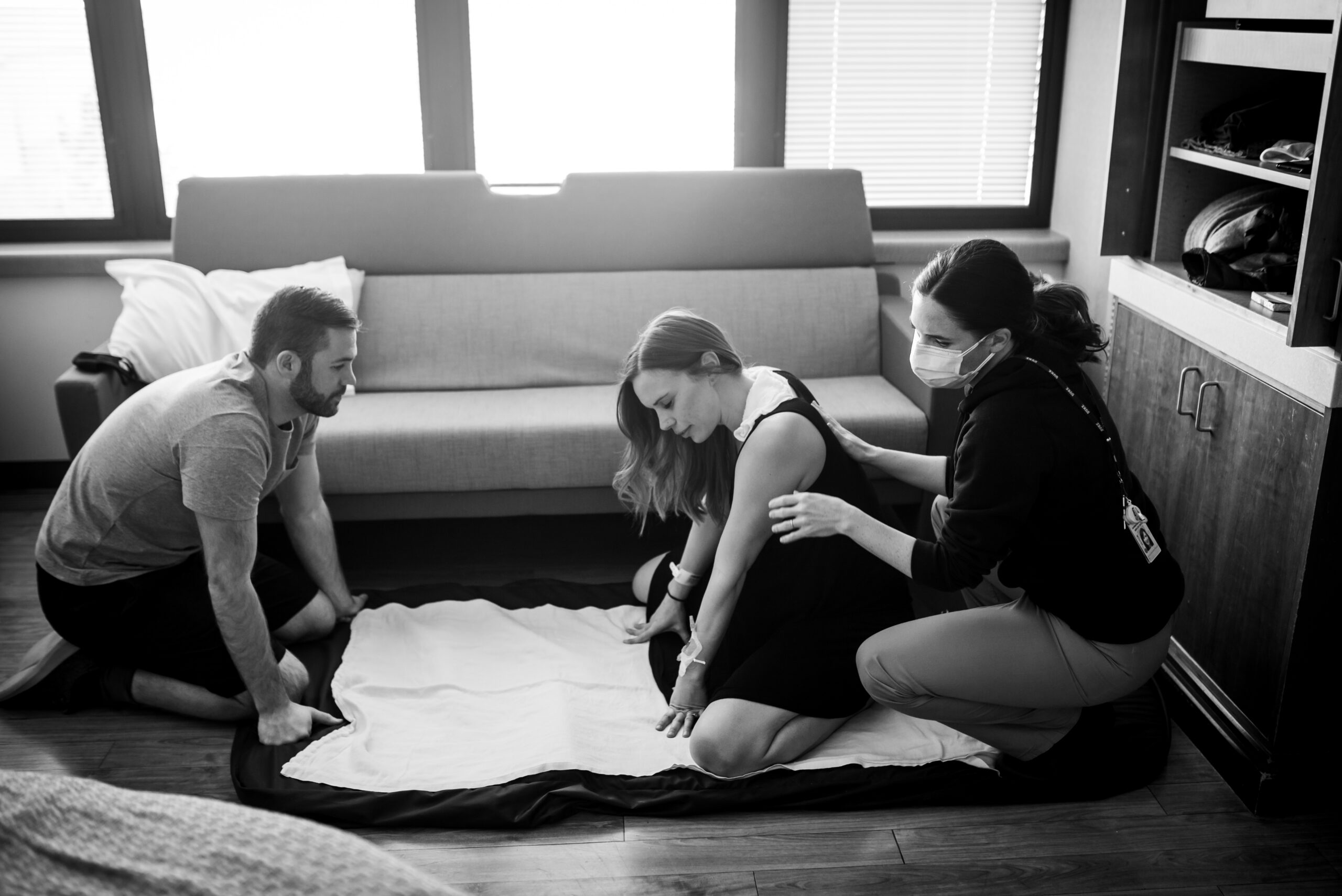


Hands up if you’re dreaming of an unmedicated hospital birth – or maybe just considering it? I’m glad you’re here…and I have been you (and now done it, 4 times)! I can’t wait to chat about all of this. But, before we talk birth tips for a “natural birth,” let’s get a couple things out of the way:
- It is not weird to want to birth without an epidural. You’re not a masochist, or trying to be a hero, or whatever else other term someone throws at you when you share your hope.
- Home birth or birth centers are NOT the only places to have an unmedicated birth.
- Being in a hospital can have some challenges in the unmedicated birth convo, so let’s not pretend it doesn’t.
- That whole “you don’t get a trophy” conversation? Get that out of here. Any birth is worth you being proud of – they’re all trophy worthy.
You may have noticed I added some quotes around that natural birth term above. That’s not how I refer to this type of birth. I like the term unmedicated birth way better. And then I’d tell you that even within that, there is nuance…are we talking no epidural? No IV pain meds? Not meds at all?
The birth tips here are going to be under that “birth without an epidural” umbrella, okay? But I think you can absolutely apply these to a Pitocin induction (or whatever other medication) and then still say you had an unmedicated birth.
Who is The Labor Mama and Why Am I Here?
Hey friend! I’m Lo – also known around here and social media as The Labor Mama. I’ve spent my nursing career in labor, delivery, and postpartum, have birthed 4 of my own babies, have labored thousands of mamas at the bedside, have taught thousands of students online, and have even delivered a few speedy little babies with my bare hands (oops).
Here at TLM, I offer online classes to empower you the way everyone should be. The education + support I offer gives you experience, evidence, and empathy; you’re getting all of my years of “clinical” RN knowledge, beautifully combined with my real experiences as a mama and a nurse. These are not your average hospital classes (those won’t do it, I promise), and honestly, birth, postpartum, and breastfeeding don’t follow a textbook or protocol anyway. You need to know so much more than that!
If you want to connect with me further, head to Instagram or Tiktok. There are hundreds of thousands of us over there learning together daily.
A note: This post may include affiliate links. This means if you make a purchase after clicking a link, I will earn a small commission (thank you)! Rest assured, this comes at no additional cost to you. You can read TLM’s full disclosure here.
Can You Have an Unmedicated Hospital Birth?
Yes. You can. Full stop. I’ve had 4 and I LOVED THEM. And like I mentioned above, it’s also important to acknowledge that the hospital can have some interruptions and obstacles that won’t always fully support that. Care providers in hospital are so familiar with interventions. They’re trained in their use, their efficiency, and the ways they can enter into a labor story. That familiarity they have with them? It means they’re super comfy using them, and often, they may think they feel necessary or helpful when you actually don’t need anything extra at all.
We’re not going to berate hospitals. I choose one to have all 4 of my kids and loved it. There are SO many good ones, and the providers within them are amazing too. But these birth tips are going to help you understand how to set yourself up for an unmedicated hospital birth, even if it may not always seem like the easiest place to make that happen.
11 Insider Tips for Your Unmedicated Hospital Birth
1. Choose Your Care Team Carefully
Obviously, this happens before labor starts. But I cannot tell you how important the people around you are going to be. This includes your time in labor at home and your time at the hospital too!
Of course, your primary care provider matters. And know that they don’t have to be “crunchy” or anti-intervention either. They simply need to support your goals and respect your choices. Flesh out their support of an unmedicated birth with Q’s like:
- What’s your favorite type of birth to care for?
- What’s your role in an unmedicated birth?
- What happens if I decline an epidural?
- Are intermittent monitors an option?
- How do you feel about movement during labor?
Beyond your OB or midwife, I want you to really think critically about who will be “in the room” with you. If you can afford a doula, I would definitely consider it. You can read more about them here. While they can support ALL types of birth, they are super valuable when it comes to unmedicated hospital birth (and can support you in basically all of the tips that follow this one). But know that you don’t HAVE to have one. Not at all – I never did!
But what I did have? A GREAT birth partner, who happened to be my husband. He did the work – and it showed. This is why I have The Partner Playbook course and guide inside of the Your Body, Your Birth course. They need education too, and they need to own it and be able to step into this experience. That means they need to be given information about their many roles, as well as opportunities to discuss, practice, and ask questions.
In my opinion, unmedicated hospital birth is a team sport – and this team has to come around you so well!
2. Learn About Every Possible Path
Some people who want a specific type of birth balk at this birth tip, but I think it’s so important. One of the biggest mistakes I see is preparing only for the birth you hope you’ll have. Instead, I want you to prepare for all of it. I want you to learn about contractions, emotional signposts, labor positions, breathing, pushing, epidurals, induction, Pitocin, fetal monitoring, assisted delivery, and cesarean birth (and more)!
Knowing your options doesn’t make them more likely to happen. It simply means that if labor takes an unexpected turn, you can make informed decisions instead of feeling scared or blindsided by what’s suddenly in front of you. Fear is one of the biggest reasons so many labors get “off track.” Not because the labor is suddenly un-doable, but because you no longer know what to do or what to choose.
In that moment, you are often hasty with your choices, lose focus, or the fear overwhelms. And if you’d simply known the possibilities (because birth is not predictable), you’d be able to say “Hey, I know what this is. I know what they’re talking about. I know what to ask. I know what I want to do.” Knowledge really is one of the greatest confidence builders there is.
3. Get “Physical” During Your Pregnancy
I’m talking about exercise, flexibility, all the things here! Labor is a marathon – the cliche is true. So follow those exercise guidelines that apply to you and move during your pregnancy. Guidelines for most are about 30 minutes a day (or about 150 mins a week) of moderate intensity aerobic exercise (or continuing the exercises that you are already doing with your OBGYN’s approval). If you’re starting from scratch or want to be sure which movement guidelines apply to you right now, please run it by your provider first.
Fun fact: There is research that shows us that those who are more physically active during pregnancy have shorter active phases of labor. Hello, that’s a fun benefit too!
Other things I think are valuable in this “physical” convo here? Things like optimal fetal positioning exercises, prenatal pelvic floor PT, hydration/good nutrition, and chiropractic alignment. I know you’re probably thinking “hey, that’s a lot” but I think you do the best you can here with your time and your resources. I couldn’t afford, nor had the time, to do all of this perfectly 4 times, but I was conscious of what I was asking my body to do. Research shows us that all of these things can impact how well you “handle” labor, so if you’re wanting to do it unmedicated, then we want to go into it as healthy and strong as we can!
Basically, just consider the question: “how can I get my body ready to go into labor and sustain labor?” Those are things to be considering and/or participating in during your pregnancy. And you just do the best you can with what you’ve got!
4. All Things Flow from Your Mental Strength
This is (maybe, definitely) THE most important thing. I know you probably know that “birth is 90% mental.” But hear me join the chorus saying “it’s true!”
Even the most perfect pregnant physical specimen will not labor well or efficiently if they are not mentally tough and have the tools to stay locked in. Why? Because your physical body responds to what’s going on in your head. If you don’t feel safe, if your fear overwhelms, if you are panicked or lose control over your thoughts, your body will tense up, blood flow to the uterus can change, hormones levels can change, and labor can literally stall, slow down, stop, or become more painful.
Obviously, no one wants this in labor, but you especially don’t want it in your unmedicated birth! So how are you going to address your fears? What will you do when it gets hard or feels a little scary? Are you practicing how to breathe through discomfort, pain, or anxiousness? Do you have mantras that can root you? Does your team make you feel safe?
All of this is so important – before any other tip or tool can work!

5. Stay Home as Long as You Safely Can
I’m sure you’ve head someone say this, right? Home is usually where your body feels safest. You’re comfortable. You can move however you want. No one is interrupting you every few minutes. All of these things? They are gold for a labor process.
Once you’re admitted to the hospital, there are naturally more people, more conversations, and more things happening around you. And while you already know I’m not going to attack the hospital, we also have to acknowledge that getting there changes what’s going on around you.
You will be interrupted. You will have to adjust. You will need to consider how to navigate that change in scenery!
One important note here: If you do head in, have your cervix checked, and it’s early and/or they want to send you home, that’s okay! Know that you can say “bummer, I really thought I was farther,” and then get your bum back home where no one is going to try and “move things along” if it’s taking some time.
For more on When to Go To the Hospital, check out Episode 38 of the Lo & Behold podcast.
When you do get there and it’s time to stay? Make that space feel like home. Lights, music, linens, your clothes, the people around you – consider all of it! This is a great job to give your birth partner. Talk about how you want it to feel or what you may want and then they can make that happen.
6. Have Someone Who Can Speak Up for You
During active labor and transition, even the most vocal of us are often going totally inward. This means you may not feel like or be able to talk much, so you need someone who can speak for you if or when needed!
This is where that ideal team comes into play. Who on that team is going to be this person for you? Do they know how birth goes? What your wishes are? How to ask questions or clarify? How you want to be communicated with? Feel confident asking for time or space to make choices?
These things are SO important and the chances of you being able to do it are LOW. So have someone else who can.

7. Know What the Hospital Will Offer
There are a lot of hospital routines and rhythms that are always going to be present. There is an admitting process. To-do lists. Certain frequencies of check-ins, charting, or monitoring you and your baby. The more you know what these routines or policies are, the better you’ll be able to handle them. Or for some, decide what you’re good with and what you may potentially decline.
This is why a birth course like Your Body, Your Birth is SO valuable. Because I’ve been the nurse and the person having the baby, I know what hospitals do, what happens, and what you need to know! Inside of that course, I give it ALL to you, because that knowledge can be the difference between unknown and confidence. And for an unmedicated birth in the hospital? You need to know those unknowns so you can have a plan.
8. Understand the Labor Process
This tip may be a little bit like “yah, yah, yah,” but truly, you have to get into the weeds a little bit and know the physiology of this process.
Understanding what contractions are doing, what transition looks like, and what pushing often feels like can make a huge difference mentally. Knowing how your baby fits through the pelvis, how YOUR movement can support that, or when and how the placenta delivers – this matters. Being knowledgeable about the connection between a tense jaw and your pelvic floor can change the way you move and breath. Being clear on the pieces of a cervical exam and what those mean for you (or your progress), or knowing what the uterus is doing and how the oyxtocin plays its roll – you’ll use this.
I’ve told you already that the mental component is, IMO, the most important one. But we are not skipping the physical and the physiological. When you know what’s happening, it becomes easier to work with labor instead of fearing it. And that’s exactly how the brain, the heart, and the body work together for you!
A great episode on Lo & Behold to listen to as you learn more about your body and the emotional components of labor? This one, Episode 10, on The Emotional Signposts of Labor. These are SO valuable to understand, especially for your unmedicated birth!
9. Have Lots of Comfort Tools Ready to Go
Skipping the epidural? Great. That’s why we’re here. But aside from an epidural, do you even know how many other comfort tools and pain management tools there are? Inside of Your Body, Your Birth, we talk about more than 30 of them! Obviously, your ability to work with and through your pain during unmedicated birth IS a big part of this, so you have to know your tools.
Some insider advice when it comes to these tools?
Don’t put all your hopes into one technique or tool. Save your “big guns” (often hydrotherapy, like getting in the tub) for when your farther along. Know that you can do multiple things at once, OR you can say “I’m just going to stand here and hold this comb” and that works too.
There are basically zero (well, there may be 1 or 2) rules on how to use all of these tools, so recognize that this is specific and unique, and inside of the process, your needs or preferences will probably (definitely) change. Understanding these comfort tools is SO important for the birth partner, because they are going to be critical in helping you use them and/or giving you suggestions of things to try as labor gets progressively harder. The Partner Guide that is inside the Your Body, Your Birth course is going to make sure they have ALL that they need for this tip!
10. Move, move, move, move
Movement is your best friend in labor, especially unmedicated labor, okay? There is great research that shows us how being upright and mobile is linked to shorter labors and less desire or use of an epidural. We have also seen evidence of movement being linked to less pain! Check, check, check, you want all of those things, right?
When you move, baby moves (or we can say, your pelvis moves and supports how baby is moving through it). Remember tip 8, where I mentioned that understanding the pelvis and your cervix and what’s happening in there is going to help you work WITH your labor? This is what I mean! The more you’re able to move and switch it up and try new things, the better you’re supporting the work baby is doing in there to come out!
Things to consider in this conversation?
- Intermittent monitoring or wireless monitoring. These will likely be crucial to this movement goal.
- Typically, we suggest you try a new position every 30 mins or so. This doesn’t mean you have to wait to move, nor does it mean you HAVE to move when something is working for you. It just means, movement helps 🙂
- Have you heard of contraction rituals? We cover them in Your Body, Your Birth. These are a big part of the movement convo, as you find positions that are working for you and then stick with them!
11. Know how to relax chill!
First – the word relax can be so annoying during labor! So, I suggest your team find a different one 🙂
Have you heard of the ice trick for labor practice? To me, this tip is what that trick is all about. The ice practice goes like this: Set a timer for 90 seconds. Then, grab some ice cubes and hold them tight in your hands and while the clock ticks, start to notice what your body naturally does when it starts to sting and burn. Then, take a break for a few minutes and do it again, but this time, try some of those comfort measures you’re supposed to be learning about!
Breathe deeply and intentionally. Play some music. Relax your jaw. Move around a bit. Distract yourself with something else. Have your birth partner do this with you or distract you.
I get it. Holding ice in your hand for 90 seconds is NOT what a contraction feels like. But, guess what that practice does tell you? It shows you how your body responds to discomfort, being annoyed, or not feeling great. And then it gives you an intentional few minutes to focus on the best ways to respond.
Most of us do not just inherently “chill” when something hurts. So you have to do the work and practice now, while pregnant, of thinking through things like how to breathe, how to cultivate a space that makes you calm, or what are the things you want to hear or listen to that support your chill.
*We’ve got a progressive relaxation walk through inside of the YB, YB course to help you practice! We also get into it about how deeply your breathing is connected to your ability to calm and persevere.

Last thoughts on your unmedicated hospital birth
You can do this. You can do this. You can do this. These 11 tips are going to change the game for you, particularly inside that hospital system that can sometimes make people believe like this is something that can’t be done. It can – but you’ve got to go into it with eyes wide open to the possibilities, both in birth and within the hospital space too.
Wanting to birth without drugs is an awesome goal. I am excited for you as you lean in, learn more, and pursue it. While you do that, surround yourself with people who care about what you care about. Who are speaking “you got this” into your universe. People who make you feel like you can, instead of people who make you feel you can’t or you shouldn’t.
And last little reminder? I LOVE caring for patients like you who want this. You, your wishes, your goals – you are not a burden when you walk into that room, ok? You are not creating more work for the RN or being silly or “have no idea what you’re getting into.” You are setting goals, making choices, and participating in this. And that is always the very best thing. xx- Lo


More resources (and freebies!) for you to take a peek at: