




It’s time – you’re newly postpartum and you’re headed back to work. Maybe, you’ve done a ton of prep to make pumping at work feel seamless. Maybe, you’re scrambling at the moment and it feels like your first day back is “looming” over you. Maybe, you feel something in between, excited to have some form of me time and devastated to leave your new baby. All of this is normal, in case you need to hear that.
Ultimately, I don’t know how you feel about going back to work, but I do know that when it comes to continuing to breastfeed after maternity leave, I can help! I’ve had 4 babies in the last few years, and I’ve been able to thread pumping and bottles throughout their stories to keep exclusively breastfeeding and do this work, here, that I love, with you. This can absolutely be done, and most often it just takes some prep, planning, and the right equipment and tools to find your version of success. So let’s get into that for you.
In the post, we’ll cover:
- Common challenges of returning to work
- Key components of protecting your supply
- Routines that support your goals
- Pump features to help overcome challenges
Who is The Labor Mama and Why Am I Here?
Hey friend! I’m Lo – also known around here and social media as The Labor Mama. I’ve spent my nursing career in labor, delivery, and postpartum, have birthed 4 of my own babies, have labored thousands of mamas at the bedside, have taught thousands of students online, and have even delivered a few speedy little babies with my bare hands (oops).
Here at TLM, I offer online classes to empower you the way everyone should be. The education + support I offer gives you experience, evidence, and empathy; you’re getting all of my years of “clinical” RN knowledge, beautifully combined with my real experiences as a mama and a nurse. These are not your average hospital classes (those won’t do it, I promise), and honestly, birth, postpartum, and breastfeeding don’t follow a textbook or protocol anyway. You need to know so much more than that!
If you want to connect with me further, head to Instagram or Tiktok. There are hundreds of thousands of us over there learning together daily.
A note: This post may include affiliate links. This means if you make a purchase after clicking a link, I will earn a small commission (thank you)! Rest assured, this comes at no additional cost to you. You can read TLM’s full disclosure here.
Challenges of Breastfeeding After Returning to Work
It’d be silly to pretend that pumping during your return to work doesn’t have any challenges. Of course it does! Specifically, if you’ve been breastfeeding (at the breast) up until this point, adding in pumping is a really big change to your routine. That change to routine, and figuring out how to make it work, is obviously one of the biggest challenges. Some other common challenges?
- Figuring out a schedule that works for your work/what baby’s needs are
- Work set up, including privacy, travel, transportation, etc.
- Maintaining your supply where you need to or want to
- Storing & transporting milk/cleaning supplies
- Addressing any bottle feeding challenges
- An increase in your mental load (clearly!)
Let’s address each of these briefly.
Figuring out schedule
You probably know this, but your employer is required to give you pump breaks. But you will still need to do the work of figuring out when you can fit those breaks in and establish some sort of consistency. Some big things for you to think about here?
- Aim to pump about as often as baby normally feeds.
- Avoid routinely skipping sessions → shift them instead.
- Consider your work day/commutes: Are their patterns you can take advantage of?
- Can you adjust baby’s routine in the morning or evening?
- Consistency (with grace/flexibility, of course)
You will very likely find that you and a coworker or friend who is also postpartum won’t pump at the exact same time during your work day. That makes sense. You have to figure out what your daily routine looks like at work, what your baby’s looks like at home, and then determine how you can be consistent. We’re going to chat more about this.
Work set-up logistics
Just as your employer is required to give you pump breaks, they are also required to give you a private pumping-at-work space. This is definitely something to look into before you are back in your space and figure out how this will work out. Is it private? Outlets to plug in a pump or charge your wearables? A fridge to store your milk? Commuting and pumping is definitely a part of the back-to-work conversation too. Many will need to utilize their commute times for a pump session, but wearable pumps can make this feel so seamless!
Maintaining your supply
The biggest thing to note here? You’ve got to be pumping as often as your baby is taking a bottle. While you can shift those times around a bit and give yourself some grace on the routine, you cannot skip a session consistently and think your supply will maintain itself. It won’t. You’ve got to be asking your body to make milk, just as your baby would be asking if you were home nursing them.
Some helpful little tips when pumping at work: Look at videos and photos of your baby while pumping to get your milk flowing. This can get the oxytocin flowing, and that is what you want! Warming your breasts (perhaps with something like this) can also help support your let down and flow. Gentle hands on massage can also help, as can having something a little something of your baby’s that smells like them. And if how much you’re getting causes anxiety? Don’t look! Truly. Tuck that pump in and don’t look at it until you are done.
Storing & transporting milk/cleaning you pump parts
This slots into that work logistics conversation. What is the set up at work? How will you get things from home to work and work to home? Will you clean your pump parts at work, bring multiple sets, or some combo of that? To be honest, there is a lot of great gear available now that make all of this feel a lot easier. This includes things like sterilizing bags, milk chillers, or cleaning wipes. So once you know what your set-up at work is, think through what you will need.
Bottle feeding challenges
If you know you are returning to work, I’d be addressing bottle introduction early and often! You want to be sure that your baby will happily take a bottle once you return to work (it is SO stressful when they will not). Typically, the advice is to start a bottle at around 3–4 weeks, then do about 1 bottle feeding a day (or more, if that’s your preference). Don’t forget that you need to be pumping anytime your baby is getting a bottle!
I’ve got more for you on bottle introduction or refusal here.
The mental load
All that we just briefly went through just scratches the surface on the many things you are going to be thinking of for this return to work! Mostly, I just want to acknowledge how this can feel like a lot, while also encouraging you find the gear, the tools, or the pumps that make this feel doable for you. You will feel SO proficient at all of this, but it’ll probably take some time.
Making Pumping Fit Into Your Workday (Instead of the Other Way Around)
As we briefly chatted about prior, your work/pumping routine will look different than someone else’s. Consider a nurse who works 12 hours with no commute vs an accountant who works a 9-5 with a 30 minute commute. Maybe one leaves their baby at home, while another does daycare. They’re leaving their homes at different times, getting home at different times, have different schedules at work, and have different flexibility within their commutes. There are a lot of factors at play here!
Let’s look at a couple sample routines. One is for a standard 8-hour, 9-5 day, the other is for a 12-hour day, like a 7-7 (shout out to all the RNs like me, making this work)! *We’re making the assumption that baby is bottle feeding every 3 hours or so, and you are always pumping to replace those feeds (crucial to maintaining your supply)!
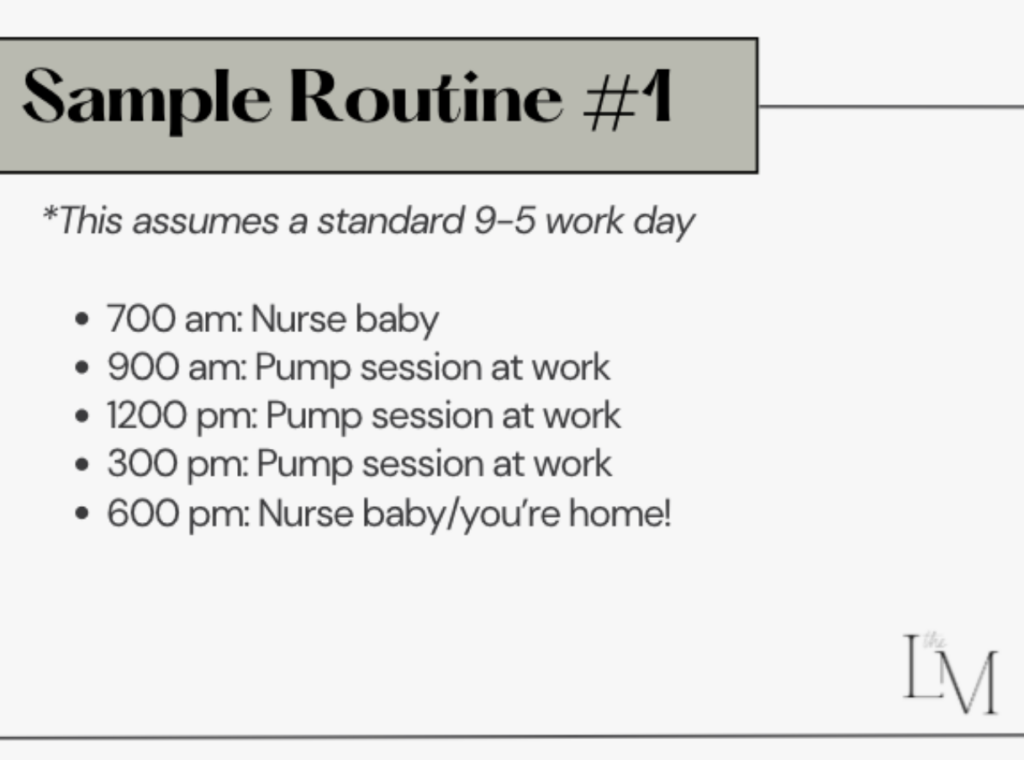
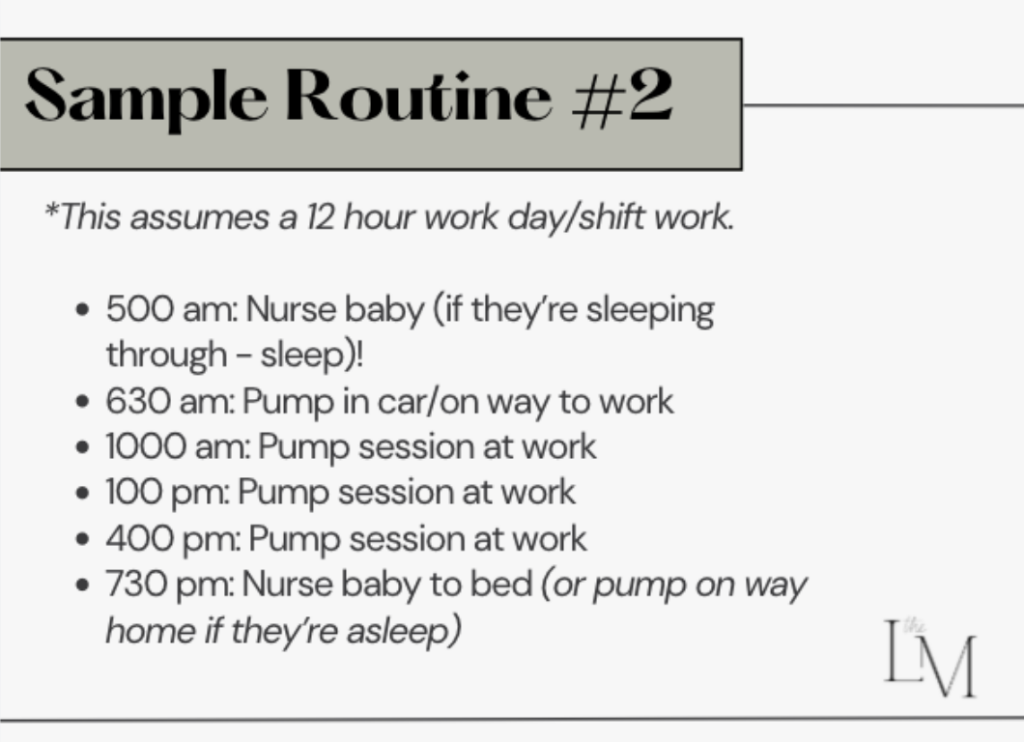
These are just examples, but what I really want you to know is that there can be some flexibility here. Do you have a standard 9 am meeting? Then you can pump at 830 instead. Do you want to be able to always do your baby’s bedtime as a nursing session at home? Then before you go back to work, start shifting their waketime or routine so they’re ready for that bedtime nursing session when you get home at 645.
You do need to protect your pump breaks – we cannot deny that! You cannot skip sessions and hope to maintain your supply. But, you can move things around and work around how your work day looks and what your baby is doing at home.
Pumping outside your “pumping room”
Pumping in the car or during a commute? Absolutely.You can see this possibility show up on that shift work sample schedule. This might be really important for a shift worker who leaves the house when their baby is still sleeping, but they need to get a pump in before their 7 am shift starts. Of course, pumping-on-the-go could apply to all kinds of other work too. Maybe you travel for work, and you need to be on the move a lot. Maybe your commute is 60 minutes, so you pump right before you start at 9 am. Maybe your baby is having their bedtime bottle when you drive home, so you need to pump on your way home.
Momcozy Air 1 ultraslim wearable can make a difference
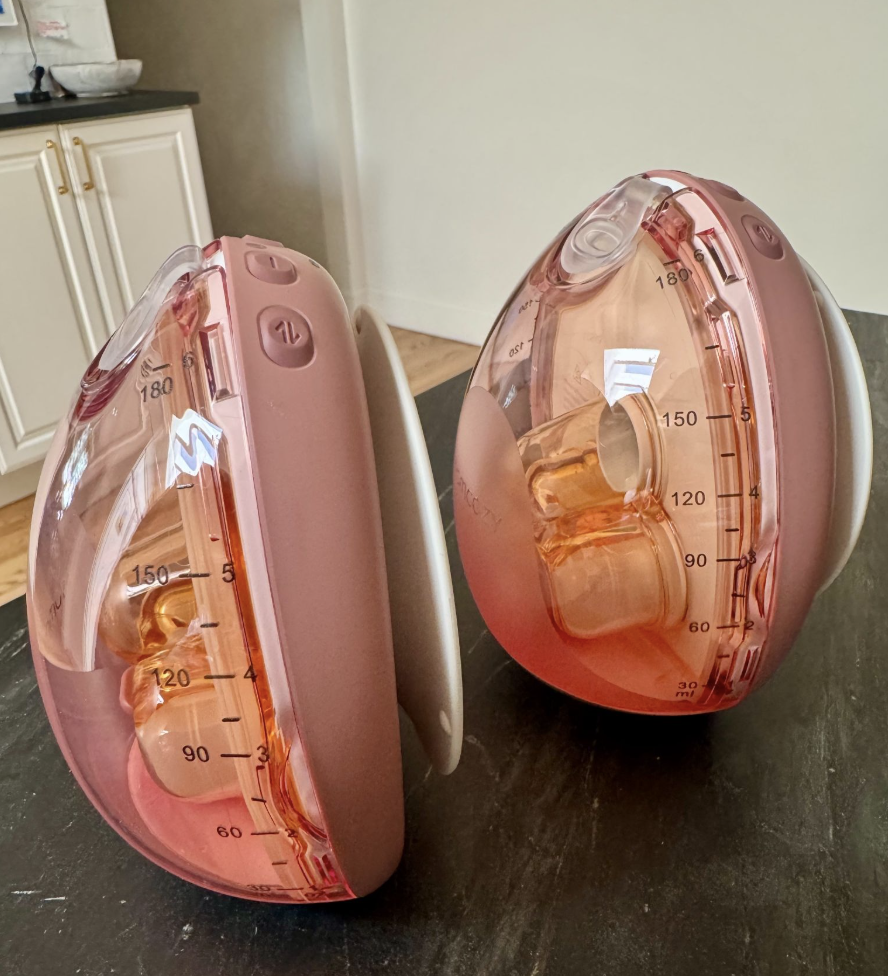
I don’t know where you might need some mobility or freedom in your pumping at work routine. But I can tell you that this is where a wearable pump like the Momcozy Air 1 Wearable can be really valuable. I’ve seen a wearable like this fit so seamlessly into back-to-work routines for commuters, shift workers, office employees, retail, etc.
Before we go any farther – are you familiar with a wearable pump? These pumps usually come in a pack of 2, so that you can pump both of your breasts at the same time. The pumps have no cords at all and they run off of battery power. The different pieces (like the milk collector cup, flange, motor) all clip together and then slide directly into your bra. They also come apart to be washed, sterilized and/or charged.
*Be sure to make note of what parts are washable vs those that are not. On the Air 1, only the milk-contact parts (flange, diaphragm, milk collection cup, and duckbill valve) are washable, while the motors are not.
The goal is definitely that you can be on the move or have free hands, helping to support that “busy mom, busy hands” stage of life that you are probably in (and decrease some of that mental load)!
Pump Features that Make On-the-Go Pumping Less Stressful
Let’s chat through some of the things I like about the Momcozy Air 1 wearable. There are definitely a few “favorite” features of mine that I like to see when I choose a wearable!
- The Air 1 is super slim, about 20% slimmer than the average of other wearables on the market. For those who are on the go, like those who are pumping on a plane or car, this offers some extra privacy and can feel more discreet. As someone who has tried MANY wearable breast pumps, anytime they’re slimmer or smaller, I am a fan.
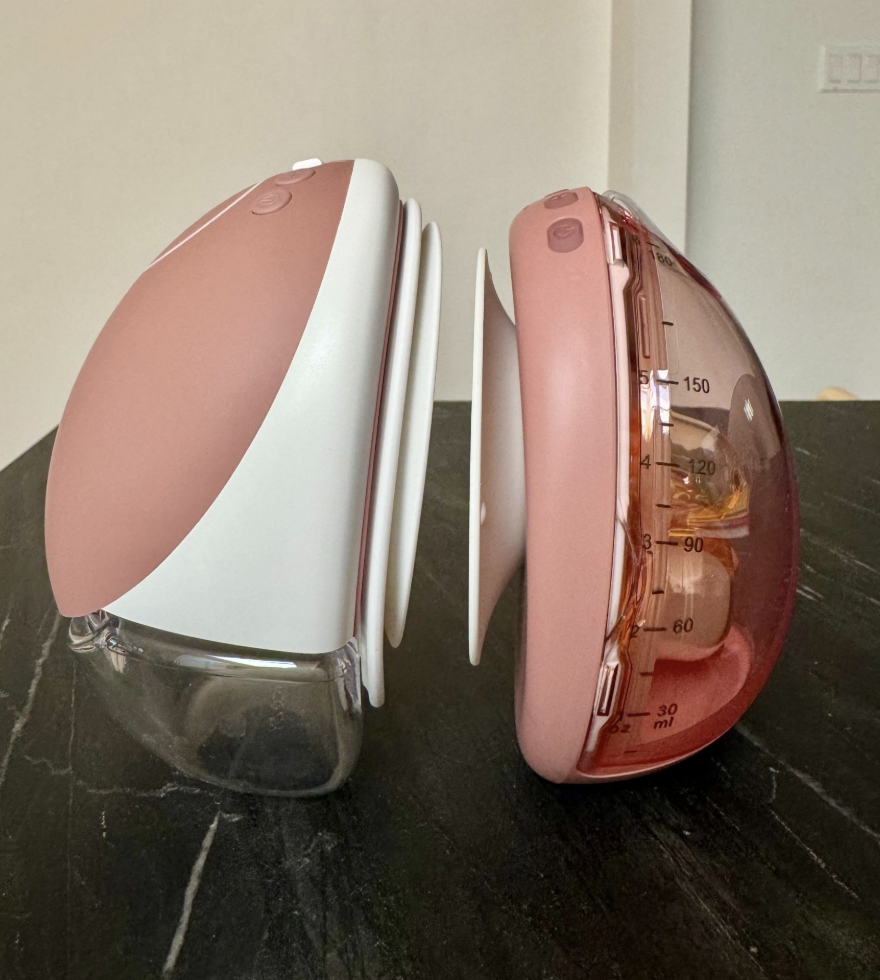
- The Air 1 also has a wireless charging case – and I love these. In the work set-up logistics section, I mentioned outlets and cord considerations at work. But wireless charging cases like this one stay charged for 3-5 days depending on how often you’re using and recharging the pump (battery usage time lasts about 15 sessions). This can relieve the stress of night before set-up and charging and eliminates the hassle of cords or needing to plug in and charge. Honestly, the ability to just toss the case (with the pumps inside of it) into your bag is so great!
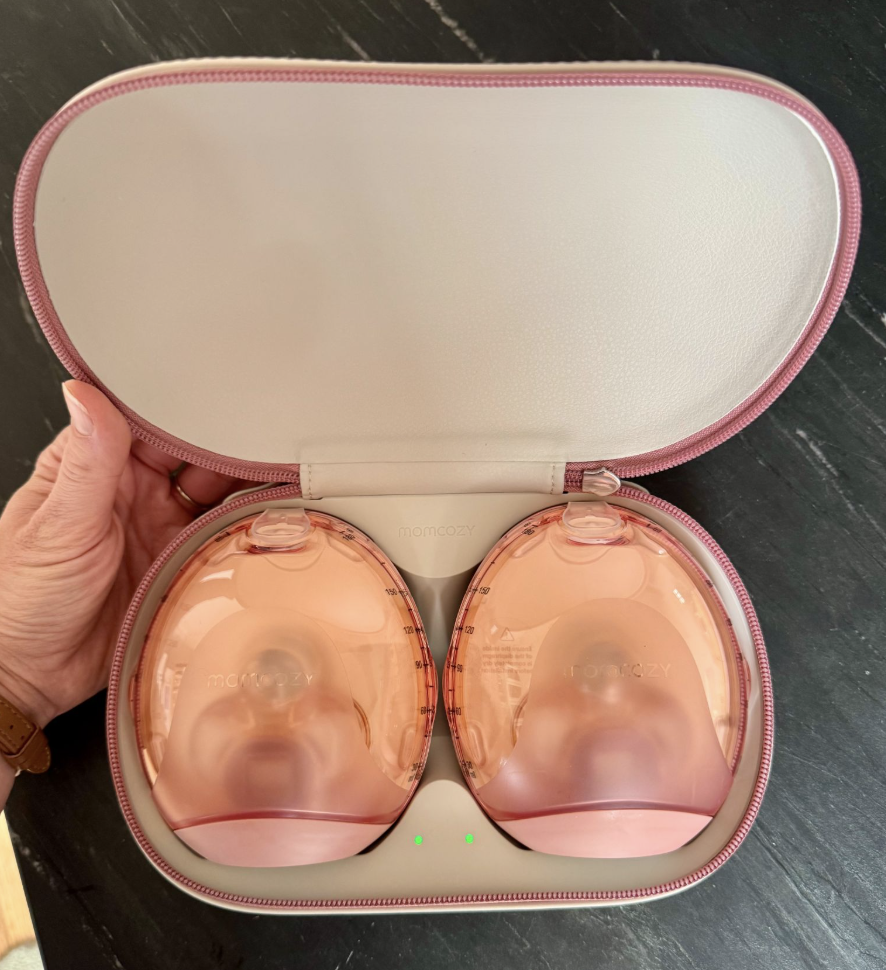
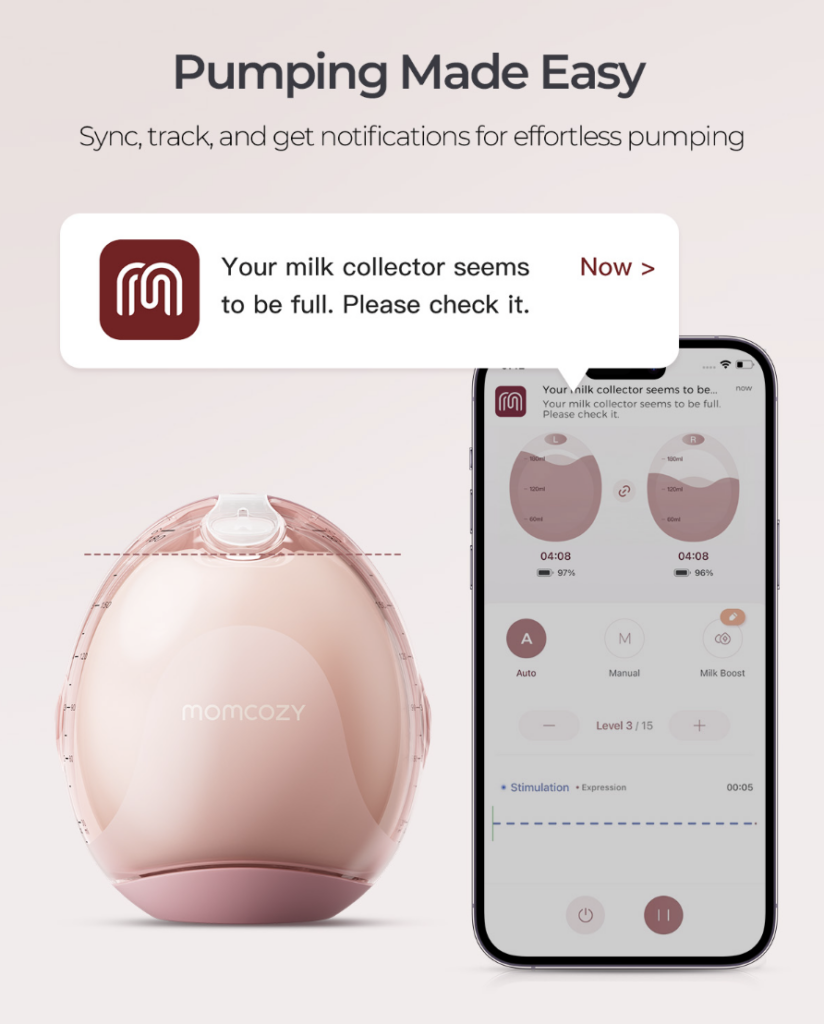
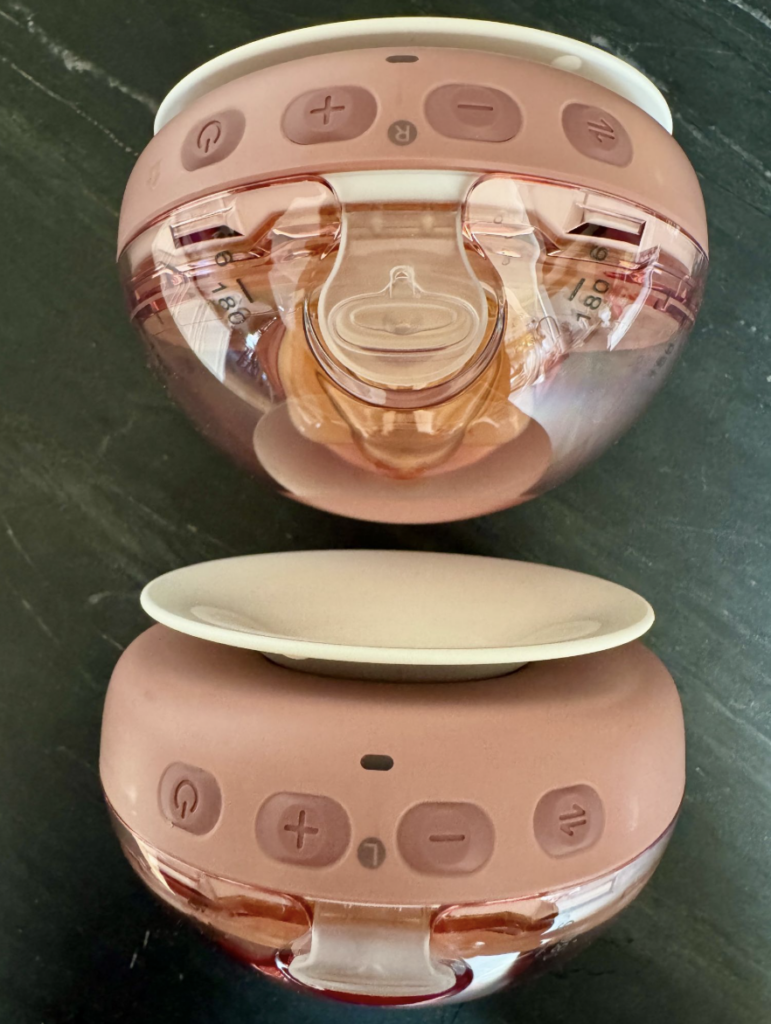
- The Air 1 also has great visibility, a first-of-its-kind “top-view” design. As you can see in the picture, the milk collector cup (this is where the milk will collect) is transparent. This transparent top view is an industry-first reengineered design that enables easy nipple alignment and the ability to quickly do milk checks without repeated adjustments to the pump. (Fun note: the pump has smart sensing technology that will alert (via the associated app) when your milk collection cup is getting full).
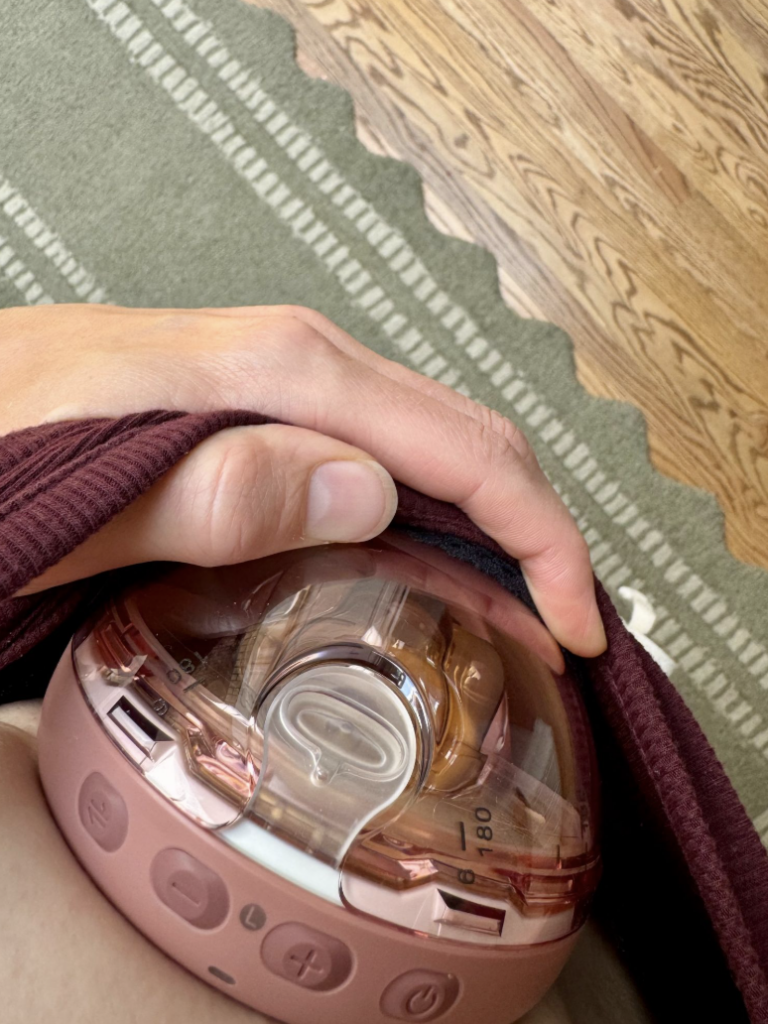
- Are you an app person? If you are, the Air 1 has an associated app! Like I said, the smart sensing of the pump can alert you via phone notification when the milk collection cup is filling up. It also can track times and outputs and has different modes/programs you can use. It also has autoswitching or milk detection capabilities, which can switch you from stimulate to express mode based on time or let down (you can always control this on your own too, via the pump or the app).
*If you are not an app person, or do not like using the bluetooth, you can use the pump manually, but you do lose some features. Directly from the pump, you can change from stimulate, to express, to mixed mode and you can use the +/- buttons to increase or decrease the suction.
One Pump Doesn’t Have to Do Everything
Overall? I love a wearable pump. Many other moms do too, and you’ll find that they love having it for work, errands, travel, or occasional pumping. I’ve also seen many moms (including me!) choose to utilize two different types of pumps in their back-to-work pumping routine. Some people really love the flexibility of a wearable like the Air 1 for commuting and travel, and then they keep a standard double electric in their classroom, their office, or other place of work. Alternatively, some prefer a standard double electric for their first sessions of the day, and then they switch to a wearable for the afternoon or evening session(s).
Ultimately, the best pump (or pumps!) is the one that helps you meet your feeding goals – and wearables are a piece of the back to work jigsaw puzzle for so many!

Final Thoughts on Pumping at Work
Everyone’s return to work is going to look different! You may be home, on the road, in the office, in a car – it’s impossible to know exactly what your days will look like. But no matter what your back to work life entails, please hear me say it’s okay to seek out a few tools or resources to make this feel less overwhelming. That might be a wearable like the Momcozy Air 1. It may be a helpful milk chiller or a new pumping bra. These things can make you feel better, more prepared, and less overwhelmed, and all of those are good things.
Also? Have some grace for yourself in the midst of this adjustment and transition. It’s okay if you get this wrong at first, or it takes a few weeks to feel settled. It’s alright if you need to make a change to a rhythm, or you realize that you or your baby need something different. Motherhood, including your return to work, is a work in progress season of life. That means you’ve got to have some space to do it a little imperfectly sometimes. xx- Lo
More resources (and freebies!) for you to take a peek at: