

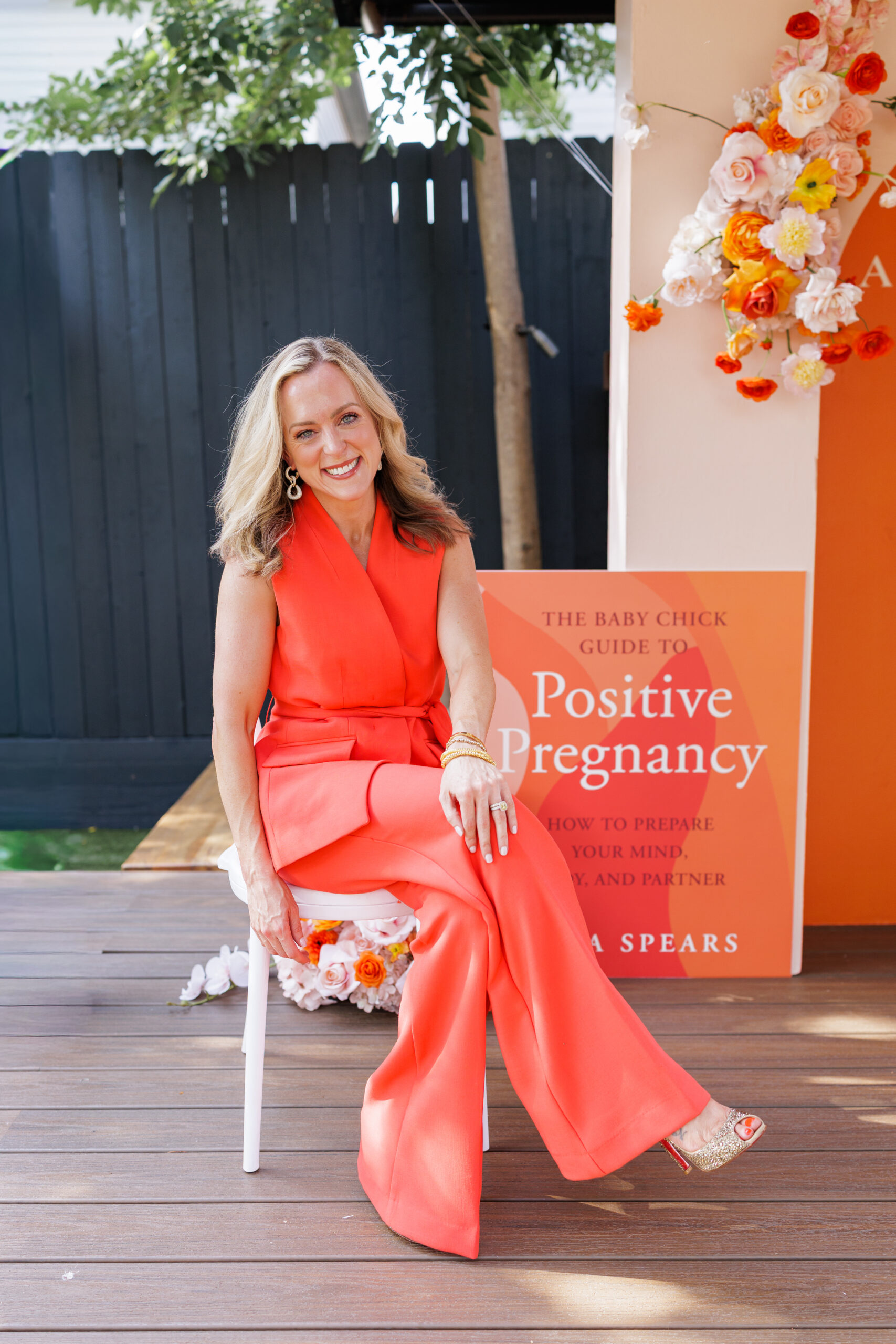


Today I’m welcoming Nina Spears – founder and CEO of Baby Chick, author of The Baby Chick Guide to Positive Pregnancy, and honestly, a bit of a unicorn in this space. She’s a certified baby planner, birth and postpartum doula, childbirth educator, newborn care educator, infant massage instructor, and perinatal nutrition expert. Over the past 15 years she’s supported more than 800 families in person and thousands more online. We get into it all – the mental load that sneaks up on you the second you see that positive test, why bringing your partner into the decision-making early (not after you’re both exhausted) changes everything, and the very practical ways partners can actually show up during pregnancy instead of just feeling helpless on the sidelines.
Join YBYB: www.thelabormama.com/birth & use the code PODCAST to save 20%
We also talked about something I think about constantly: how to take in information without drowning in it, and why finding a few trusted voices matters so much more than trying to listen to everyone. Nina got real about the stuff nobody prepares you for – how birth is so much more mental than physical, how much you lean on your people (yes, even your nurse) more than you expect, and how lonely postpartum can feel even when you’re surrounded by support. If you’ve ever felt like you’re supposed to have it all figured out before baby even arrives, this episode is your permission slip to slow down, ask for help, and trust your own intuition along the way.
More from Nina Spears:
The Baby Chick Guide to Positive Pregnancy
Checkout her podcast: Chick Chat
Follow her on Instagram @thebabychick
Helpful Timestamps:
- 00:00 Simple Birth Prep with Nina Spears
- 07:05 The Pregnancy Mental Load
- 12:47 Partner Tips That Help
- 23:49 Avoiding Information Overload
- 29:53 Mental Side of Labor
- 33:43 How to Prep Mentally
- 45:43 Postpartum Support Plan
About your host:

 Lo Mansfield, MSN, RNC-OB, CLC is a registered nurse, mama of 4, and a birth, baby, and motherhood enthusiast. She is both the host of the Lo & Behold podcast and the founder of The Labor Mama.
For more education, support and “me too” from Lo, please visit her website and check out her online courses and digital guides for birth, breastfeeding, and postpartum/newborns. You can also follow @thelabormama and @loandbehold_thepodcast on Instagram and join her email list here.
For more pregnancy, birth, postpartum and motherhood conversation each week, be sure to subscribe to The Lo & Behold podcast on Apple Podcasts, Spotify, or wherever you prefer to listen!
 A request: If this episode meant something to you, would you consider a 5 star rating and leaving us a review? Yes, we read them, and yes, they help keep L & B going! ♥️
Connect with Lo more on: INSTAGRAM | TIK TOK | PINTEREST | FACEBOOK
Disclaimer
Opinions shared by guests of this show are their own, and do not always reflect those of The Labor Mama platform. Additionally, the information you hear on this podcast or that you receive via any linked resources should not be considered medical advice. Please see our full disclaimer here.
Additionally, we may make a small commission from some of the links shared with you. Please know, this comes at no additional cost to you, supports our small biz, and is a way for us to share brands and products with you that we genuinely love.
Produced and Edited by Vaden Podcast Services
Transcript
Labor and birth, no one talked about this enough.
:I think the thing that I hear is, "Oh my gosh, it's so much more mental than I thought it was going to be." The partners can do so much more, but they really think that they can't really do too much because it's not their body.
:Partners, if you're listening to this, there's a ton that you can do, and you will make her pregnancy feel so much more comfortable, so less anxiety-ridden, and she'll just feel like, "Oh my gosh, we're in this together.
:I'm not in this alone."
:Motherhood is all-consuming Having babies, nursing, feeling the fear of loving someone that much Then there's this baby on your chest, and boom, your entire life has changed
:It's a privilege of being your child's safest space and watching your heart walk around outside of your body
:The truth is, I can be having the best time being a mom one minute, and then the next, I'm questioning all my life choices
:I'm Lo Mansfield, your host of the Lo and Behold podcast, mama of four littles, former labor and postpartum RN, CLC, and your new best friend in the messy middle space of all the choices you are making in pregnancy, birth, and motherhood.
:If there is one thing I know after years of delivering babies at the bedside, and then having, and now raising those four of my own, it is that there is no such thing as a best way to do any of this, and we're leaning into that truth here.
:With a mix of real life and what the textbook says, expert insights, and practical applications, each week we're making our way towards stories that we participate in, stories that we are honest about, and stories that are ours.
:This is the Lo and Behold podcast.
Lo:If I had to pick a, let's say, a vocabulary word to describe today's guest, I think it would be kindred spirit.
Lo:Nina Spears is the founder and CEO of Baby Chick.
Lo:She's the author of The Baby Chick Guide to Positive Pregnancy.
Lo:She is, okay, get ready for this, a certified baby planner, a birth and postpartum doula, a childbirth educator, a newborn care educator, an infant massage instructor, and a perinatal nutrition expert.
Lo:She is a lot of things and cares about all of these things for you, for your family.
Lo:Over the past 15 years, she has supported more than 800 families in person, thousands and thousands and thousands more virtually through her educational content, her courses, and her resources.
Lo:My guess is you have probably seen her or heard her online at some point and in some space.
Lo:Her mission is to just transform how women prepare for motherhood by helping them prepare not just for birth, but for your full lifelong journey of becoming and being a mother Nina, thank you so much for being with me here today.
Lo:Why don't you go ahead and give us the I meet you in a coffee shop, how would you introduce yourself intro-
Lo:and then we can get into our chat.
Nina:Oh, my goodness.
Nina:First, whoa, thank you so much for having me.
Nina:Like I was just telling you, this is just so fun to be able to connect with you here.
Nina:And oh, my goodness, if you and I were just meeting at a coffee shop, and we didn't, you didn't know what I did, you, I would be like, "Well, I work with, I work with moms during pregnancy, birth, postpartum, and parenting.
Nina:I am the founder and CEO of Baby Chick, which is a digital media resource for expecting and new parents.
Nina:I've had the pleasure of helping over 800 families in person, thousands virtually, and been to over 350 births in multiple birth settings as a birth doula, but I'm not only a birth doula, I'm a baby planner, postpartum doula, childbirth educator, newborn care educator, infant massage instructor, and I'm recently a perinatal nutrition expert.
Nina:And so literally, I'm obsessed with supporting women, supporting moms, and yeah, it's just my everything pretty much.
Lo:I f- I feel like I would've heard the first sentence where you're like, "I work with moms," and I'd made- immediately would've been like, "Oh, me too." Me too.
Lo:And then the last sentence where you're like, "And I'm obsessed," and then say, "Oh, me too."
Lo:Yeah.
Lo:But it's like all this stuff that you do, and then the culmination of all that is just like, "Well, I'm just obsessed with this birth and baby space, and I wanna help you walk through it." Yeah.
Lo:Like, that's kind of what I hear-
Nina:Exactly
Nina:… Lo: when you give the elevator pitch, you know?
Nina:It's ultimately-
Nina:And
Lo:it's so
Nina:funny-
Nina:that's what it comes down to … that I, p- people will ask me, like, "Oh, you probably totally got into this, like, once you had babies, and like, you know, something just happened. Either it was, like, amazing or not so amazing, and you wanted to, like, make a difference for other women." And it's so funny.
Nina:I was like, "Oh, no.
Nina:I totally found this well before I even knew my husband." And so I've been doing this for, like 15 years now, , 15 and a half, and it's been so cool.
Nina:And I just feel so lucky that this found me before I became a mom, 'cause wow, did it, like, really prepare me for what I was getting myself into.
Nina:I mean, to a certain extent.
Nina:I, I feel like, I feel like God still throws some things your way to just keep you humble, but but I still- Absolutely.
Nina:Man, it was, it was, yeah, it's been, it's been quite a journey, and I've loved it.
Lo:It's interesting, I just like how you just said it found you, 'cause I feel very much the same about my own journey.
Lo:Like, there were things, things going on with my mom that, like, pushed me towards healthcare and considering, the way that those who work in healthcare can impact- Mm-hmm … the people who end up in front of them.
Nina:Yeah.
Lo:But there's this, like, circuitous route, but as soon as I landed in L&D, pre-kids, pre-marriage, all of the same things, like, there- Yeah
Lo:it was like, this is it for me.
Lo:And I, I tell Calvin now, my husband now, and we have four kids, like I will be 78 and still be like, "Hi, can I help you with, breastfeeding?" You know, I just, like, picture myself still like, "You wanna talk about second night syndrome?" Like, I just- … think it will never, that desire to just sit in this space and be with someone, obviously- Mm-hmm
Lo:I'm not, like, having the child, but be with them.
Lo:I just don't know that it'll, it'll go away.
Lo:Yeah, it's- Yeah … it's like you said, it just- It's kind of- … it found me
Lo:… Nina: it's kind of like the, the priesthood, I think.
Lo:Like, it either, it either is, like, the most amazing and beautiful thing you've ever seen, or you're like, "Oh my gosh, absolutely not."
Lo:Like, it is definitely a calling.
Lo:Yeah.
Lo:Yeah, and I think as nurses that, that can be so true for us, too, of like- Yeah … the, the niche.
Lo:You know, the different, uh, groups of nurses are like, "Oh, I could never do ER," and, "Ugh, I could never do L&D," but it's like a- Right … very real thing.
Lo:Like, if you're in L&D you're probably there 'cause you wanna be there, and if you're not- Exactly
Lo:you're getting the heck out of there as fast as you can, so.
Nina:Exactly.
Lo:Yeah, very, very true.
Nina:Oh, man.
Nina:And it's so funny 'cause m- my dad is a retired surgeon and my mom is a retired nurse, and I just, sitting at the dinner table, like, hearing the latest operation and going to the hospital and all this stuff, I was like, "That is the last thing I wanna do.
Nina:No thank you." so I went to, like, college and studied business and corporate communication and all of these things, and then it came around and I was like, oh man, I ended up back in the, in this situation.
Lo:But I'd still say you're using all that stuff to run a busi- I mean, you're running this massive business, too.
Lo:You just found the niche inside of which to run-
Nina:Exactly, yeah
Nina:… Lo: that business.
Nina:So it ca- you know, it came full circle.
Nina:All right, so you mentioned when you were saying, "I did not have, like, this amazing story or this really bad story to like- Yeah … push me into this desire." But I feel like- Yeah … that's a great segue of just this idea of we know that birth, pregnancy, and postpartum, really all of these seasons, for some are really incredible, for some are really hard, for some it's, m- I mean, I would say for most it's both.
Nina:You know, like, we have these highs and we l- and these lows.
Nina:So I think when we're pregnant, and, and I'm sure you would attest to this both personally and then anecdotally or professionally with those you work with, there's this big mental load that kind of immediately lands on our shoulders.
Nina:Oh, yeah.
Lo:Well, like when we're expecting, and then obviously as we continue to parent, and there's 10,000 things we're supposed to be doing right and wrong and, you know, all the things.
Lo:So how do you kind of- Like let's say walk through with a client or someone inside of your communities, just that idea of addressing this mental load of pregnancy.
Lo:What does that look like?
Lo:What does that maybe entail for us, and then what do we, we do about it when we're kind of standing at the precipice?
Lo:That sounds so dramatic, but when we're at those early, in those early days, then we're going, "Okay, here it comes. Here comes kind of the onslaught."
Nina:It's so true.
Nina:Oh my gosh, Lo, great question.
Nina:Love this because what you just described before, I think we hear on social media and through other moms this invisible mental load that we are carrying.
Nina:The thing is we're not discussing enough how this really does start during pregnancy, if not before pregnancy.
Nina:Before,
Lo:yeah.
Nina:And but for sure when you see that positive pregnancy test, you are the one that's then have this list of to-dos of things that you can and cannot do, a- appointments you need to attend, pediatrician you need to choose, maybe childcare.
Nina:And usually, I'm not saying, I'm not, I don't wanna generalize because every family is different and I love that, but usually the ones that I work with- the woman or the birthing person is the one that is choosing all of these things because she has a certain way of how things want to go, and all of a sudden she is carrying this mental load during pregnancy.
Nina:the problem that I see with this, Flo, is that when we make sure that, oh, we're getting all of our ducks in a row and h- getting things the way we want to and not incorporating our partners during pregnancy, we're already setting ourselves up to become the default parent.
Nina:We're already setting ourselves up to continue carrying that mental load and being that project manager for the entire household.
Nina:So if you do not start sharing these responsibilities during pregnancy, oh my goodness, it's only gonna catch up to you and continue carrying on throughout your postpartum and motherhood journey.
Nina:So I really encourage that as soon as you decide you're gonna start a family or as soon as you find out your family is growing, to bring in your partner and start having discussions then on how you're going to divide those responsibilities when it comes to making those choices for your family.
Nina:Household responsibilities, your expectations, 'cause I think especially if this is your first child, how you were raised might have some influence, usually does, on what you think is normal or what you want for your family.
Nina:And your partner, you know, vice versa.
Nina:They might think, "Oh, well of course you're gonna stay home with the kids once you have a baby."
Nina:But maybe you really love your career, and you're like, "Well, no.
Nina:I plan on taking some time of course, but then I want to go back to work." Or, you know, maybe you really want to breastfeed, but the partner's like, "But I really want to help with the feedings too, so I wanna-- I, I really think we should do formula so I can help you so you can get more sleep."
Nina:So h- again, having these conversations during pregnancy is a lot, in my opinion, better and easier to have than waiting until you're both living in it and exhausted.
Nina:Because when you're exhausted, oh my gosh, that's affecting your prefrontal cortex, that's affecting your empathy, that's affecting your logic, that's affecting so many different things.
Nina:And that can make anger, resentment, just being short.
Nina:You know, it, it just makes things a little bit more stressful.
Nina:So I'm really glad you brought that up because I think making sure that we cover certain topics during pregnancy, and earlier than you think, is, is really key.
Nina:So then that way everyone has their expectations set out.
Nina:We know how we can help.
Nina:We know that it's not just reliant on one person, you know, the, the pregnant person to, to do all of this work and really distribute, you know, all of these responsibilities.
Lo:So what would you say to kind of, let's say the practical truth that there is that bit of I, like let's say I'm the one pregnant right now, but I do have to do more of the work, right?
Lo:Like, it is my body that's changing.
Lo:Mm-hmm.
Lo:I'm the one who has to go to the appointments.
Lo:I know my answer to this question I have for you is kind of like, oh, let's just make sure we're communicating, right?
Lo:But-
Nina:Yes
Nina:… Lo: but practically speaking, what does this kind of look like?
Nina:Or maybe what are some specific topics, I know you- Yeah
Nina:kind of threw a few in there already, where you can just keep bringing them in.
Nina:Because at the end of the day, sometimes it's just, "Hey, I wanna share what's going on right now with you just so you understand, not the burden I'm carrying, but how much, you know, my brain is thinking about." 'Cause if we're not saying those things, then we're Yeah, they just, they don't know, you know- Correct
Nina:them being the other one who's gonna parent.
Nina:And it's not necessarily their fault if they're not taking on the load.
Nina:I'm, I'm air quoting for those of you who can't see.
Nina:' Cause if we're not sharing, it's just this default setting that happens.
Nina:So are there specific- For sure … like let's say in pregnancy, like specific- Ah
Nina:scenarios or times during pregnancy appointments where you say, "Hey, here's a great time to be like, 'Hey, guess what's going on right now.
Nina:Let's talk about this.
Nina:What do you think about this?
Nina:I want you to know about this'"?
Nina:Definitely.
Nina:Absolutely.
Nina:So that's actually m- or the reason why in my book I included each week partner tips because I wanted them to know exactly certain things they can do and bring up and help with- And participate
Nina:each point of the pregnancy.
Nina:Yeah.
Nina:Because you are not the only one that should be carrying this pregnancy on your own.
Nina:But for example, so just some, you were saying like practical tips on what, you know, some ideas that partners can do.
Nina:For example, okay, she needs to start taking a childbirth class.
Nina:Partner, maybe you do the research on what's local, what's digital, and figure out, okay, these are the different options that work for our timeline, that work for what she's really wanting, and I can present this to her.
Nina:Maybe she's stressed out on, oh, she has to research the strollers and the car seats and all that stuff.
Nina:Maybe you should do some of that research and say, "Hey, I did some research on these. I feel like these are really good. You can look at them and see which ones stand out to you." Maybe you can look at some prenatal yoga classes.
Nina:Find those for her.
Nina:Schedule a prenatal massage for her and say, "You know what?
Nina:I think it's important for you to get this like at least once every other month," or something like that.
Nina:Or, "I found this… I found these, prenatal chiropractors." Maybe go to a couple appointments with her.
Nina:Bring some questions.
Nina:Ask and, and build that relationship with her primary care provider as well, so then that way you're not just meeting for the very first time in the labor and delivery room.
Nina:So I think there is so much more that you can do.
Nina:You can also encourage like, "Hey, you know what? After a long day, let's go on a walk. I know that research shows that walking like 30 minutes a day during pregnancy is really important, so let's just debrief, get some fresh air, vitamin D, and go outside for a walk for a bit."
Nina:Encourage her to stay active, to find the resources that are gonna be beneficial to her.
Nina:Maybe she's experiencing a lot of anxiety.
Nina:You know, encouraging her to talk to a therapist or her therapist if she has one.
Nina:But partners, oh my goodness, you could even like go to the store and make sure that the pantry is always stocked with like her favorite pregnancy cravings.
Nina:Literally, the list is endless.
Nina:Like you can do so much to make things more comfortable and less overwhelming for her so that she's not constantly going through things.
Nina:Even like the pediatrician You can say, "Oh, I talked to our friends.
Nina:These are the ones that they go to, and also here's some, like, concierge pediatricians.
Nina:So which, what are you leaning more towards?
Nina:And I can set up some consultations if those are available." I mean, whoa, the list is endless.
Nina:The partners can do so much more, but they really think that they can't really do too much because you're right, it's not their body.
Nina:They're not the one that's, you know, feeling all of these pregnancy symptoms, and they're not the one that's going to be going into labor.
Nina:But oh my goodness, you can also start preparing for how you can best support her during labor and preparing for how you can best support her during postpartum because I don't think you should be doing a crash course for either of those and trying to figure it out in the moment.
Nina:So oh my goodness, partners, if you're listening to this, there's a ton that you can do, and you will make her pregnancy feel so much more comfortable, so less anxiety ridden, and she'll just feel like, "Oh my gosh, we're in this together.
Nina:I'm not in this alone."
Lo:I feel like we can take the last two minutes and make that a soundbite, and then people can send it to people.
Lo:'Cause I do think there's this idea of I don't wanna say a cop-out.
Lo:I don't think they're all just like, "Well, I can't do anything 'cause I'm not the one pregnant."
Lo:But I do think there's this idea of like, "I can't take the pregnancy away from you, so this is just for you." And so that idea of, of almost reframing for the birth partner I can't be the one pregnant, but I can do this." Yeah.
Lo:And then figuring out, like, what that this is, which you just listed, like, 18 different things, right?
Lo:And there's obviously more.
Lo:yeah.
Lo:I do also love the idea of them being the one to look into birth education because if everyone was listening closely, what you then said right after that was because then you can look, think about, like, what type of birth she's wanting and w- and, and that's gonna then, like, really enmesh you in what she's wanting, what the goals are, how that includes you.
Lo:So it's not just like, "Hey, let's, I'm gonna go Google birth class close to me." First, you're gonna have to do the work to figure out what kind of birth is being- Yes … envisioned and hoped for, and that's just gonna serve both of you so, so well.
Lo:Yeah.
Lo:So I love saying, "Actually, no. I want you to figure out birth education options, and before you do that, let's chat."
Lo:I just think- Exactly … yeah, that's, that's such a great, great job to give them, and I don't know that we give that away very often, but maybe we should be giving that one away a lot more.
Lo:I
Nina:think we should because I think that if they were doing the research and then finding the class, and I think that they would be a lot more participative and excited to go because it was their thing that they're contributing, you know?
Lo:Yeah.
Lo:No, definitely.
Lo:I did-- I wanted to have my kids unmedicated.
Lo:That was my goal, and so, my husband, Calvin, and I did a birth class, and I sought out the class.
Lo:But there was this bit of, I just remember him, these conversations even before the class, of, "Hey, this is the way I'd like to do it," him almost- Mm-hmm
Lo:being like, "Well, why?" You know, like, "Why would you, you know, quote-unquote, 'put yourself through that?'" You know, if that sounds a little freaky or, like, extra painful, I don't get it, you know.
Lo:And so there was those really good, in my opinion, really great conversations before we ever went to class of like, " Hey, this is the goal.
Lo:This is why, this is why it's important to me." And then when we got to this class that supported that goal-
Nina:Yeah
Nina:… Lo: it was so much easier to get him on board.
Nina:So we didn't do it the way you just laid out, and that I think would be amazing.
Nina:But it, it was those conversations early on of like, " Here's my vision and my hope," and then he, like, stepped into that vision, then finding a class that supported-
Nina:Mm
Lo:That vision for us.
Lo:So it didn't happen on that perfect timeline, but- … I do think that that can happen, right?
Lo:Oh, for sure.
Lo:But we've gotta get them on board and give them the opportunity to understand why we're hoping for what we're hoping for.
Nina:Yeah.
Lo:Hearing what they have to say as well about their vision or if they have a vision.
Nina:Yeah
Nina:… Lo: and then finding the education that really serves the two of you for what you've, where you're kind of landed, so.
Nina:So good.
Nina:Yeah.
Nina:Everyone, so good.
Nina:And
Nina:I can, I can relate- … to that totally, Lo, because, like, when I was getting serious with my now husband when we were dating, I told him, "H- hey, by the way, if we decide to, like, do this and have kids together, I will be having our babies at home."
Nina:And, we were in the car, and he was- I
Lo:love that you had this convo dating.
Lo:That's- I mean, that feels,
Nina:like- Sorry
Nina:… Lo: aggressive to me.
Nina:I'm the baby chick.
Nina:You should know this.
Nina:It's important.
Nina:Like Yeah,
Lo:true.
Lo:I
Nina:was like, "Uh, so we're gonna have this gu- " So we were, we were talking about something, probably I was at a birth or something, and then I brought it up.
Nina:I was like, "You know what? I'm gonna bring this up. if we decide to do this, I'm gonna have my, our babies at home." And he looked at me.
Nina:He was driving, and I was in the passenger seat, and he looks at me and he goes, "Ugh, why do you have to be so weird?"
Lo:Exactly.
Lo:You're
Nina:like- And then- "Okay" … I came back with- "We need to address that"
Nina:"Well, excuse me," and, you know, listed this whole thing.
Nina:But if I hadn't, if I had waited till, you know, after we were married, like, just about to have kids, like, he would've never been warmed up to this.
Speaker:Hey friend, quick pause for just a second.
Speaker:If you are listening to this podcast because you wanna feel more prepared, more confident, and less freaked out about birth, that is exactly why I created the Your Body Your Birth course.
Speaker:This birth course will not tell you what kind of birth you should want, and nobody has the right to do that.
Speaker:It is about helping you understand what's happening in your body, what your options actually are, and how to walk into your birth feeling grounded, excited, ready, instead of overwhelmed and scared.
Speaker:When you have education like this, everything changes, your mindset, your conversations with your care team, and the birth experience itself.
Speaker:No more relying on random opinions, okay?
Speaker:Stop scrolling.
Speaker:Take intentional action with me and start trusting your body, your voice, and your decisions today.
Speaker:Head over to www.thelabormama.com/birth, also linked in your show notes, and be sure to use the code podcast at checkout to save 20% and start working towards this better birth for you right now.
Speaker:Okay, let's get you back to the episode
Nina:And I cannot tell you how many times, I don't know if you've experienced it on, on your side as an L&D nurse, Lo, but as a doula, I'll have clients who I work with, and she's like, "I really want a home birth, but my husband won't let me."
Nina:And then they feel like they have to compromise that wish and go to the hospital even though that's not where they necessarily wanna go because that's what makes their husband or partner feel more comfortable.
Nina:And that's where I'm like, "Ugh, if we could have these conversations earlier," you could get on a more just even playing field of really getting to know without, like, the time pressure of we need to choose a provider and…
Nina:You know what I mean?
Nina:There's a timeline after, a- after that point.
Nina:And I think if we talked about these things before, it would maybe warm them up to, to the idea.
Nina:'Cause at the end of the day, I also feel like, girl, it's your body, and you're the one that's gonna go through all this.
Nina:But I understand, like, I want partners to be comfortable too.
Nina:But yeah, I see a lot of, I see a lot of women changing their decision because of what makes their partner feel more comfortable.
Lo:It's interesting that you just said your husband's response was, "That's weird." 'Cause I think a lot of birth stuff, if they either don't have any exposure or, I mean, obviously you had- endless amounts of education before you even were the one having the baby.
Lo:But my mom was similar when I told her that I wanted to see midwives, which is like
Lo:- Nina: Not weird at all, right?
Lo:Why would you
Lo:do that?
Lo:But she was like, "Oh, is that safe?" And it, it makes me, that made me- Mm, yeah … think of your husband.
Lo:Just this idea of I would say a decent majority of the population is misinformed, not because they've chosen not to learn something.
Lo:It's just like, why do they know about the birth world anymore?
Lo:And my mom was- Right … still thinking about, you know, maybe lay midwives from olden times.
Lo:Yes.
Lo:Yeah.
Lo:Like, that whole vision was still- Mm-hmm … in her head.
Lo:And so some simple education.
Lo:I literally was like, "Mom, I work with certified nurse midwives every day.
Lo:Like, this is what it looks like.
Lo:They can do all the things OBs can do except surgery." You know, I just was like- Yeah … it's really easy to explain.
Lo:And so I think, again, like, with your husband as well, like, let's just explain some stuff that people simply just don't know unless they're in the world.
Lo:Exactly.
Lo:And then we can keep talking about it and going from there.
Lo:So yeah.
Lo:Yeah.
Lo:I think, like you said, the sooner you have conversations like that, just the more warmed up they're gonna be, and it's just gonna be a lot easier to come to places where you're both like, "Oh, okay.
Lo:I see where you're coming from.
Lo:That actually makes sense to me.
Lo:That's not weird.
Lo:It's a logical choice as well." Like, just getting to that common ground would be probably- Oh, for sure … a lot easier- Oh, and now- … with those
Nina:little sprinkled combos … if you talk to my hu- oh, if you talk to my husband now, he's like, "Oh, the only place. If we get pregnant again, we are only having home births," because I've had both of my kids at home.
Nina:He's like, "Oh, no." He's a convert.
Nina:Like, absolutely.
Nina:A full convert.
Nina:He's a true convert.
Nina:He's like, "This is the best. Why would…" He meant it.
Nina:And so it's just funny how you can go from one extreme to the other.
Lo:Yeah.
Lo:Well, but I, like, this is a kind of segue into this question I had for you as well.
Lo:But this idea of it's just information, right?
Lo:Like, so many people- Yeah … are just missing information.
Lo:But my question around that, a very broad idea of information, is, like, how do you dance the line, or what do you suggest for dancing the line between information overwhelm- Mm-hmm … versus, yeah, taking in information's really good, but then this is what you do with it.
Lo:Or like, here's the next step.
Lo:'Cause I think if we just say, "Hey, turn into a vacuum and start sucking in information," that doesn't end well for anybody.
Lo:No.
Lo:So what do they do to bridge the gap between, "I need information- And I need to be able to make choices- Yeah … with that information.
Nina:Absolutely.
Nina:Yeah.
Nina:Well, we live
Nina:in unprecedented times, Lo.
Nina:Like, oh my gosh, we have access to so much information.
Nina:It's just we're inundated by it on social media and mean, it's just constant.
Nina:And then not only that, just the opinion of everyone around you, hearing, like, what worked for them and, and that can sometimes really dim your own intuition and your own desires and really what you want.
Nina:So whenever someone gets to this point in their life when they're like, "Okay, I think I- we're ready to, you know, start trying," or, "Hey, we just found out we're expecting," I really encourage them to find, you know, find the people that really speak to you and, like, your values, your goals, and just listen to that.
Nina:Like, make sure that they are, you know, knowledgeable and evidence-based and all these things.
Nina:But at the same time, like, you don't need to listen to everything.
Nina:I think that's when it gets really overwhelming.
Nina:Like you said, just being a vacuum and trying to consume it all.
Nina:Like, if you're like, "Ugh, I found Lo.
Nina:She is awesome.
Nina:This is the information that I want," like, then stick to listening to Lo.
Nina:Like, don't try and listen to everybody.
Nina:Like, you can kind of take bits and pieces, but I really think finding your people and saying, like, "Okay, these are the influencers or educators" 'cause when people are like, "Oh, you're an influencer," I'm like, "That's a nice word, but I really prefer to call myself an educator."
Lo:I'm the same.
Lo:I'm always like, "I'm an online educator." Exactly.
Nina:Not the other
Lo:one.
Nina:Not the other one.
Nina:Exactly.
Nina:So I'm like- Not that
Lo:it's bad.
Nina:No
Nina:… Lo: just not
Nina:what I'm doing.
Nina:Exactly.
Nina:Not what I'm trying to do.
Nina:So that's where I'm like, oh, try and find, yes, the educators that just you feel like I, I like their energy, I like their belief system, I like how just their whole philosophy on things, and really stick to that.
Nina:Name, just a couple, and then that way you can… Because I don't know about you, Lo, but I love it when someone, like, sends me a DM, asks me a question.
Nina:Like, I get involved and, but if people are just trying to listen to everyone and not really taking in the information from one good source or a couple good sources, you know, you're, I think you're missing out on the good stuff.
Nina:You could, like, really grow that relationship and learn more and really thrive in the things that are most valuable to you.
Lo:I am a big encourager of kind of, you know, some people are like, "I have no idea what's in front of me." Yeah.
Lo:"I have no idea what's going on for labor." And so it's like, yeah, let's get you a general outline.
Lo:Let's, you know, teach you some foundational basics certainly.
Lo:Yeah.
Lo:But after we've done that, or maybe you're already in that place, I'm a big believer on this idea of like honing in on the things that matter to you.
Lo:Mm-hmm.
Lo:And I think a lot of that comes when we do kind of pare down who we're listening to.
Lo:Because if we keep ourselves really open to everyone, we're gonna think, "Oh, should I be worrying about perineal massage?
Lo:I didn't really care about that.
Lo:I actually felt, like, comfortable just leaving that one off to the side, and now this person-" Right … "is making me feel like if I don't do it, I'm gonna have a seventh-degree tear," which isn't a real thing.
Lo:Oh, my God.
Lo:But you know what I mean.
Lo:And so I think that, like, sometimes I'm saying, like, if you don't care about that IV in labor, move on.
Lo:Check.
Lo:Yeah.
Lo:Like, you're gonna have one, move on.
Lo:You don't need to, like, listen to any more conversation about it, like you've already- Yeah … made your decision.
Lo:Like, what do you care about?
Lo:And let's, like, deep dive that.
Lo:And so giving yourself kind of some anchors for the things that matter to you, and knowing that it's okay to not- Everything doesn't have to matter.
Lo:Everything doesn't have to be- Yeah … this massive decision.
Lo:You can feel, you know, you can go with the immediate intuition.
Lo:You can go with a provider's, suggestion when you trust them and you're like, "Okay, I appreciate you sharing that with me.
Lo:I'm gonna follow that plan of care, and let's talk about this 'cause I really care about this one, though." You know?
Lo:Totally.
Lo:Totally.
Lo:And I just think we don't always feel like we have that freedom or we give ourselves that freedom to, to say, "Oh, my best friend cares about that, but I don't really care about it."
Lo:Mm-hmm.
Lo:"So I'm talking about this instead." Yeah.
Lo:And so I think that information overload can be really pared down when we pare down who we listen to or kind of niche down who we listen to, like you said, and then also recognizing we don't have to deep dive every single thing-
Nina:Exactly
Nina:… Lo: to have, let's say, that ideal experience that, that we're looking for.
Nina:Exactly.
Nina:Yeah, and I think that also, like, if something is said that just doesn't sit well with you and you are, like, concerned about it, like, you do your own fact-checking.
Nina:Don't just take what someone says as Bible.
Nina:figure out what, what sits right with you.
Nina:But, but I totally agree.
Nina:I think that just finding the people who are really knowledgeable and f- and are in the same path that you're in, like, that's, it's gonna just feel a lot better for you.
Lo:It's such a fine line between ownership, right?
Lo:Yes.
Lo:Because we need your ownership and participation, or else you're gonna say, "That just happened to me and I don't like how it felt, and I wasn't-" Yeah … right.
Lo:Yeah.
Lo:And also recognizing you don't have to take on this burden of knowing everything an OB- Everything
Lo:a midwife, and a doula know.
Lo:And so- Yeah … I mean, probably that's going back to surrounding yourself with good people, leaning into your own intuitions.
Lo:Like, i- yeah, it's a fine line to thread, but I do think it's important to recognize- Yeah … you're not capable of genuinely leaning into every topic and being an expert.
Lo:And so how do we surround ourselves with- Especially within 40
Nina:weeks.
Nina:Like, no.
Lo:No.
Lo:Lord, no.
Lo:Well, and that's, like, so sweet, right?
Lo:When you have that second baby and you're like, "Okay, cool. I learned a lot with that one. Now I'm gonna hone in on what I, like, was lacking on." Right.
Lo:That sweet wisdom we pull forward is so nice for a second or third, et cetera, baby.
Lo:So true.
Lo:Okay.
Lo:So I want you to get specific for me, and obviously, you know, other people might answer this question differently, but what are some, you know, for the families you've been bedside with or births you've attended, people you've been, like, intimately spending time with when they're having that baby, what are some of those, like- How come no one told me this things that you feel like maybe pop up- Hmm
Lo:more often, and I say particularly like for labor and birth.
Lo:So things maybe people are like, "Oh, maybe I need to put a pin in that and, and dig into that- Yeah … a little more."
Nina:Specifically when it, like labor and birth, no one talked about this enough, I think the thing that I hear is, "Oh my gosh, it's so much more mental than I thought it was going to be."
Nina:I thought I was preparing like this physical event, which you are.
Nina:Like it's definitely we wanna practice that strength and mobility and flexibility.
Nina:But oh my goodness, it is so much more mental.
Nina:So I think I hear that.
Nina:Like I didn't realize how much my breath and my mind would be truly the things that help carry me through to the next stage of labor, whether you wanna get that epidural or whether you don't, you wanna go completely unmedicated and, you know, then hold your baby.
Nina:So I think that is the main thing that I hear, about, wow, I didn't, I didn't recognize how much more mental it would be, and how much I would be leaning on the support people around me.
Nina:The support people around me were s- truly significant, and thank God I had a doula or thank goodness my husband and I went to this class, or my partner and I went to this class and did this course together And thank goodness, like, my provider and I are completely on the same page, and that they were on call, thank goodness.
Nina:You know, and thank goodness I had this angel of a nurse who, like, totally was, like, helpful and in it with me.
Nina:Like, I think all of that, they didn't realize how… Ugh, I… That's another thing.
Nina:They don't realize how much their nurse is really, like, the star.
Nina:They're like, "Oh, but I chose this great doctor."
Nina:I'm like, "Cool. You'll see them maybe twice." Doesn't matter.
Lo:And then… Yeah.
Nina:So really- It does matter
Lo:a little … the
Nina:nurse.
Nina:It does matter a little when, when it comes to, like, the delivery.
Nina:I think it
Lo:matters in all the moments getting to your labor at the hospital.
Lo:Right, right.
Lo:And then, like, like, the nurse is such a huge chunk of those, you know, 48 hours or whatever.
Nina:Huge.
Nina:Yeah,
Lo:yeah.
Nina:Huge.
Nina:I mean, as a doula, oh my gosh, I'll go into a hospital and I'll be like, "Oh my gosh, so-and-so's on call." Like, or someone s- "So-and-so's at the desk.
Nina:Like, let's see if we can get one of her rooms." Mm-hmm.
Nina:Like, that's… There's… It's just a totally different experience when you have, like, a rock star of a nurse.
Nina:So that's another thing.
Nina:But I do wanna say, I know it's not with, like, pregnancy and birth, but postpartum, I think that even though… Oh my gosh, Lo, I will like… They'll be like, "No one told me enough how, like, hard postpartum was gonna be." And I was like, "Literally, I did.
Nina:I, I literally told you that this was, this was the one to really focus on."
Nina:And that's why when people are like, "Oh, I started taking my childbirth education course like 32, 34 weeks," I'm like, "Okay.
Nina:You know, great.
Nina:Let's do this." If I could ideally pick the time, I would say really preparing in your second trimester, and practicing and revisiting these things all throughout, so then that way your third trimester you focused on your postpartum period and really getting that together.
Nina:Like building your village, having those conversations, stocking that freezer, getting all of your, resources, meaning like your lactation consultant, your pelvic floor therapist, your chiropractor, your… Like, whatever it is, like, all lined up so you know who you can lean on when things get challenging, you know?
Nina:So yeah, that's… I think those are the main things that people will tell me, "Oh, no one told me about this." What about you?
Nina:I'm curious.
Nina:Like- Yeah … is there anything that stood out to you?
Lo:I agree with the mental one, for sure.
Lo:I think what's challenging about that one is that people go, "Okay, so how do I prepare mentally?"
Lo:And that's where sometimes I think people can check out, because it's not like- Mm … do this five times a day, three times a week, and you will be prepared mentally.
Lo:And I think- Right … so I feel like we default to, "I'm gonna do optimal fetal positioning exercises, you know, five week- Yeah … five times a week, a- and yay me," and that's really import- It's one of my…
Lo:What's one of my favorite ways to prep your body for birth, honestly, is focus on those things.
Lo:So I'm not diminishing that at all.
Lo:But I think the mental prep conversation and that feeling of like, "Man, I just didn't realize how important that is," can be said prenatally, and then a lot of people are like, "Okay, yeah.
Lo:Okay, I got it.
Lo:I need to be strong." And then it's like they don't know how to actually get to that place or what that actually means. Or we just gloss over it 'cause you're like, "I get it.
Lo:I get it.
Lo:I've gotta be strong.
Lo:I gotta know how to breathe."
Nina:Mm-hmm.
Lo:And so I think that what I've just found, and this is particularly in educating others of like, no, no, no, no, no, you do not get to skip past these conversations about fear and how it impacts you, what you're gonna do when you're scared of something.
Lo:Like, what are the conversations you're shying away from?
Lo:How are we gonna think about those?
Lo:Because, like, to me it's that cliche.
Lo:We're creating this mental toughness, right?
Lo:And so you feel really capable to then utilize whatever tools come next, but not until your brain, I guess that, like, feels a little clinical, your brain, but, like, till your…
Lo:What's going on in your mind is really, really strong.
Lo:For sure.
Lo:And so I agree with that, and my follow-up question to you was going to be- What are, like, quick tips for someone when they say, "If birth is 90% mental, please tell me what to do next to prepare for that 90%"?
Lo:So that's really what I was thinking about.
Lo:Like, I agree, but tell me what your answer is to that.
Nina:Yeah, absolutely.
Nina:So you're… Yes, that can be really difficult for someone to wrap around, like, "All right, how do I strengthen this?" Well, I first am like, okay, if you had menstrual cramps, you know, how did you kind of get yourself through it?
Nina:You would get, like, a heating pad.
Nina:You would work on your breath.
Nina:You would probably close your eyes and just get, get through whatever the cramp was.
Nina:Well, imagine yourself, like, going through this in labor and things getting more intense.
Nina:Where are you going in your mind?
Nina:And the only thing is our mind is, think of it as like a muscle.
Nina:The more that we practice this, the more it will get stronger, and we can start getting to this place a bit easier.
Nina:So that's why a lot of people do, you know, go into, like, the hypnobirthing.
Nina:But I also think that, like, just meditation and practicing those, cues to get yourself into a more calm, relaxed state can be so powerful.
Nina:Even, like, a lot of my clients love when I will read a script to them, and they can close their eyes and do this, like, visualization, technique.
Nina:And so they can, like, visualize themselves.
Nina:But the more that you practice listening to that visualization prompt, the more you can get yourself to that spot a lot faster, rather than, "Oh, I'm gonna, you know, listen to this meditation, for the first time when I'm also experiencing contractions." That can be really hard.
Nina:So if you start listening to these meditations and these different different cues that can help you get into a more relaxed state, I think that can be so powerful.
Nina:Also, like, repeating things, when you're practicing with your partner, 'cause yes, I really do think that you should practice how you are going to handle a contraction together with your partner.
Nina:So like, what position changes you're gonna do, how are they gonna support you physically, what are they gonna say to you?
Nina:So certain things, like, I'll tell clients, like, maybe not the word relax.
Nina:Like, we don't necessarily like to be told to relax in this moment, more like release and open and things like that.
Nina:And when you put, like, your hand on her shoulder, these kind of cues, if you practice them over and over again, when she's in labor, it will start triggering your mind to relax and open and release your muscles and all of these things.
Nina:But it- but again, you have to practice those things.
Nina:And that's why I say, if you can learn these things in the second trimester, and then you have the rest of the second trimester and your third trimester to practice those things, oh my gosh, when you're, when you're in it, it's gonna come just, like, more like second nature to you.
Nina:So yes, I'm really big on listening to different meditations, practicing cues.
Nina:I love a good mantra, like, mantras throughout that you can have around you, have your partner say, you repeat.
Nina:And yeah, breathwork.
Nina:Practicing that breathwork, that 360 breathing, diaphragmatic breathing, however you wanna call it, so good.
Nina:But those are just some things immediately that come to my mind.
Lo:That's great.
Lo:It makes me think of, so I like the ice trick for labor.
Lo:Yeah.
Lo:And a lot of people are like, "That's not labor. Contractions don't hurt like that." No.
Lo:Yeah.
Lo:I'm like, "That's not the point." Like, I feel like people miss it.
Lo:I'm like, I'm not saying this is that painful.
Lo:Maybe for some people it is.
Lo:No.
Lo:It's not.
Lo:But what it is, is going back to what you just said.
Lo:This is work about figuring out where your mind goes when you're uncomfortable.
Lo:That's it.
Lo:Yes.
Lo:Right?
Lo:Yeah,
Nina:yeah.
Lo:And so do you start shaking your hand?
Lo:Are you wiggling around?
Lo:Do you s- forget to breathe?
Lo:Again, labor is harder.
Lo:Like, that's not a con- Yes … that's not a discussion to me that's really relevant.
Lo:But we're just talking about you being aware of what you do with your body or where your mind goes when you're not totally comfortable, right?
Lo:Yes.
Lo:And so I think I love that trick or game or tool, however, whatever you wanna call it, because I want people to start being aware of what they do when they, yeah, when they aren't comfortable.
Lo:And then- For sure … the practice can step in where you're like, "Okay, yeah, like my hand's a little uncomfortable from holding these ice cubes." So just work on some deep breathing, right?
Lo:Or like, does some music help?
Lo:Like, yeah, you can start to throw those things in.
Lo:Again- Exactly … knowing, yeah, labor's gonna be a lot harder, but I just don't know that most of us are really that aware of what we do with our bodies when we're uncomfortable.
Lo:And so I think if we can put ourselves in some situations like this that are safe to do so and go, "Oh-" Yeah … like, "I'm uncomfortable.
Lo:How am I gonna handle this," right?
Lo:Or-
Nina:Yeah
Nina:… Lo: even how you said, how have you handled periods in the past?
Nina:Like, I can think back to painful periods for myself, and I'm bent over, hands on knees, like deep breathing, like what am I doing with my body?
Nina:Was that, was I- Exactly … practicing for labor?
Nina:No, I wasn't- … thinking about that at all.
Nina:But it's just like trying to really zero in on, on what your tendencies are, and if they- Yeah … maybe aren't gonna be helpful for labor, like what are some that are gonna be helpful?
Nina:And then start practicing them, even in these, huh, situations that are not the same as an eight-centimeter contraction, you know?
Nina:Right.
Nina:Exactly.
Nina:Yeah.
Lo:Yeah.
Nina:I'm so glad you brought that exercise up with the ice, 'cause actually, it just made me think of like one of my clients where she did the ice practice, and she was like, "Nina, I thought like, you know, you've talked to me all about like, you know, I could have a mantra.
Nina:I could be doing, like swaying my hips, like moving.
Nina:Motion is lotion," right? She was like, "I'm gonna breathe a certain way.
Nina:I'm gonna say this mantra." And then she goes, "When I was doing that ice practice, I could only do one thing.
Nina:I could not focus on all three things.
Nina:I thought I was gonna be able to use all these tools." So that's another thing that I want like your listeners to hear, is that sometimes when you're going through that, sometimes just focusing on one thing to get you through, and then, and use that until it maybe stops working, like it's not as effective, then switch that up with something else.
Nina:So maybe that is a position change and some movement.
Nina:Maybe that is a different like breathing practice.
Nina:Maybe that is a different mantra.
Nina:Maybe that is incorporating massage.
Nina:So that's the reason why we teach you like all of these tools.
Nina:It's not necessarily to use them all at once- No, not at all
Nina:'cause that can be really overstimulating.
Nina:Yeah.
Nina:But it's to then say like, "Okay, this, I was riding this and doing great with this one tool, but it's now not working as effectively, so I'm gonna try something else." So just made me think of that, Yeah … one of my clients saying that to me, and I was like, she I was like, "Yeah, you can't have a mantra while you're breathing, while you're like-" No
Nina:"moving your hips while holding that. Like, that's hard."
Lo:Yeah.
Lo:That's funny, I had, Jen Hamilton on a few episodes ago, and she mentioned, she said this idea of like, "Don't blow your load early," essentially meaning like don't use your best tool when you're one centimeter, particularly depending on what your, you know- Oh, totally
Lo:your goals are, right?
Lo:So- If you wanna go unmedicated, don't get in the tub at one centimeter 'cause you might wanna save the tub for seven centimeter or whatever.
Lo:You know, that type- Yeah … of idea.
Lo:But you just made me think of that, of like the job for you, you know, when those first contractions hit, and I would say, and for the birth partner, 'cause they're s- they can be so supportive- Yeah
Lo:in helping you with these tools, is not to be like, "All right, let's turn the music on.
Lo:Here's your comb.
Lo:I'm massaging you.
Lo:I attached your TENS unit." Like- phase these things out.
Lo:Yes.
Lo:See what works for a moment- Yeah … like you said.
Lo:And then if you're like, "Nope, I'm getting to the point where I can't do this anymore in this way," well then maybe that's when we add something new.
Lo:And really looking at it as more of like, you know, every mile on the road, maybe you come across a different tool and start utilizing it as opposed to, yeah, throwing it all a- in at the very beginning.
Lo:And I would say- Oh, for sure … that can be dependent- Oh … on goals, right?
Lo:Or what… If you're just like, "I just wanna get to four centimeters and get my epidural," like then maybe you are throwing in earlier.
Lo:So having your goals helps, and then recognizing, yeah, like what, what, what's gonna feel valuable for you and what are you capable of like doing, doing all at once, for sure.
Lo:It's real- Oh … it's really good advice.
Nina:Definitely.
Nina:And I, I love that also for partners, 'cause I actually say that to partners.
Nina:I'm like, "Maybe don't do the double hip squeeze, like when she's one centimeter."
Nina:Yeah.
Nina:Like save that a l- because you are gonna be sore, sir. You are gonna be- Yes.
Nina:Yes, they are … so tired and sore.
Nina:And she's gonna need it, like at the, towards the end.
Nina:So like maybe just like some light back rubs in the beginning.
Nina:Yeah.
Nina:Like work your way up to, not just mama.
Lo:Well, it makes me think of that, going back to our pregnancy conversation, of going I can't do X, Y, Z right now, but I can do this.
Lo:And so for that birth partner, having a really good idea of, hey, the stages of labor, they get harder, and they get more intense.
Lo:So, you know, in these early ones like maybe here's half a dozen things I would do, and then, you know, unless you were to ask for or really show me, I, I need the next thing, like then I know I'm gonna hold these ones for later.
Lo:And having- Mm-hmm … that kind of knowledge to go tools, interventions are on this list, you know, kind of some stages of labor, understanding of pain and emotions on this list, and then, you know, this means you gotta get some, some education, birth partner.
Lo:But being able to put those together so you understand- Yes
Lo:how to be valuable in the different kind of stages or moments of labor.
Lo:' 'Cause, the ways you add value might, might change a little bit as, as labor progresses.
Lo:It will change, not might.
Lo:It will change.
Nina:So, yeah.
Lo:I think the last thing, I'll just circle back, we can end here on this, 'cause you asked like postpartum, going back to that idea of like things we didn't, weren't, didn't feel prepared for.
Lo:I think the one that my kind of heart almost instantly went to is I just wasn't prepared for actually how lonely it could feel.
Lo:And I don't, I don't know that there's like specific ways to prepare you listening for that except for you to just understand that, that that's a, you know, like a normal feeling and that you're not the only one feeling it, and that you can have a baby on your chest and still feel that loneliness.
Lo:So knowing like you're not- crazy, or however you wanna say that.
Lo:And then also talking about that, you know, getting out of the house and maybe plopping your booty at the park down the street and taking yourself and baby out, and just kind of not hunkering down in your home feeling lonely, particularly if that really doesn't feel good to you.
Lo:I had friends having babies all around me.
Lo:Like, I was surrounded by people in a similar stage of life, and it still felt really lonely at different points.
Lo:I mean, it still can, to be honest.
Lo:Yeah.
Lo:And my kids are different ages, and- Totally … all of that.
Lo:But I think in those immediate days, there was this- Sometimes it was so sweet, like I'm up at night with my babies, and other times I'm like, in theory I know there's a million other moms up right now with their babies, and man, I feel so alone at 2:00 AM.
Lo:And so- For
Nina:sure
Nina:… Lo: I think that is that first time experiencing that type of loneliness when maybe you're thinking, "I shouldn't feel lonely right now." So yeah, it was a shock a little bit.
Nina:Oh, absolutely.
Nina:And you're 100% not the only person who feels that.
Nina:walking into so many homes as a postpartum doula, and women, they don't immediately tell me that.
Nina:They usually wait a couple weeks to start opening up and sharing how they really feel.
Nina:And they're like, "Wow, yeah, this is, this is so lonely. I just feel like I'm all alone in this." And whenever I do have the ability to work with them prenatally, I actually kind of… It sounds, it sounds very aggressive, but I almost force all of my clients to make a postpartum plan.
Lo:Yeah.
Nina:And in my postpartum plan, I have a part where I write, I make you write out who are the people that you can call during the daytime, and who are the people that you can call during the nighttime when you're struggling.
Nina:And obviously ask those people for permission, like, "Hey, can you be one of my people that I add on my list that I can reach out to and call if I'm just having a hard time?"
Nina:And if I find a mom who is similar to you, who has like other women who are in the same similar stage, I then encourage them, "Can you please create a group text message chat?" And then that way, you guys can have your like do not notify- like no notifications ding off, but if someone else is up at 2:00 in the morning, like you can send a text and be like, "Hey, who else?
Nina:This is, little one is, you know, just cluster feeding tonight." Then you can literally have then a conversation a little bit of like, what's going on or… But I know that sometimes it can feel like, ugh, but if I… And I, and I don't even wanna call it complaining.
Nina:It's just like- Yeah … explaining how you're feeling in the moment, and the overwhelm, and the exhaustion, and you're still so grateful for that baby.
Nina:And I tell people like both of those feelings can coexist.
Nina:You can be so grateful and in love and just happy with the stage of life that you're in, but also feel overwhelmed, anxious, tired, like all of that.
Nina:And sometimes hating it.
Nina:Like, why is this part so hard?
Nina:You know, both of those can coexist, and it's okay to To talk about it with other women because I think it helps normalize that it doesn't make you a bad mom.
Nina:It just makes you a human being who needs some sleep and a good meal, you know?
Lo:Yeah.
Lo:Yeah.
Lo:Okay, I want to add one thing 'cause I like your postpartum plan of, like, having some people.
Lo:Yeah.
Lo:I always teach as well, when we're talking really specifically about, postpartum mental health disorders or perinatal, you know, like the depression, the anxiety, maybe out of those people that you trust or that are in it with you, or it could be just someone else who spends time with you or around you.
Lo:I typically say maybe not your birth partner or your spouse, whoever's raising baby with you because they too can be struggling with some of their own things.
Lo:Yeah.
Lo:But I'm like f- find a person and let them know or ask like, " Hey, I want you to be a person for me, that has total freedom to say, "I'm a little, I, I'm checking in, I'm a little worried about you."
Lo:Like, someone who has that kind of blank check to come to you and say, "Are you all right? Are you sure you're okay?" Like-
Nina:And for real … like,
Lo:yeah Like,
Nina:for real-
Lo:Yes … are you
Nina:all
Lo:right?
Lo:No.
Lo:Yeah.
Lo:Where you're literally saying, "I want you to be the person- Mm-hmm … who has the freedom to ask me the hard questions, 'cause I think I need someone like that."
Lo:So, and I, and it's not that your spouse or the other parent, whoever that is, can't be that person, but they actually end up with kind of sometimes postpartum depression or post-peri- what is it called?
Lo:The partner-
Nina:It's
Lo:patrus … postpartum depression.
Lo:Yeah.
Lo:Yeah.
Lo:Thank you.
Lo:Oh, oh, well I also- There's like the…
Lo:Well, they can also have, postpartum mental health issues as well and struggle with transition.
Lo:So you should be supporting each other, but we don't always see each other- Yeah … when we're in the midst of that, 'cause we're both caught up in our own thing.
Lo:So maybe one of those friends, Lord willing, if you have some of those ones in it with you, ask one of them, or the closest one to you- Mm-hmm
Lo:or the one who comes over three days a week and you do your playtime together, whatever, and say, "You have the freedom to speak into my life, and I want you to do that for me. Would you be comfortable and, like, willing to be that person?" So that's my little add-on to- I
Nina:love that
Nina:… Lo: the postpartum plan that you just mentioned.
Nina:That's so
Nina:good.
Lo:Yeah, yeah.
Lo:Okay.
Lo:So I'm guessing, but correct me if I'm wrong, Juani, you mentioned your book once or twice.
Lo:Are some of these plans and things inside of it?
Lo:Like, tell us a little bit more about your book, and then, I mean, we know we can find you at The Baby Chick, but where we can find you, where people can find your book too.
Nina:Yeah, absolutely.
Nina:Thank you.
Nina:Yes.
Nina:So I basically wanted to write a guide that I wanted every expecting woman to have, 'cause I know not everyone can hire a baby planner or a doula, and I get that.
Nina:So I was like, "But I still want you to have this information." So basically it is a roadmap of each week, each month, each trimester of things to think about.
Nina:And because a lot of times people are like, "Well, I had no idea that was an option for me." And so it's just letting you know at this point, maybe start thinking about these things.
Nina:And it's oftentimes a lot earlier than what people think.
Nina:'Cause the first trimester you're feeling so, like you're just trying to survive.
Nina:Second trimester you're feeling great and you're maybe doing like the fun stuff of planning the stuff.
Nina:And then third trimester you're like, "Oh my gosh, I have to birth a human and go through postpartum" and no, we wanna like spread all of this out for you.
Nina:again, practical tips for partners.
Nina:And what's really cool, what I wanted to do different about my book, is that it also, it comes with a book.
Nina:You get free access inside my app, and it has all the printables and all of the exercises, meditations, recipe cards, everything because I really, I look at how a woman is holistically.
Nina:Not just the information, but also your mindset, your nutrition, how you're moving your body, how you're working with your partner.
Nina:So, so yeah, it's, it's a whole, whole thing to make sure that you're feeling just that much more prepared throughout your pregnancy so that you can be ready for birth and postpartum.
Lo:So obviously we can find your book on the web, on your website-
Nina:Yes
Nina:… Lo: your social media account- I'd
Nina:say that the easiest- All the places
Nina:I think that's- Do you think- Yeah, the easiest place- Yeah … for sure is my website baby-chick.com.
Nina:available at all major retailers.
Nina:And yeah, and then hit me up on social @thebabychick and send me a DM. I'd love to chat, and I, yeah, I love it.
Nina:I'm here for all of you.
Lo:You have a podcast as well, don't you?
Nina:Yes, ma'am.
Nina:Chick Chat, where we chat- Chick Chat.
Nina:… with amazing experts and mothers and telling, talking all about trying to conceive, pregnancy, birth, postpartum, motherhood, all of the things.
Lo:Okay.
Lo:Perfect.
Lo:Last question I ask everyone before they go.
Lo:What is something in your life right now that's just bringing you a ton of joy?
Lo:And it can be anything.
Lo:It doesn't have to be about babies, but it can- Baby … whatever.
Nina:Oh my goodness.
Nina:The thing that's bringing me the ton of joy, I… So recently I just did my book launch, and what was so cool, Lo, is I invited all of my previous clients, and some of them, these kids are teenagers.
Nina:They're in high school.
Nina:And so I had a bunch of them come, and they're taller than me.
Nina:So what brought me so much joy is seeing my babies not be babies.
Nina:Like one mom texted me a picture of me holding her twins, in my arms, , and then me taking a picture of them standing next to me.
Nina:And just watching how these families are really growing and evolving and being a part of their story and, and helping families just start on the right foot, and know that there's support out there available to you.
Nina:Whether that's me or somebody else, there is support out there, and I want that for you.
Nina:So that's, I think, what's bringing me joy, is seeing the full circle moments.
Lo:I love that.
Lo:It's awesome.
Lo:Well, thank you so much for this hour of your life today.
Lo:I know you are busy and you did just launch.
Lo:It's been fun to kind of go through your book, and since I have a copy, and just, I love to just see the way that people, just see the things that people think should matter to you, right?
Lo:And like you said, you're so holistic with it and I appreciate that, of saying this isn't just about learning the stages of labor, like we've talked about here.
Lo:This is also about your body, and this is also about your heart, and this is also about how you're eating and how you're hydrating, and just really- Yes
Lo:it can feel overwhelming- 'Cause you're- But having
Nina:the guide- You are growing more than a baby.
Nina:Yeah.
Nina:Oh, yeah.
Nina:Yeah.
Nina:I mean- You are growing another inside you- Yeah … and you have to prepare for her too.
Lo:Yeah.
Lo:Well, the book is gorgeous, what I've gotten to go through so far.
Lo:And yeah, I just hope that launch is going well and it, and that it does get into more hands, 'cause I think it's a really great guide for someone to have, have next to them.
Nina:I'm so grateful, Lo.
Nina:Thank you so much.
Nina:This has been such a pleasure.
Nina:I'm so grateful for all of the work that you do for families too.
Nina:It's so inspiring.
Nina:It's just awesome to be around other women who are doing incredible work for, for families out there.
Lo:Thanks, Nina.
Lo:Back at ya.
:Thank you so much for listening to the Lo and Behold podcast.
:I hope there was something for you in today's episode that made you think, made you laugh, or made you feel seen.
:For show notes and links to the resources, freebies, or discount codes mentioned in this episode, please head over to loandbeholdpodcast.com.
:If you aren't following along yet, make sure to tap subscribe or follow in your podcast app so we can keep hanging out together.
:And if you haven't heard it yet today, you're doing a really good job.
:A little reminder for you before you go, opinions shared by guests of this show are their own and do not always reflect those of myself and the Labor Mama platform.
:Additionally, the information you hear on this podcast or that you receive via any linked resources should not be considered medical advice.
:Please see our full disclaimer at the link in your show notes.