

Join YBYB: www.thelabormama.com/birth & use the code PODCAST to save 20%
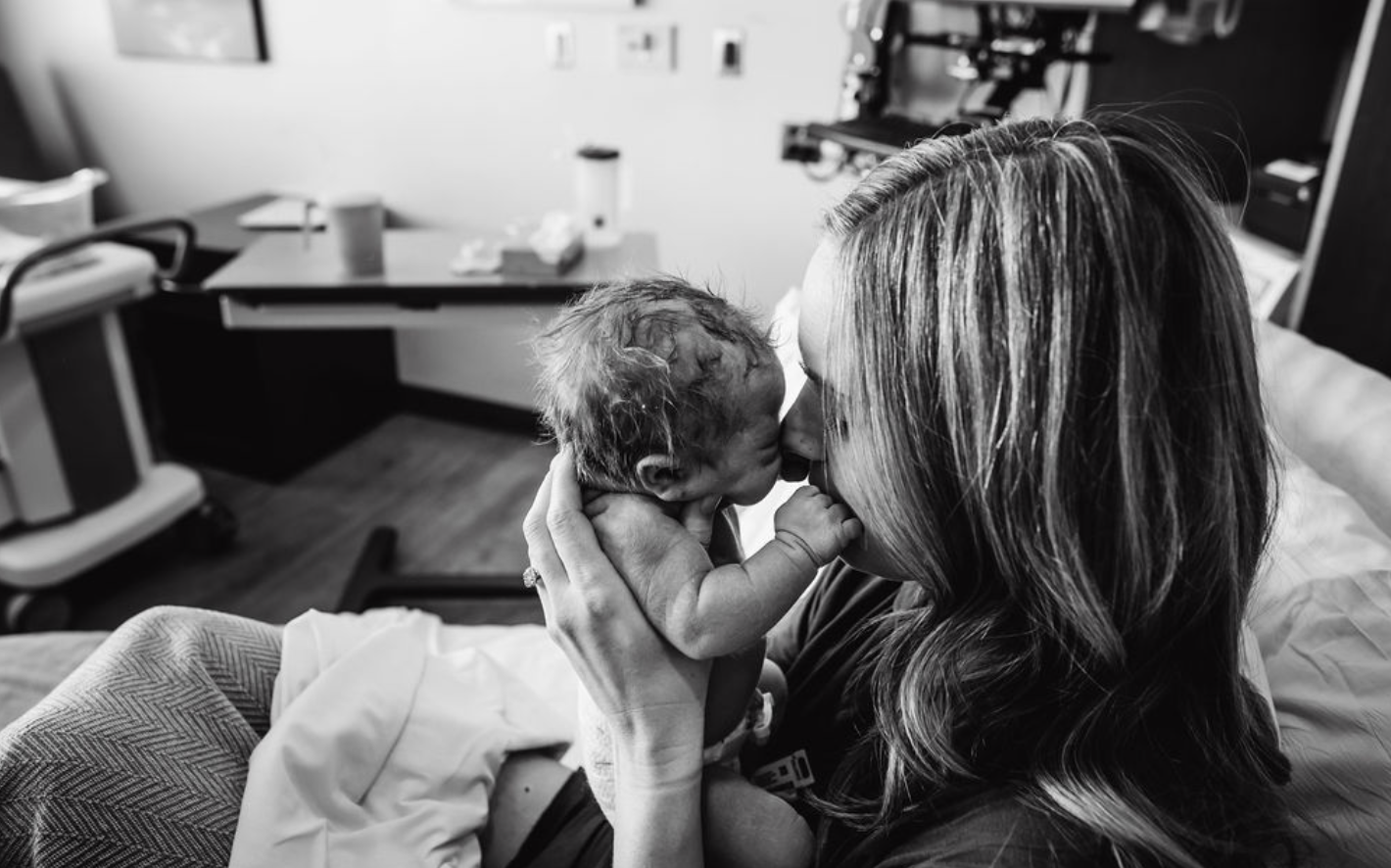
Listen in as I get vulnerable and raw, going all the way back to those first time mama feels, and share my own first birth story. Our birth stories may not tell us who we are, but for so many of us, they are the very beginning of the motherhood story we are writing.
From finding out I was pregnant, to navigating a healthy pregnancy while juggling the heartbreak of my mom’s illness, I’m opening the door on all of it. You’ll hear about my unmedicated hospital birth, a super doula husband by my side, and the overwhelming pride of how well we did as a team.
This story isn’t just about birth; it’s about why I do what I do. Becoming a mom while working as a labor nurse opened my eyes to the gaps in birth education—stuff we need to know but aren’t always taught. That’s why I created The Labor Mama platform and now this podcast: to empower you with a safe space for real talk, practical tools, and a reminder that there’s no one “best” way to do any of this.
Whether your pregnancy or motherhood feels joyful, heavy, or both, you’re not alone, and I’m here to walk it with you.
What You’ll Get in This Episode:
- My raw, real first birth story and why I’m here.
- How my mom’s cancer journey intertwined with my pregnancy.
- Why birth education became my passion—and why it matters for you.
- A nudge to own your pride in your birth, however it unfolds.
If this episode made you laugh, cry, or feel seen, hit subscribe and join me next week for more stories, expert insights, and practical mama wisdom. You’re doing an amazing job mama, and I’m so glad you’re here.
Listen to my other 3 birth stories here:
Listen to episode 40: Labor Nurse’s 3rd Fast, Unmedicated Hospital Birth with Midwives
Helpful timestamps:
- 00:00 My First Birth Story
- 07:03 Getting Pregnant & Telling Kelvin
- 12:41 Mom in the ICU
- 17:59 A New Cancer Diagnosis
- 21:04 Birth Class & the Unmedicated Plan
- 28:41 Last Shift Before Baby
- 31:36 Early Labor Overnight
- 38:26 Triage Surprise: 7–8 cm
- 44:22 Pushing Through Fear & Baby Girl Arrives
- 48:25 Born on Mom’s Birthday
About your host:

 Lo Mansfield, MSN, RNC-OB, CLC is a registered nurse, mama of 4, and a birth, baby, and motherhood enthusiast. She is both the host of the Lo & Behold podcast and the founder of The Labor Mama.
For more education, support and “me too” from Lo, please visit her website and check out her online courses and digital guides for birth, breastfeeding, and postpartum/newborns. You can also follow @thelabormama and @loandbehold_thepodcast on Instagram and join her email list here.
For more pregnancy, birth, postpartum and motherhood conversation each week, be sure to subscribe to The Lo & Behold podcast on Apple Podcasts, Spotify, or wherever you prefer to listen!
 A request: If this episode meant something to you, would you consider a 5 star rating and leaving us a review? Yes, we read them, and yes, they help keep L & B going! ♥️
Connect with Lo more on: INSTAGRAM | TIK TOK | PINTEREST | FACEBOOK
Disclaimer
Opinions shared by guests of this show are their own, and do not always reflect those of The Labor Mama platform. Additionally, the information you hear on this podcast or that you receive via any linked resources should not be considered medical advice. Please see our full disclaimer here.
Additionally, we may make a small commission from some of the links shared with you. Please know, this comes at no additional cost to you, supports our small biz, and is a way for us to share brands and products with you that we genuinely love.
Produced and Edited by Vaden Podcast Services
Transcript
Hello, my friend.
:Welcome back to the Lo and Behold podcast.
:I wanna share a quick note with you before we get going.
:The podcast is actually on a little bit of a break right now.
:This last year as a mom and a wife has been a big one.
:You can listen to episode 77 for more on that.
:So I am taking some time to rest, reset, and be really present with my four little kids.
:I'm also working on some new podcast ideas and content, and I will be back with fresh episodes soon.
:In the meantime, we are doing an encore of some of your favorite episodes.
:I'm talking about the ones you messaged me about, the ones that got shared on Instagram, the ones that got a lot of you through some long labors, some wild postpartum days, and some sleepless motherhood nights.
:If you are pregnant right now and you want more than a podcast episode can give you, my birth course, Your Body, Your Birth, is open and it is ready for you.
:You do not have to wait for me to come back to the pod to get prepared.
:The link for that is in your show notes.
:Okay, let's get into it.
:You are going to love this one just as much as everyone else did.
:Enjoy
Speaker:I don't have time to be a nurse.
Speaker:I'm not interested in being a nurse anymore.
Speaker:I'm just a woman trying to have a baby.
Speaker:I felt that baby, like, come all the way down, and I said, "Oh, heck, like, absolutely not. I am not doing this." Look at Calvin.
Speaker:And I remember him staring down at me like, "You're good. You can do this. You're okay." And it was like being anchored,
Speaker:The only way out is through." And she was born with the next contraction.
Speaker:and those moments of, "I freaking did this, and I am a badass," I hope you feel that, and I hope you own that, and you don't let anyone talk you down from that ledge,
Speaker:Motherhood is all-consuming Having babies, nursing, feeling the fear of loving someone that much Then there's this baby on your chest, and boom, your entire life has changed
:It's a privilege of being your child's safest space and watching your heart walk around outside of your body
:The truth is, I can be having the best time being a mom one minute, and then the next, I'm questioning all my life choices
Speaker:I'm Lo Mansfield, your host of the Lo and Behold podcast.
Speaker:Mama of four littles, former labor and postpartum RN, CLC, and your new best friend in the messy middle space of all the choices you are making in pregnancy, birth, and motherhood.
Speaker:If there is one thing I know after years of delivering babies at the bedside, and then having, and now raising those four of my own, it is that there is no such thing as a best way to do any of this, and we're leaning into that truth here.
Speaker:With a mix of real life and what the textbook says, expert insights, and practical applications, each week we're making our way towards stories that we participate in, stories that we are honest about, and stories that are ours.
Speaker:This is the Lo and Behold podcast.
Speaker:Welcome to the Lo and Behold podcast.
Speaker:I am so excited to finally be able to say that.
Speaker:Having a podcast has been a dream of mine forever, and if you already follow me on Instagram or the occasional TikTok, I don't really post on TikTok that much, but I am there, Facebook, wherever, you've probably become aware pretty quickly that brevity Speaking simply is not my strong point.
Speaker:I spend a lot of time explaining and teaching, and so a podcast feels like the perfect place to be able to say more, right?
Speaker:Our social media world doesn't typically allow for us to say all the things we wanna say in that specific amount of time, but the podcast definitely will allow for that, right?
Speaker:So anyways, if you don't already know me, if you didn't happen to listen to the trailer and you're just jumping in here with me right now, my name's Lo Mansfield.
Speaker:I am the mom, the nurse, the CLC behind the Labor Mama platform, which is a space where I just spend time on social media, my website, in my online courses, educating parents, families about birth, postpartum, breastfeeding, all of the type of education that I know that you need to have a better experience, especially inside of our hospital system when we're talking about birth.
Speaker:And all of that passion and that desire for that for you was really, you know, it culminated or started when I started the journey of becoming a mom myself.
Speaker:I'd been at the bedside for a very long time at that point, but I hadn't experienced it, right?
Speaker:So it's really different to be the patient, to be the person in the bed, to be the person asking questions or having to respond to interventions or whatever.
Speaker:And so all of that, I think, just really solidified how I felt about birth, and then how I felt that you should be prepared for birth based on how it went for me and what I felt was lacking and what wasn't, and all of that.
Speaker:And so that's actually what we're gonna get into here today.
Speaker:I went back and forth on how to start this podcast, and honestly, I delayed even recording this first episode for a very long time 'cause I just wasn't sure, how do we start this?
Speaker:How do we start telling the story of why you should stick around with me, why you may wanna spend time with me, why I'm sitting here in front of you throwing my voice out into all the noise, right?
Speaker:And I really just kept coming back to my birth stories.
Speaker:So, in case you don't know, I am a mom of four.
Speaker:If you're listening to this present day, my littlest just turned one year old.
Speaker:So no- right now, from the moment we're starting this podcast, I have an eight-year-old, a six-year-old, a four-year-old, and a one-year-old.
Speaker:And I felt like our birth stories don't define us, right?
Speaker:They are not the thing that tells us who we are.
Speaker:But I think they tell us a lot about what we believe about motherhood, or they help show, like, the foundation of how we move forward from that, you know, kind of, quote unquote, "day one," right?
Speaker:And so I just felt like if you wanna understand who I am or where I'm coming from or why I mother the way I do or teach the way I do or love the way I do, a lot of it starts with that first birth story and that kind of transition from LDRP nurse who'd taken care of all these patients, sister, wife, all of that, but I wasn't a mother, right?
Speaker:And so becoming a mother and then walking through all of the things that I now want to walk through with you online, right?
Speaker:I just think that that's such a pivotal moment in the who I am, and it can just tell you a lot about who I am.
Speaker:And then also, you're gonna find that it probably tells you a lot about yourself.
Speaker:And I want to reiterate again, I do not think our birth stories are what set us up for success in motherhood or good motherhood or whatever you want to throw in front of that motherhood term.
Speaker:But I do think that they are foundational, right, to how we move forward from that place, whether that be immediately into our postpartum or if we're talking even longer term of just, "Here's how my births went, and then this is how it really, how it impacted me for the rest of my life, all of my subsequent births," stuff like that.
Speaker:So anyways, that's a long intro.
Speaker:That's a long welcome.
Speaker:But ultimately, I'm delighted to be here, and I think this first birth story is a great place to start.
Speaker:So when it comes to getting pregnant, my husband and I did not struggle with getting pregnant with our first baby.
Speaker:We were blessed for-- that it happened really quickly.
Speaker:I did not spend too much time kind of debating How to get into it or tracking or anything like that.
Speaker:For us, it was just kind of a, "Let's go for it and let's see what happens." And so we were pregnant.
Speaker:I'm pretty sure I had a chemical pregnancy my first month.
Speaker:If you guys know what that is, it's essentially where the egg is and the sperm…
Speaker:Oh my gosh, I'm blanking on the na- where you do conceive and an embryo is created, but it just doesn't attach to the uterine wall.
Speaker:And so sometimes you get a positive pregnancy test, sometimes you won't.
Speaker:But often what happens is your period comes, you know, like five, six, seven days late because for that briefest interval, your body was kind of, I guess the word is, like, hesitating 'cause that embryo was potentially there and it just doesn't attach, so pregnancy never really begins.
Speaker:But my second, the second month of trying, we did get pregnant, which was obviously a surprise that it happened so quickly.
Speaker:I think nowadays, often a lot of us think that it just won't happen quickly for whatever reason, because we know that infertility and complications and things like that are more common than maybe we had priorly believed or, you know, that our moms talked about or whatever.
Speaker:So we were delighted and very excited about this pregnancy.
Speaker:One thing I wanna note is my first pregnancy is a very tender space for me because it's very complicated and twisted up in the story of my mom.
Speaker:And if you follow me on Instagram, I've definitely shared about my mom a ton over the years, and you'll hear that more in this story.
Speaker:So if for some reason, like, listening to a story of a sick parent or something like that doesn't feel right for you right now, I would encourage you to just step out of this podcast and come back and listen if or when you feel ready.
Speaker:But that is a part of this story, and so I just wanted to put that in front of you if you're just in that tender space maybe of loss or something like that, and this is not something, you know, that you wanna listen to right now.
Speaker:Okay.
Speaker:So I told you getting pregnant was, quote-unquote, "easy." We found out we were due the first week of December.
Speaker:I actually don't remember my specific due date.
Speaker:But that actually shows you that I don't care that much about due dates, so that's the nurse in me who just knows that due dates are guess dates.
Speaker:But I know that I was due in December because for whatever reason, I-- And it was early December, and for whatever reason, I thought, "I will not I'm, I'm going to have my baby in November," which makes no sense because we have no data to show that anything happens when we think it's gonna happen.
Speaker:And first-time moms, if anything, I feel like often go late.
Speaker:And the data we do have shows that in general, the majority of us deliver around 40 weeks and three days to 40 weeks and five days.
Speaker:That's like average.
Speaker:So I don't know why I was convinced that I would have my baby in November, but I was, so there you go.
Speaker:Interestingly, a lot of people ask, "Oh, how'd you tell your husband?"
Speaker:You know, and I actually am maybe a weirdo.
Speaker:You can leave me a comment and let me know, but I kind of kept it a secret from my husband, Calvin.
Speaker:And so I think I took the pregnancy test, I wanna say like early in the morning, and it wasn't positive.
Speaker:I tossed it in the trash, and then I came back to it later, which I know it's like technically not positive if you have to come back to it.
Speaker:But it was obviously positive a couple hours later.
Speaker:I don't remember why I came back and looked at it again.
Speaker:I think it was just my period was late, and so I thought, "I have to be pregnant, right?" So I came back to it and it was positive, and I sat on that for… I think I sat on it for the whole day.
Speaker:You know, I'm surprised I can't even remember it now.
Speaker:It might have even been till the next day, because for whatever reason, I told him on Easter, and I remember standing with him in church.
Speaker:I think it had happened that morning, or I'd taken the test that morning.
Speaker:Anyway, we're standing together at, at church, and I remember just singing and thinking, "I'm pregnant right now, and nobody in the world knows, not even my husband," which maybe makes me not sound that, that nice 'cause he should know.
Speaker:But I just wanted to tell him in a sweet way, not the running into their room and waking them up or whatever.
Speaker:Their room.
Speaker:We share a room.
Speaker:But it's not like you can't tell them straight away as soon as you know.
Speaker:But I wanted to like do a little something.
Speaker:So I made this little card, and that night I gave it to him, and I've since made a card for all of our other babies that has this little, like a little poem that basically says, "You know, it's gonna be two.
Speaker:We're gonna be two, and then we're gonna be three, or we're having another baby." So I have these cute little cards that I've always shared with him when I've told him, uh, because I've never told him immediately.
Speaker:I've always kind of then given him this card once I've known we were pregnant.
Speaker:And I have these cards now, and I keep them, and they're glued to the front of our kids' baby books, so it's kind of a sweet memory.
Speaker:But anyways, I told him that night, and then we kind of waited for quite a while before we wanted to tell parents and family and stuff.
Speaker:You're gonna learn this from me.
Speaker:I have no qualms with you telling the whole world the second you're pregnant.
Speaker:I don't care if you keep it a secret the whole time.
Speaker:Like I absolutely think The idea of sharing our pregnancy when we want to, it's, yeah, any, there's any right moment in all of that, whether that be sharing with your family, your best friend, the world, social media, whatever.
Speaker:I don't think that you have to wait.
Speaker:I don't think that you have to do it straight away.
Speaker:I think you can keep it from people.
Speaker:It's totally between the two of you.
Speaker:So we personally, I just felt like I wanted to wait until we'd gone to that first ultrasound and ideally heard that heartbeat, right?
Speaker:And I think a little bit of confi- You know, competing emotions with that was that my mom was pretty sick at that time.
Speaker:When I was, I guess, technically like about five or six weeks pregnant, somewhere in there, I'd just found out, my mom ended up in the ICU, and she has a long health history of complications at this point, cancers that she's beaten, an autoimmune disease, things like that.
Speaker:So she was more or less well.
Speaker:She'd, she'd go through something really hard, and we'd navigate it as a family, and then she'd beat it.
Speaker:And then, I don't know, a couple years later, something would happen again.
Speaker:And then, of course, if you're a cancer survivor, you know, at that point, she'd survived two cancers, I think it was.
Speaker:Sometimes, you know, the body, you just have more check-ins, more things going on.
Speaker:You can be immunosuppressed or whatever.
Speaker:So she kind of always had a little something going on.
Speaker:But at this specific moment, her body, she just got hit with this fungal infection, pneumonia, and flu all at the same time, and she had an autoimmune disease which had made her lungs less efficient, let's say.
Speaker:And so the combo of this, like, triple infection and the autoimmune disease and the weaker lungs, she just ended up in the IC- ICU for about a month.
Speaker:And so the day of our first ultrasound, we went in, and I remember looking at my nurse, or, um, excuse me, my midwife, and I was, I was crying and emotional, I think before, just because of my mom, and I just felt so burdened by everything going on.
Speaker:But of course, also pregnant, right?
Speaker:And excited and, you know, nervous and scared and all.
Speaker:It's just a lot of juggling emotions throughout my entire pregnancy, as you'll continue to hear.
Speaker:So anyway, I looked at my midwife, and I just told her, "We really need a win today." And then she put that little ultrasound probe on my belly, and we heard that heartbeat.
Speaker:And you guys, if you've heard that, yay.
Speaker:You know how sweet that moment is, and if you haven't and you want to, I hope and pray that that moment comes for you soon.
Speaker:But it is just pretty precious.
Speaker:And I think it was, for Calvin, I just think almost it was the coolest in that moment 'cause there's something about that first time.
Speaker:Like, it's been a delight to hear the heartbeat of every single one of my children, and I have cried every single time.
Speaker:But I do really remember that moment with Calvin, where it's just like, oh my gosh, we made a baby, and there is its heartbeat.
Speaker:So we got that win, and I actually-- my husband and I got on a airplane that day.
Speaker:We were planning already to fly home, see my parents, so I could spend some time with my mom in the hospital because we did not live in the same state.
Speaker:So we flew home with the news that we were pregnant and got to tell them.
Speaker:It was a little complicated telling family.
Speaker:It's just not the way you picture it, right?
Speaker:'Cause she was in the ICU.
Speaker:She couldn't get out of bed.
Speaker:She could talk, and she was, you know, more or less with it, but it was kind of Yeah, it was just a little bit-- It's a, it's a sticky memory, right?
Speaker:Like, you picture telling your parents or whoever it is you love, "Hey, we're pregnant," and there's cheering and hugging and all of that, and that's not quite how it went.
Speaker:But either way, it was a real, a joy to be able to share something so good with her in the midst of something so rough.
Speaker:She did get better.
Speaker:She left the ICU a few weeks later, and so we'll continue to have some struggles throughout the, my pregnancy.
Speaker:I'll get there soon.
Speaker:But yeah, she was out of the ICU soon, and it was kind of just like normal life while I, you know, grew this baby and worked at the bedside.
Speaker:So I will say, as I was working, there was a lot of, you know, this interesting back and forth of being a nurse and also just being a, a mom, right?
Speaker:And how-- and juggling all of that with… You see all these things that happen at the bedside, and some of them are really broken and really hard, right?
Speaker:And so I might have someone come into triage, and I'm 30 weeks pregnant, and so is she, and she has decreased fetal movement or something like that, right?
Speaker:And so it's really tough To navigate or kind of separate yourself from your work when you are literally, like, your body is doing what your work is, which is growing a baby and then birthing that baby.
Speaker:And so there were a lot of times I'd shoot my parents a text during that pregnancy and be like, "Hey, can you just pray for me?
Speaker:You know, I saw something really hard at work today, and it s- and it was… It's just hard, right?
Speaker:I'm just clinging onto that a little bit." Or yeah, that kind of stuff was just, let's say, keeping me up at night more than it should type thing.
Speaker:So I don't think it was miserable to be a nurse when I was pregnant.
Speaker:I, like, I loved all the knowledge I had.
Speaker:If anything, it bettered my birth, it bettered my pregnancy because I felt so educated and informed and all of that.
Speaker:But it, there was that idea that, you know, knowledge is power, but sometimes it can also cause fear if you're not careful.
Speaker:So that's kind of how it felt to navigate my pregnancy.
Speaker:I was totally healthy.
Speaker:Everything went beautifully with that entire pregnancy, and I felt amazing.
Speaker:So really the only challenge was kind of that little balance of knowing too much and just making sure that I used or had really good boundaries around, like, myself and what I let kind of those anxieties do to me, my own mind, my own body, as I kind of grew this baby.
Speaker:The other thing that I would say that was most challenging, and really was the most challenging thing, but doesn't obvi- doesn't really have anything to do with pregnancy, was my mom.
Speaker:And so I told you she got out of the ICU in the spring, and unfortunately a couple months later in the fall, so I was probably, like, six, seven months pregnant, my mom got a new cancer diagnosis, and it was lymphoma or non-Hodgkin's lymphoma.
Speaker:And y- I know it might seem weird that I don't know, but this was her third cancer.
Speaker:I know you're probably like, "How do you not know?" Third or fourth, I can't even recall right now, 'cause she had had one, was in remission.
Speaker:She had had breast cancer.
Speaker:She had multiple myeloma.
Speaker:I think this was the third thing, and if you recall, she left the ICU right after about a month, and so her body just wasn't ideally prepared to handle anything like this, right?
Speaker:And so we were pretty scared when she got this diagnosis because it, it possibly just meant that… I don't wanna say that, oh, this could be the end, but we just-- we knew she wasn't equipped to fight cancer again, and that chemo and radiation and all of that.
Speaker:She was pretty thin.
Speaker:She was pretty frail.
Speaker:She'd had a hard time gaining weight after the ICU.
Speaker:We just knew that this was not a body that was prepped to do this big, hard thing.
Speaker:So that became a pretty significant challenge the last couple of months of my pregnancy, just navigating those emotions, everything that was going on with her, being scared that, you know, my baby maybe wouldn't know her, and that this, this really could be the beginning of the end.
Speaker:I don't know.
Speaker:That sounds so gross to say, but it was pretty scary and, and we all felt it, but we also were trying to, you know, live, right?
Speaker:Grow my healthy baby on my side.
Speaker:My mom's, you know, saying, "No way, I'm gonna be here for everything." So it was kinda brutal, honestly, that idea of becoming a mother while, you know, losing my mom at the same time.
Speaker:It was, ugh, it was not easy.
Speaker:If… 'Cause I know you guys, if I start to cry, I promise I'm not gonna cry every episode or every birth story.
Speaker:But some- this one is not the easiest one for me sometimes.
Speaker:But like I said at the beginning, I think this is all part of who I am and why I care about the things I care about in the ways that I do.
Speaker:So anyways, sick mom, and inside of that, we'd kind of learned that she couldn't travel to see me when my baby was going to be born.
Speaker:My husband and I had gone back and forth on whether or not we wanted to have my mom there.
Speaker:We definitely wanted her to be with us postpartum.
Speaker:She was just the best grandmother, helper, just knew how to be present, but not overbearing.
Speaker:And she'd been a grandmother to my niece for four years at this point, and then I had one other niece who was one year old.
Speaker:So she'd been a grandmother, and she was a fabulous grandmother.
Speaker:So we-- My kids, the kids called her Nana, the ones who could speak anyways.
Speaker:Uh, so she was an incredible nana, and we could not wait to have her do that and be that with us and for us.
Speaker:So unfortunately, that was part of that news, though, is that she could not come out.
Speaker:She could not be with us, and so we would have to bring baby home at some point to meet her and to get to be with her.
Speaker:So just another disappointment to kind of walk through.
Speaker:But I will say, Cal and I, we were pretty sure, and then ultimately we did decide that we just wanted it to be us in the birth room.
Speaker:Cal and I did birth class together, and I am so proud of him and us for doing it.
Speaker:I think a lot of times I got the question, you know, "Lo, why are you doing a birth class? You know everything." Which, first of all, is not really true, right?
Speaker:Like going through birth just opens your eyes to so many things, even if you've been a nurse for 35 years.
Speaker:But I will say, I, yeah, I do know a lot, or I know a lot of the clinical stuff, but my big goal was, hey, I've never been the person in labor.
Speaker:Like, what is it like when it's my body?
Speaker:Not the patient in front of me, my body.
Speaker:What is transition gonna feel like for me?
Speaker:How do I prepare my body at home?
Speaker:Like, there's so much more to learn, so I think everybody should be in birth education, including a labor and birth nurse, especially, you know, if it's your first baby and you haven't done it yet.
Speaker:And then for us equally so was Cal. I wanted-- My goal was to try to do birth unmedicated.
Speaker:So at the hospital, but no intervention, low intervention, and unmedicated.
Speaker:And I wanted Cal to be on board with that.
Speaker:I didn't necessarily feel like I wanted to hire a doula.
Speaker:I felt like my midwives and the nurses who I worked with, 'cause I delivered where I worked every day, that they would be really good support and care and extra love and all that good stuff that you kind of get when you deliver where you work.
Speaker:And so I felt like the combination of them, and then if Calvin got prepped and ready and all of that would be a good enough combination or a great combination for me to, yeah, get after.
Speaker:I always say chase, chase that unmedicated birth.
Speaker:So to get Cal on board, he'd never held a baby.
Speaker:I mean, he had like zero experience in any of this.
Speaker:And to be honest, when I'd come home from work and tell him stories, he was like, "Yeah, great. I'm good. I do not need to hear any of this." He works in business and, but consulting, and just our two niches, passions, worlds could not be farther apart.
Speaker:So I felt like it was time for him to get, yeah, introduced to this, to this birth world and, and what it looks like for him to truly actively play a role because I knew, I absolutely knew he could, and I trusted him with that before he ever learned a thing.
Speaker:And so the birth class was just invaluable for the both of us.
Speaker:It taught me so much about my own body, and I feel like it taught me the-- I'm gonna use the word crunchy.
Speaker:This stuff is not crunchy.
Speaker:It's what we should all just know, and that's why I teach all of this now in my own Your Body, Your Birth course, is because this isn't crunchy.
Speaker:This is our bodies.
Speaker:But the Uh, a class that we took, we did a, a class with a doula with two other couples, some of our best friends who were also having babies, and the six of us took it together, and it just taught us so much about our bodies, what was happening, that it was normal, that unmedicated birth was not a weird thing.
Speaker:I felt like that was super valuable for Calvin.
Speaker:Like, "Hey, here's the physiological process.
Speaker:This is all normal.
Speaker:It's what bodies are designed to do.
Speaker:We've got chemicals and hormones and systems moving around together.
Speaker:Like this… not a single part of this is weird or strange or creepy, and if your wife," in this case me, "wants that unmedicated birth, then you can absolutely support her in that and know that it's normal and something worth chasing if that's what you guys want."
Speaker:And so I felt like Cal just really grasped onto that once he, he got the knowledge of the process and that understanding of how it works and, and just how he could step in.
Speaker:So he was just… Yeah, he was on board.
Speaker:And then he can be pretty competitive too, and so I think the-- Our friends we were in birth class with, I'll be honest, they are both-- All six of us are, like, wildly competitive.
Speaker:Some of them were D1 athletes at their college, so I f- And all of us wanted to do birth unmedicated.
Speaker:So this, you can laugh at me and think that's ridiculous, but I feel like part of it was all of us thinking, like, "I'm gonna do this unmedicated. We're all gonna do this," right?
Speaker:So it was almost like… Oh, and we were all due within two weeks of each other.
Speaker:It was-- Our kids all literally ended up, up coming within, like, 20 days of each other over their three births.
Speaker:So I felt like we were all just locked in, and Calvin for sure, 'cause he is so competitive, was also locked in, like, "She's gonna do this. I'm gonna help her, and our friends are gonna do it, and we're all gonna be able to say we did it," and he probably, probably liked that part of it too.
Speaker:So anyways, we were totally prepared education-wise, as prepared as you can be, and then I, as labor got closer, started doing some of the things, right?
Speaker:All those natural induction tools and tricks and all that stuff that you hear about.
Speaker:I did… Let's see, the first time I did Primrose oil pills.
Speaker:I would poke a hole in them and then insert them in the vagina every night.
Speaker:I think I started that around 37, 38 weeks.
Speaker:I drank the raspberry leaf tea.
Speaker:I did not eat dates, you guys.
Speaker:I know that's, like, so big, and I teach about it and talk about it, and we talk about all of these tools inside of Your Body, Your Birth, including the ones I've never tried.
Speaker:Tea-- So yeah, tea, pills, no dates, because I think I just, like, didn't know a ton about it at the time.
Speaker:Tons of optimal fetal positioning.
Speaker:That really mattered to me in my birth class that I'd taken with that doula.
Speaker:She had just taught a ton about that, and so that felt… Yeah, I-- From that moment on, honestly, I've just believed that optimal fetal positioning exercises pre-birth and then doing everything we can to have our baby in that great position is just…
Speaker:Yeah, it's a, it's one of my favorite things.
Speaker:It is the thing, I think, to birth prep long before tea or pills or whatever.
Speaker:All of that stuff, I have to say, I have to caveat, of course, I did with, you know, midwife approval and just checked in and kind of did the, "Hey, can I start doing the things?" And, you know, my midwives are probably pretty traditional midwives.
Speaker:They're like, "Yeah, do whatever you want, you know, within hea- safe boundaries." And so those were the big things I did at that time.
Speaker:But I know I told you that I thought babe would come early without any reason to think so.
Speaker:But I also wasn't obsessed with it, if that's the right word.
Speaker:I-- It wasn't like I started doing the mile circuit every day or lunges or squats.
Speaker:I just quietly and, like, consistently did things each day.
Speaker:I'd sit on a birthing ball at work because I was still working at the bedside, you know, 12, 13, 14 hours a day.
Speaker:I was just kind of thoughtful throughout my day about my positioning, but also didn't feel super stressed about it.
Speaker:I wasn't having cervical checks at my last appointments.
Speaker:I actually never had my cervix checked until we got into labor.
Speaker:Yeah, I just-- I was prepped and ready, and for some reason thought that I would go a little bit early.
Speaker:But other than that, I would say I felt pretty chill, if that-- I'm not maybe always a chill person.
Speaker:But in that, I, in that, I don't remember being too worked up about anything, but definitely was doing a little bit to, to get ready.
Speaker:One thing I can say is that I worked all the way up until the baby was born.
Speaker:I know sometimes you hear nurses or other professions as well, they'll take off a week or two before.
Speaker:But we got no maternity leave at work.
Speaker:We just got-- We could use our disability and then FMLA.
Speaker:Nothing was paid.
Speaker:So I did not wanna use, you know, a day of leave until my baby was born.
Speaker:And so I had scheduled myself to work up until Thanksgiving, and then I had requested Thanksgiving off because I had thought that my mom could come out and be with us.
Speaker:And then, like I mentioned, it wasn't possible, but I just kept those PTO days just requested off and thought I'll spend the holiday with Kelvin and, you know, we'll be about 39 weeks, so that'll probably feel nice to have Thanksgiving off.
Speaker:So the day before Thanksgiving was my, ended up being my last shift, and I worked, so funny to me, 14 hours, and I wanna say I was 39 and zero days pregnant.
Speaker:So obviously, if you've been 39 weeks pregnant, you know you are pretty uncomfortable and pretty ready.
Speaker:But I worked 14 hours, and you guys, I did it with joy.
Speaker:I felt so amazing this pregnancy.
Speaker:And the reason I worked 14 hours is because right at shift change, this mom walked in, and she was having a precipitous birth, which means really, really fast, right?
Speaker:And it was her third baby, and, you know, the charge nurse and everyone's looking around 'cause it's shift change.
Speaker:We're getting ready to go home, and it's like, "This woman is about to have a baby. Who's gonna take care of her?" And so I said I'd stay, and I'd deliver her and then go home after that.
Speaker:And so we did, and we had a beautiful birth, and she went really quickly.
Speaker:I, I do not remember exactly what time she delivered, but it was right around like 7, 7:15, something like that.
Speaker:And I delivered her and got her through recovery, and then I finally clocked out, you know, charted, clocked out, and then went home.
Speaker:So that ended up being my last shift.
Speaker:It was an very long shift, but it ended in, like, a really beautiful, just classic physiological birth, which is kind of cool to think about now because that would be the last birth that I would see before I would have my own.
Speaker:So the next day was Thanksgiving.
Speaker:We spent it with some friends and their family.
Speaker:Everyone made jokes about me the whole day, like, "Oh, don't have the baby on the floor. Ha ha ha." You know, everyone likes to make those kinds of jokes when you're really pregnant.
Speaker:But I felt nothing, like zero indication of going into labor at all.
Speaker:There were-- I do remember there were dates on the charcuterie board, thank- for Thanksgiving, and Calvin was telling me to eat, "Eat them," you know?
Speaker:"Maybe it'll do something." So I think I ate one or two.
Speaker:I hate dates.
Speaker:We'll talk about that some other time.
Speaker:So I think I choked down one or two, as if that would do anything, which, spoiler, two dates at 39 weeks won't.
Speaker:But I did choke them down.
Speaker:I remember Calvin thinking it could be valuable.
Speaker:So I ate those dates.
Speaker:We had a sweet Thanksgiving with our friends, and then we just went home and we went to bed.
Speaker:And like I said, there was absolutely nothing going on.
Speaker:Never had been checked anyway, like Zero indication of labor.
:Hey friend, quick pause for just a second.
:If you are listening to this podcast because you wanna feel more prepared, more confident, and less freaked out about birth, that is exactly why I created the Your Body Your Birth course.
:This birth course will not tell you what kind of birth you should want, and nobody has the right to do that.
:It is about helping you understand what's happening in your body, what your options actually are, and how to walk into your birth feeling grounded, excited, ready, instead of overwhelmed and scared.
:When you have education like this, everything changes, your mindset, your conversations with your care team, and the birth experience itself.
:No more relying on random opinions, okay?
:Stop scrolling.
:Take intentional action with me and start trusting your body, your voice, and your decisions today.
:Head over to www.thelabormama.com/birth, also linked in your show notes.
:And be sure to use the code Podcast at checkout to save 20% and start working towards this better birth for you right now.
:Okay, let's get you back to the episode
Speaker:The middle of the night, you know how it goes, right?
Speaker:I woke up, and I actually felt like I had to pee.
Speaker:And so I got up, which is, you guys know, the, that's normal when you're pregnant.
Speaker:So got up, went pee, laid back down, and then I wanna say like 15 minutes later, I thought, "Oh, weird, I have to pee again." And it w- and truly, like nothing else going on.
Speaker:I just thought like, "Oh, my bladder feels full." Got up, peed again, and I remember sitting on the toilet, and it felt like painful to pee, I guess is the best word to say it, because I was feeling, you know, a little bit of crampiness, which I later understood, oh, those were contractions.
Speaker:That's why I felt like I had to pee.
Speaker:And so it was that very cliché like period crampy fullness feeling, like kind of the front of your pelvis where things just feel full down there.
Speaker:And so at that point, I think I thought, "Oh, I think these are maybe contractions. That's why I keep feeling this." Got back in bed, laid down, and had another one like 15 minutes later.
Speaker:And I know everyone says sleep, and if you are a student in my course, I will tell you the same, sleep.
Speaker:But guess what I did not do?
Speaker:I did not sleep.
Speaker:I did not sleep at all.
Speaker:I got up 'cause I, at that point, was like, "I can't, I'm so… I'm distracted," right?
Speaker:"I might be in labor, and I need to know if I am." Not that you could do a darn thing about it, but, so I got out of bed, and I do-- At some point, I started tracking.
Speaker:ion I started tracking was at::26, I got out my little app tracker, and I just let Calvin keep sleeping, of course, and just started tracking.
:And w- over the next couple of hours, like textbook, things just started getting closer and closer and closer together.
:Nothing was, in my opinion, worth waking Calvin up for, but it was like exactly like you would read in a book.
:You know, I'd woken up, and those were 15 or 10 minutes apart, and then it was eight, and then it was seven, and then they were six.
:I mean, I've not had a labor since that one that was as textbook as my first one when it came to labor pattern and what felt real and all of that.
:And they did continue to get painful.
:They weren't at first.
:They were that noticeable twinge, and then it started to be a little bit painful, and then it started to be clear, like, "Oh, I'm definitely in labor. These are six minutes apart, and, like I have to get up off the couch." I had turned on Friday Night Lights.
:Shout out for Friday Night Lights, one of my fave shows ever.
:I had turned it on and was just watching it through the morning, like early morning, 3:00 AM, 4:00 AM, and just contracting and watching TV and kind of chilling in between.
:And at this point, after those couple of hours, maybe five, six minute apart contractions, I had to get up off the couch and just sway or breathe or something to get through them.
:And so obviously at that point I'm going, "Okay, this is, this is probably, you know, real. When do, when should I wake up Calvin?" Like, kind of start having the true conversation in your head of what to do and what does this all actually mean.
:And I would also say that kind of at some point in that morning when these contractions got closer, the pain was real, it was also when I feel like I made this switch from nurse to, to mom or, like, nurse to, to woman in labor, because up to that point I had been a little more clinical, right?
:I'm paying attention to my contractions.
:I'm thinking, "Oh, do I have bloody show?" Not gonna lie, guys, I checked my own cervix, but I do not recommend that.
:But I did because I knew what I was looking for and had what I needed to do so, and so I ha- you know, I was doing nursey things, paying attention to almost, like, the management of my own labor, and then it's, I hit a point where it was, it, that stopped, and it was just like, all right, I'm just in labor and it's time to just…
:I don't have time to be a nurse.
:I'm not interested in being a nurse anymore.
:I'm just a woman trying to have a baby.
:And so that was around the point when I woke up Cal. It was about 6:00 AM.
:So I'd done labor for, you know, six or so hours on my own, and he slept.
:I went in the room, said, "Hey, I think I'm in labor."
:He flipped the covers back and said, "Okay, great.
:Get back in bed." Which makes us laugh now because our, our birth instructor had said, you know, "Try to get her to rest, try to get her to rest if she's in early labor." But he didn't know I'd been up for like five hours at that point.
:So I tried to lay down, had one contraction.
:It's like, hell no, absolutely not.
:I am not laying in this bed.
:So I got up.
:He got up.
:And yeah, we just started laboring together at home.
:We probably did a couple hours of labor.
:He tried to get me to eat some food.
:He called our parents and let them know, 'cause I was sure.
:When I had checked myself prior, I was like four to five centimeters and had had some bloody show and stuff, so I knew that, you know, I, I was in labor.
:I didn't know how long it would take from that point on, but we did know, we're gonna have the baby today, tomorrow, something like that.
:So eventually, we got to the point where I didn't wanna eat.
:He wasn't calling people.
:I more, like, needed his support, and we were in our living room of our tiny little suite rental first house, and we were swaying together.
:I don't know, doing one of those things you can do together when you're laboring at home.
:And I remember I felt a contraction that was… I did not feel pushy, but there was a fullness to it.
:Like, whoa, the baby just dropped.
:Like, something felt different than it had those prior six, seven hours or so, and I said, "I think we should go."
:And Cal did, again, what our birth instructor had taught and said, just, you know, like chill for a minute, hear her out, and then kind of question her, not in a negative way, but just like, "Are you sure?" Especially because if the desire is unmedicated birth, it's great to stay home as long as you can, right?
:And so he just kind of said, "Are you sure? Like, we can stay here and keep working. You're doing great," that kind of thing.
:And I had another contraction, and I said, "Yes, I'm at… Yes.
:Like, I wanna go to the hospital." And so he's like, "Great, let's go." And guys, I gotta be honest with you, Calvin wants to be at the hospital every time.
:He does not like that idea of, oh my gosh, what if you had a baby in the car?
:This is stressful, anything.
:So anytime I'm saying, "Let's go," he is more than ready to get in the car and get to the hospital.
:So we jumped in the car, rode to the hospital.
:I won't tell you the whole story, but we have this dumb story about the seatbelt, which he forced me to wear, so I was super pissed at him because it was so uncomfortable, and I tried to ride in the backseat, but he wanted me buckled, and it was, yeah, a miserable car ride, as it can be.
:So my guess is maybe I was getting close to transition or something in the car.
:So pretty uncomfortable, pretty unhappy, and we had about a 25-minute drive.
:So we made it, not the end of the world, but not my favorite part of the whole story.
:And when we got onto the unit, again, I delivered where I worked, so I knew every single face on the unit when I walked in the door And I had called ahead and told them I was coming.
:I'd been texting my friends.
:Like, it's so sweet to deliver your baby where you work 'cause everybody… Like, I figured out who's gonna be my nurse, who's the charge nurse, who's the anesthesiologist, just in case, like, just knowing all those things brings you a lot of peace.
:And so we walked in, everybody knew I was coming, and we get to the front desk.
:And I don't know if I had thought about anything up to this point, but I th- in my head now, when I look back, I think, "Why did they not just put me in a room? I obviously said I'm coming in, I'm in labor." But I'm a first-time mom.
:You gotta remember this, right?
:And so big deal, yeah, I'm a nurse, but also first-time moms often may come in and think, you know, "Oh my gosh, this is real.
:This is horrible." And they-- It's possible they can be two or three centimeters.
:They just don't have a gauge for what real labor is 'cause we've never been in it, right?
:And so it's pretty typical to put a first-time mom, and even second, third, fourth, if that's you, into triage, where you get checked out first, and then they decide if they're gonna keep you for labor.
:And so they put me in triage.
:Sweet Mark at the front desk.
:I felt so bad looking back 'cause I was not nice to him.
:But he's like, "Hey, you're gonna go in room 283 or whatever," or triage room.
:And I looked at him like, "Are you kidding me right now?" I mean, I feel like I was shooting fire at him, and he kind of cringed 'cause it's not his choice.
:He's just doing the front desk.
:And he's like, "Yeah, they want you in, you know, blah, blah, blah room." And I was so livid that they were triaging me because I knew I was in labor based on what I felt.
:Obviously, I checked my own cervix.
:Like, but they still triaged me.
:So they put me in triage.
:They come in.
:Sweet Sally was my labor nurse.
:She's one of my faves from work.
:She actually used to work in Australia, and now, so she… And then now works here in the US.
:So she came in to see me, and she asked if she could check my cervix, and I said sure And I was seven to eight centimeters with a bulging bag of water, and I kid you not, kid you, kid you not, can't talk.
:In my head, I just thought, "Told you so." And I don't think I said it out loud, but part of me was so smug, like, "Yeah, put me in a room, you guys.
:I'm gonna have a baby." So they were kind of like, "Oh, great," you know.
:Sally's incredible.
:I love her.
:I love her so much.
:So she's like, "Cool, let's have a baby," and she's very chill.
:Honestly, Sally coulda ca- caught my baby, no problem, and I would not have worried a single bit if no one else was in that room.
:So they got us admitted for real labor and got us into our real room.
:We started an IV.
:I had an IV that birth, and then yeah, we just labored in the room for a couple hours.
:Things were moving quick for a first-time mom.
:Nobody really bugged me.
:Nobody really, like, put or expected anything of me.
:We did a 20-minute monitoring of baby for the first 20 minutes in triage, and then after you get that, this is pretty typical for everyone, so this would be true for you, too, probably, if you go into hospital.
:You have to monitor about 20, 30 minutes when you first get in or get admitted or get there, however you wanna say that, and then they can pull it off, and then do intermittent monitoring if everything's looking great.
:So that was what we were doing.
:And then throughout that, like, I think it was maybe 90 minutes or so from when we got there to when it was kind of time, I just wanted it quiet and chill, and Cal and I just did our thing together.
:I like being on the birthing ball, so they had that in the room for me, and then eventually, I ended up on hands and knees on the floor, which if you listen to all my birth stories, I'll share all the rest of them later.
:But hands and knees on the floor is my jam, and it's where I end up every single birth.
:Like, my pictures from my births often look the same because it's like, "There she is on hands and knees on the floor again." So, hands and knee on the floor.
:Things were moving pretty fast, and I will say, in the back of my head, that kind of nursey part was saying, "This is too fast for a first-timer. Like, you're not as far as you think you are," 'cause I started to feel pushy, and at this point, I'd been in labor fully for about nine hours.
:And if you guys know, the average first-timer, you know, they're usually in labor, like, 18 to 24 hours, if not longer.
:Of course, I'd seen, like, two, three-day labors and inductions.
:So in my brain, I thought, "This is, this is too fast.
:We're not gonna have the baby today.
:Like, don't get ahead of yourself." But I started to feel pushy, and I asked my midwife if she would check me, 'cause I just thought, "Is this possible?
:Can I really be, like, in transit- Is this r- yeah, is this possible?" And then the flip of that is, "If this is not, if we're not close, I don't know if I can do this, you know, if I'm still seven or whatever." And so I asked her to check me, and Cal jumped up to go to the bathroom, and I was on the floor 'cause I was on hands and knees, so I just flipped over really quick and laid down so she could check me.
:And she said, "Oh, you know, this is so great.
:You're 10, and your bag of water is still bulging, and it's right there.
:If you want, I can break it, or I can just leave it, and, you know, you can keep going." And I said, "Break it.
:Please break it." Like, to me, I felt like, "It's time.
:Let's have this baby now." I kinda wish I would've tried to have an in-call birth, but whatever.
:So, I had her break it, and When she broke it, obviously when it's bulging like that and you're 10 centimeters, there's often gonna be a ton of fluid, and it was-- it just went-- We didn't, we didn't think it through very well since I was laying on my back on the floor.
:But it just went everywhere, like water all up my back and into my hair.
:Again, like picture I'm just flat on the floor on this mat.
:And the baby, we ha- There was meconium, unfortunately.
:So it's just poopy meconium water everywhere.
:And all of this is happening in, you know, 90 seconds, right?
:So Kelvin comes out of the bathroom, and every-- everyone's not frantic, I don't wanna say that, but there's, you know, water everywhere, and they're saying, "You're complete," and I'm trying to get up off the floor, and everyone kinda looks at Kelvin like, "She's 10 centimeters.
:You're gonna have your baby." And he's kind of like, "What?
:I just went to the bathroom, and, and now I'm-- Okay, we're having the baby.
:Like, I left for two minutes and everything changed." And so he-- We-- I wanted to be in the bed.
:At, up to that point, I had thought, uh, yeah, I just, I wanna deliver in the bed.
:That's where I feel good, or I think I'll feel good or whatever.
:And so I got in the bed.
:Kel helped me kind of get in the bed, and then I was ready to push.
:Definitely there was no, no passive descent or anything like that that I was interested in.
:I wanted to try and push and have this babe.
:And so my water had broken at::We jumped in the bed at some point, and then I feel like the body kind of just took over, as it often does, especially unmedicated as well, where you feel that strong urge to push.
:Baby was really low, all of that.
:And I remember, I think, trying to push with the first contraction and not being super efficient at it, which is probably true for a lot of us when we have that first babe or if we're kind of trying to tune into our body and how it feels to actually push well.
:And then the next contraction I pushed, let's say well.
:I did a, I did a good job.
:And babe came down, and I'm telling you, I felt that baby, like, come all the way down, and I said, "Oh, heck, like, absolutely not. I am not doing this." And I got really fearful in that moment.
:I… It's the only-- I've felt that feeling with my other kids, but that time it scared me.
:And I, I don't, I don't wanna say I started freaking out, but Sally, my wonderful nurse, she could tell that I was kind of like losing my grip a little bit at what I was feeling, and just refused to kind of push through it, 'cause you really have to kind of push through that fullness and get past that point.
:And she's like: Hey, look at Cal. Look at Cal. 'Cause he was on one side and Sally was on the other, and she's like: Look at Calvin.
:And I remember him staring down at me like, "You're good.
:You can do this.
:You're okay." And it was like being anchored, because at that point, I just, I think I would've backed up and said, "I'm out of here," for whatever reason.
:What I was feeling was way too much for me.
:And so next push, it was the truth.
:Like, saying, "Fine. I'm, I'm gonna push past this. The only way out is through." And she was born with the next contraction.
:And we were going to have Cal deliver, and he-- The midwife said, "Hey, come here, like, babe's coming." And he went to drop.
:He was on my right side, and he went to put my right leg down, and I was like, "Absolutely not.
:You are not allowed to leave." Which I feel bad about now, because that's actually the only baby he didn't get to literally catch and be the one, because I thought, "Uh, no way.
:You're not going anywhere.
:Do not move that leg."
:And so I wouldn't let him actually, like, kind of go around the bed and grab.
:But midwife delivered babe, held her up.
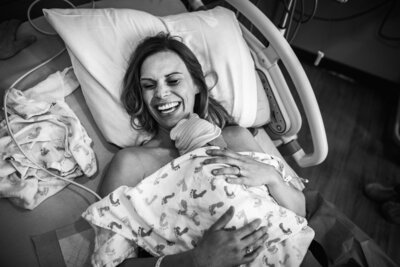
:We did not know what we were having, so kinda held her up for Calvin, for him to tell me it was a girl, and then just laid her right on my chest.
:And I gotta tell you guys, you know, nobody…
:I'm sure you've heard the term or someone will tell you, nobody gets a trophy for unmedicated birth.
:And I will tell you that just in that moment I was so delighted that Kel and I had done this thing together.
:And I think I would've been delighted either way if, like, whatever way she'd been born or if I'd gotten an epidural or something else had happened.
:But I just remember this overwhelming feeling of pride in the two of us, that we had done this thing, and that she was here, and that together we had figured out how to do this.
:And so I would tell you, yeah, maybe no one hands you a trophy, but if you feel just immense pride or joy for the way your baby was born, and those moments of, "I freaking did this, and I am a badass," I hope you feel that, and I hope you own that, and you don't let anyone talk you down from that ledge, because we were both so, so delighted that we had done this thing together.
:And, and I don't want that to take away from, obviously, we had this beautiful, healthy baby on my chest.
:But we, we were, we were holding both those next 30 minutes, hour, as we started to meet her, hold her, both of us doing our skin-to-skin, all that.
:We definitely just kept looking at each other like, "We did it.
:Oh my gosh, we did it." And it, and it was a mutual thing and a mutual point of pride in both her and what we'd done.
:So, I just wanted to say that because I think sometimes people are kind of like, "Oh, you know, it doesn't matter," like, everybody's a champion.
:And I agree with that.
:Like, doing what we do is, is incredible.
:But if you feel that immense pride and you feel like you've got a trophy, good.
:You own that, and you feel that because what you've just done, however it looked, is phenomenal.
:And so I felt like Kel and I really felt that phenomenal-ness.
:I know that's not a real word, okay?
:But I felt like we really felt that in that moment.
:And here is the coolest part about all of this.
:So you guys, obviously, I've told you all about my mom and how hard and broken and messy everything had been.
:My daughter was born on my mom's birthday.
:So she was born at::ontraction I'd tracked was at::So very, very cool, grand little entrance for this tiny baby girl.
:And I would say this is kind of like, oh, not, not to drop a big, sad thing at the end, but my mother ended up passing away a few months later.
:And so Obviously then reflecting back and just knowing that she came on that day, w- uh, just calling my mom and getting to s- to say she's here.
:My mom, I still remember, she's like, "But it's my birthday." Like, "Yes, Mom, it is.
:How do you…" Like, sorry to my sisters, you can't ever trump this birthday present.
:But just for my mom to have that experience, you know, on her last birthday, for my girl to share it with my mom, you know, they never got to share it in real life, and I could get lost on that, and you don't need to hear me do that right now.
:But it just sat- felt like such a gift, especially once she was gone too.
:Like, how sovereign, how cool that that's how it all worked out.
:Because I have to tell you, when I was pregnant, I never for once thought, "Oh, this baby will come on my mom's birthday." I hinged no hope on that because no one can predict stuff like that.
:So when it really truly happened, it was pretty Pretty incredible that it worked out that way.
:So that is it, you guys.
:That is my first birth story.
:And, and I do wanna encourage you, if you find yourself in a similar kind of back and forth tug and war of being excited about pregnancy and walking through other hard things at the same time, it can be complicated, and it can be super tough, and you don't always feel like there's people who understand.
:That, I know that we felt like all of our friends around us are surrounded-- They're so joyful, and they're excited, and then they had their babies.
:Both of my friends did it unmedicated as well.
:Our little crew did it.
:And, you know, so those friends had their babies, and they're all delighted, and I'm over here, you know, struggling with my mom and this loss, and then she actually did pass away, and so postpartum was, ugh, complicated, and, and it felt pretty lonely and isolating.
:So I think ultimately, I would just encourage you, if for whatever reason your pregnancy feels hard j- and heavy just as much as it feels joyful, like, you're not alone in that.
:It doesn't mean that the story won't be good and beautiful too, and it's okay if you wish it were different.
:You know?
:I would do this-- I would do all of that differently with a healthy mom.
:Like, I would change so many things if I could, but I can't.
:And so I've just learned that that's the story that was written for my mom and for me and for my baby girl, and, and we did the best we could with what we had, you know?
:So if that's you, I just… You know, you're not alone in that, okay?
:I just want you to hear that too.
:And then ultimately, the-- you can kind of see so much of, of that experience just instilled in me.
:I mean, I hope you can hear it even in my voice.
:This passion and love for, for what our bodies are capable of, what we can do as a team and with our partners too, what it looks like to integrate family into birth, into postpartum, into our breastfeeding stories, and just what it means to deliver in a hospital, but in a way that you're, you're in charge of.
:And I think becoming the mother, being the patient, however you wanna say that, just was so eye-opening for Cal and I about how much you really do need to know, how much we don't get taught at our prenatal appointments, and how important and valuable it can be to go and learn outside of maybe the hospital birth class, which we did not do ours, or go outside, maybe a book or a friend, and, and intentionally learn and turn yourselves into a team that has the same vision and has the same goals for, for what birth can look like.
:And so that's what the Labor Mama platform came from, is holy cow, we, we need more than what we're given, and now that I'm a nurse and a mother, I can see all these gaps, and I'm gonna fill them.
:And so That's what I'm doing with my birth courses.
:Uh, ho- ultimately, I hope that's what I'm doing here with the podcast, right?
:Is we're just dropping knowledge in your head all the time, empowering you, giving you those little me too moments as well, so that you just feel like you're not alone in your questions, that you find a place to ask your questions, and that you know that birth, postpartum, breastfeeding, all of it, birth especially too in the hospital, that these things can be done and they can be done well.
:That narrative is not always taught.
:It's not the one we hear the most.
:And so I think the value of learning with and being with someone who says, "Hey, this is hard. Hey, here's all the things that might come up that are actually kind of crap, but also, here's how you can navigate them, and here's some tools for you," that's, yeah, that's just what we all need, and that's what we all deserve.
:And Kell and I found that in our own birth education and chased that, and now it's just an absolute privilege for me to, to get to share that with you.
:And honestly, I kept applying it.
:I had three more babies after this one, and I'll share those more later.
:So you can tune into those at another time, and I can kind of cross-reference all of these so you guys can listen to all of them if you jump in later.
:But everything that I learned, you know, from that moment on, it may sound dramatic, I just kept applying it to all of the days and the stories that were coming after it.
:Okay, you guys, I'm gonna stop there.
:This ended up way too long, but you will find that I love birth stories, and this podcast is not a birth story podcast, but we will certainly have birth stories in here, not just mine included.
:So thanks so much for giving me the space to share mine today, and I look forward to talking with you and being with you again in the next episode.
:Thank you so much for listening to the Lo and Behold podcast.
:I hope there was something for you in today's episode that made you think, made you laugh, or made you feel seen.
:For show notes and links to the resources, freebies, or discount codes mentioned in this episode, please head over to loandbeholdpodcast.com.
:If you aren't following along yet, make sure to tap subscribe or follow in your podcast app so we can keep hanging out together.
:And if you haven't heard it yet today, you're doing a really good job.
:A little reminder for you before you go, opinions shared by guests of this show are their own and do not always reflect those of myself and the Labor Mama platform.
:Additionally, the information you hear on this podcast or that you receive via any linked resources should not be considered medical advice.
:Please see our full disclaimer at the link in your show notes.