



Back labor is SO real, and if you’ve ever heard someone say “back labor was horrible” – yeah, that tracks. But here’s what I don’t want is for you to spiral into fear about it, because knowledge is everything, and today we are getting into all of it. We’re talking about what back labor actually is, why it happens (spoiler: it usually comes down to your baby’s positioning), and most importantly – what you can actually do about it, both before labor starts and while you’re in it. Because feeling prepared? That’s the whole point of everything I do.
The big thing I want you to walk away with is this: back labor doesn’t mean something is going wrong, it doesn’t mean you failed, and it does not mean you can’t do this. There are real, tangible tools and strategies that can help you manage it and even help your baby rotate into a better position. We are going to talk about all of them today.
In this episode, I’m answering:
- What exactly IS back labor, and how is it different from typical labor?
- Why does baby’s position cause back labor – and what is a “sunny side up” baby?
- What can I doright nowduring pregnancy to encourage a better baby position?
- What actually helps during labor when back labor hits?
- Does having back labor mean I did something wrong?
Helpful Timestamps:
- 00:00 Back Labor
- 04:21 What Back Labor Is
- 06:44 What Causes Back Labor
- 10:33 How It Feels & Challenges
- 15:05 Prenatal Positioning Prep
- 17:13 Optimal Fetal Positioning
- 21:17 Positions to Relieve Back Labor
- 29:28 Mindset
About your host:
🩺🤰🏻Lo Mansfield, MSN, RNC-OB, CLC is a registered nurse, mama of 4, and a birth, baby, and motherhood enthusiast. She is both the host of the Lo & Behold podcast and the founder of The Labor Mama.
For more education, support and “me too” from Lo, please visit her website and check out her online courses and digital guides for birth, breastfeeding, and postpartum/newborns. You can also follow @thelabormama and @loandbehold_thepodcast on Instagram and join her email list here.
For more pregnancy, birth, postpartum and motherhood conversation each week, be sure to subscribe to The Lo & Behold podcast on Apple Podcasts, Spotify, or wherever you prefer to listen!
👉🏼 A request: If this episode meant something to you, would you consider a 5 star rating and leaving us a review? Yes, we read them, and yes, they help keep L & B going! ♥️
Connect with Lo more on: INSTAGRAM | TIK TOK | PINTEREST | FACEBOOK
Disclaimer
Opinions shared by guests of this show are their own, and do not always reflect those of The Labor Mama platform. Additionally, the information you hear on this podcast or that you receive via any linked resources should not be considered medical advice. Please see our full disclaimer here.
Additionally, we may make a small commission from some of the links shared with you. Please know, this comes at no additional cost to you, supports our small biz, and is a way for us to share brands and products with you that we genuinely love.
Produced and Edited by Vaden Podcast Services
Transcript
Back labor is a very real thing in labor and birth, and for a lot of people, it can be this, this almost a shock of, "I just did not realize it could feel like that." So we're gonna go through it, and I wanna talk to you guys about what it is, what you can do about it, what can you do about it prenatally, what can you do about it during labor, what does this mean for you, and should you be worried about it
:Motherhood is all consuming.
:Having babies, nursing, feeling the fear of loving someone that much.
:Then there's this baby on your chest, and boom, your entire life has changed.
:It's a privilege of being your child's safest space and watching your heart walk around outside of your body.
:The truth is, I can be having the best time being a mom one minute, and then the next, I'm questioning all my life choices.
:I'm Lo Mansfield, your host of the Lo and Behold podcast.
:Mama of four littles, former labor and postpartum RN, CLC, and your new best friend in the messy middle space of all the choices you are making in pregnancy, birth, and motherhood.
:If there is one thing I know after years of delivering babies at the bedside, and then having, and now raising those four of my own, it is that there is no such thing as a best way to do any of this, and we're leaning into that truth here.
:With a mix of real life and what the textbook says, expert insights and practical applications, each week we're making our way towards stories that we participate in, stories that we are honest about, and stories that are ours.
:This is the Lo and Behold podcast.
Lo:Welcome back to another episode of the Lo and Behold podcast.
Lo:If I can be honest with you guys, life is just life-ing in our house right now, and it feels like there's 10,000 things to do and only 20 minutes to do them all in.
Lo:And so oddly enough, sometimes it's so nice to just come and sit and just teach about something that I know and that I love.
Lo:So that's what I'm gonna do today.
Lo:We are gonna get into the topic of back labor.
Lo:And again, it just feels so nice to say, "Hey, here's something that might happen to you in your birth or might happen during your birth," not necessarily to you, but in your body, let's say that, " and here's some things you can do about it," right?
Lo:' Cause I feel like so much of raising kids sometimes, being a wife, being a mom, being all these different things is like, I don't know the answer to XYZ, right?
Lo:And there's this unpredictability to everything, be that birth or being a mom and all these other things.
Lo:But there's a lot of times I feel like right now, especially with my older kids, where I have no idea what the answer is.
Lo:I have no idea how to, like, prep or prepare.
Lo:You know, follow, follow me for parenting advice, I guess.
Lo:But essentially what I'm saying is I like talking about these topics about birth because they can feel really foreign, right?
Lo:And you might be saying, " I don't know what to do about any of this stuff," but I don't feel that way, and so then I get to teach you so that you don't feel that way, right?
Lo:So can I help you with your eight- or your nine-year-old and tell you how to do all these things really well or show up really confidently?
Lo:I'm not so sure that I can.
Lo:But I can do this.
Lo:So today we're gonna do this about back labor.
Lo:I don't know about you, if you've ever heard someone maybe say online or someone in your own personal life or maybe where, you know, you've already had a baby, and so now you're here listening.
Lo:It's your second or your third baby and you're pregnant.
Lo:Maybe you're saying, just like a lot of other people, " I had back labor and it was horrible," something to that effect, right?
Lo:That narrative is alive and well and out there, and I'm not saying it's a false narrative and we need to shut it down.
Lo:Back labor is a very real thing in labor and birth, and it can cause significant, I would say, angst sometimes leading up to birth because you're wanting to avoid it.
Lo:It can cause significant pain and, not drama, but just again, this, like, extra challenge during some births because back labor is just its own separate part of the labor and birth process that can, that can cause a little bit of extra stuff for you to think about, process, or actively work through during your labor.
Lo:So we're gonna go through it, and I wanna talk to you guys about what it is.
Lo:Yes, it's real.
Lo:We've already acknowledged that.
Lo:We'll get into that a little bit more.
Lo:What you can do about it, what can you do about it prenatally, what can you do about it during labor, what does this mean for you?
Lo:And should you be worried about it?
Lo:Which, you know, spoiler alert, what is my answer to that always is no.
Lo:Pretty much all of these things, my answer is always no, you shouldn't be worried.
Lo:Also, let's learn about it so you understand why you don't have to be worried, and so you can feel like, "I'm gonna take an active role in this, and I'm gonna be able to not necessarily shut this down, but be able to respond to it, and maybe actually shut it down," when we talk about some prenatal prep here.
Lo:So let's go to the very basics, right?
Lo:What is back labor, if this is brand new to you?
Lo:Basically, typical labor pain is often felt, people describe it, you know, "I felt, like, really sharp period cramps, and then they got worse, and then they got heavier." And what we're talking about, let's say geographically on your body, is pain that you're feeling, like, down deep in that lower uterine area where you feel period cramps, lots of tightening, maybe it wraps around a little bit, maybe it gets fuller up through your belly, you know, spreads like a wave, all of these things.
Lo:But a lot of times, typical labor is described as something that's happening in the front of your uterus and belly area, right?
Lo:That's a- again, that quote-unquote typical idea of where labor pain is going to be felt.
Lo:So back labor is primarily pain that is felt in the back.
Lo:We can say solo, you're just, all, all your laboring is being felt and happening what feels like in your back.
Lo:Or back labor, it can be in addition to, you know, the pain and whatever you're feeling in your front as well.
Lo:So I think a lot of people when they have back labor, it is an all-consuming thing, so probably, yeah, there's cramps and contraction and stuff going on in the front of their body as well, essentially.
Lo:But that back labor is the one, is the the only one that you can focus on.
Lo:It's the only one you can think of.
Lo:The pain coming from that area and spreading from the area maybe around to your hips, that is the one that is kind of dominating your labor process.
Lo:So I think the other thing to know about back labor as well is that sometimes, and this can be true for, let's say, typical, we'll call the other type typical labor as well, but there's often a constant Pain or a lingering pain between contractions, and we're gonna get into why that's true.
Lo:So back labor doesn't necessarily always feel like that ebb and flow, that wave that I just mentioned of typical labor where, you know, it's- you feel it coming, it peaks, and then the pain subsides and goes away, and then you get a break, and then it comes and peaks and subsides and goes away.
Lo:Sometimes back labor doesn't look like that or feel like that because the contraction patterns are different based on what's going on or because you're just feeling achy back pain between contractions as well because of baby's position.
Lo:Which again, we're gonna get to that in just a second.
Lo:I just wanted you to hear what back labor was, which basic, long story short, you didn't need that last three minutes, is feeling labor in your back as opposed to or in addition to that typical experience of feeling labor in your front.
Lo:So it's almost not necessarily a different type of labor, but a different experience of labor because you're experiencing it in a different place, either again, singularly or in addition to that typical experience.
Lo:So what causes back labor?
Lo:And I just was hinting at that a little bit.
Lo:I mentioned something about baby's position.
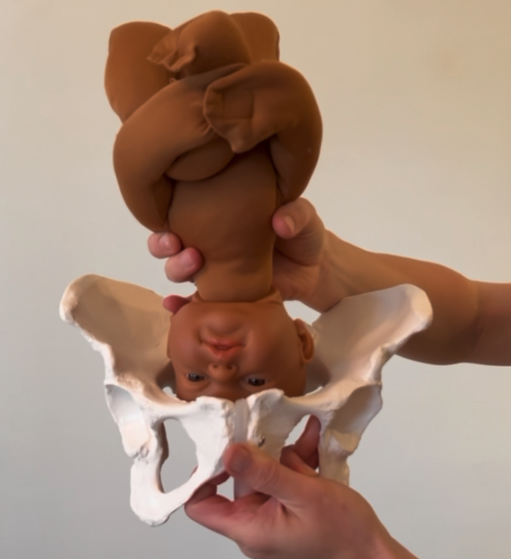
Lo:So the most common reason for back labor is related to your baby's position, and specifically it's related to a baby being occiput posterior.
Lo:So if you are able to or you're really curious about this, I want you to hit pause and jump onto the YouTube video of this episode and watch instead 'cause I'm gonna show y'all what I'm talking about a little bit when I talk about this baby's positioning thing too, and you can see it on the video.
Lo:But in general, if back labor is related to baby's position often, then we're talking about where baby is at inside of your body and how that is going to impact the pain that you're feeling.
Lo:So ideally, we have babies coming down the front of our body and their back, baby's back, would be along your front.
Lo:This is going to be an occiput anterior position, and what that occiput is referring to is the back of your baby's head.
Lo:So that's their occiput, and that anterior is referring to you, your body.
Lo:And so we have a occiput anterior baby.
Lo:It means baby's occiput is along your anterior.
Lo:Back labor is often associated with an occiput posterior baby, and so what we have is, again, the baby's occiput, that's the back of their head, is along your posterior.
Lo:And so if you're just visualizing this right now while you're listening, you can just picture baby coming down through the body, their head down, right?
Lo:We're saying their head down at this point.
Lo:And if they're occiput posterior, their eyes are, like, looking out Of your belly button, right?
Lo:They're coming down, and you can, like, see their face.
Lo:Versus what would be ideal, what we would prefer, is a occiput anterior baby, and so if they were to be able to look straight out of your body, they're basically, like, looking out your back because the back of their head is along the front of your body.
Lo:So we also call an occiput posterior baby, you might hear this vocabulary, a sunny-side up baby, and that's kind of common, like, let's say labor slang.
Lo:And so sometimes you might hear a nurse say, "Oh, it seems like her baby is sunny side up," something like that, and what they mean is your baby is occiput posterior.
Lo:Now, if baby is occiput posterior, or OP, we'll say that from here on out, OP, then what this means is that their head, again, 'cause their head, their occiput, is along the back of your body.
Lo:So their head is kind of like pressing on your spine.
Lo:Or if you think about that, that track or that pathway, we talk about this a lot inside my birth courses, this idea of if they're the passenger and you're the passageway, these are some of the P's of labor.
Lo:The passenger, the back of their head, is coming down your passageway, and the back of their head is pressing on your spine and on your tailbone, right?
Lo:Whereas if they were flipped around, it would be their face essentially pressing on those things, but not this hard, firm surface like their back.
Lo:And so if baby's head is pressing on your spine and your tailbone while they're coming down through the birth canal, potentially even delivering, 'cause yes, people have babies OP all the time when they come out vaginally.
Lo:So if you're delivering that way, there's going to be a lot of extra pressure and pain for a lot of people along the back as baby kind of makes their way through that passageway, as that passenger, again, makes their way through the passageway.
Lo:There are a couple other things that could cause back labor as well.
Lo:This is not the only thing, but it is the biggest thing, and so it's what we talk about the most, and then we can kind of be proactive about the most.
Lo:But a couple other things like your pelvic shape or your pelvic tilt, some of these things you don't even know and maybe you will never actually know, but it could impact labor.
Lo:Sometimes having, like, a shorter torso or certain anatomy differences just affects the way the baby can kind of lie in there and present in there.
Lo:Spinal issues like scoliosis could possibly cause some issues 'cause it's obviously changing your back, and so it might change the way the baby can come down and through as well.
Lo:But again, the most common issue is this idea of baby being positioned in a funky way.
Lo:Asynclitic is a term that we use often to describe a baby who's in there, like, a little crooked or I, I like to say a little wonky.
Lo:So an OP baby or maybe even one that's just in there a little bit off, maybe this can cause this different type of labor where you're feeling it more in your back.
Lo:So what does back labor feel like?
Lo:I know I kind of just broadly said, "Oh, it's pain that's felt in your back," but I think when people describe back labor- They use words that have a lot of intensity, like this idea of it will not let up.
Lo:It was so intense.
Lo:I never expected it to feel like this.
Lo:It's almost this surprise because it isn't a period cramp, you know, exponential.
Lo:Like so many people describe that typical labor, it's different, and often you don't get that letup or that release or that wave-like feeling.
Lo:So those ideas that we have in our head of what labor might feel like, back labor can present really differently than that.
Lo:And so I think it can be this, this almost a shock of, "I just did not realize it could feel like that."
Lo:And for a lot of people, sometimes there's also that, " I was not prepared for that." Or a lot of my students, they're coming back with baby two, and they're joining the birth course, and they're saying like, "What do I do about back labor?
Lo:Because I had that last time.
Lo:It was horrible." Maybe they didn't want an epidural or something like that, and they're saying, "I had to tap out so early.
Lo:Like, what do we do this time to avoid that?" So I think that that's a really good general summary of what it feels like, of just this idea of it's unexpected.
Lo:You're not maybe necessarily prepared for that because it's not that typical labor idea that we have.
Lo:Yay, right?
Lo:This sounds a little bit freaky, and you're probably sitting there going, " I don't wanna have this.
Lo:What do I do about this?" And this is why this is talked about so much online. If you're paying attention or you're online, you hear this OP baby and what to do about OP babies and how to avoid back labor, and, "Oh my gosh, back labor was hard.
Lo:Here's what you do." And you're hearing a lot about this because it can be a challenge.
Lo:But you can get through this with certain supports.
Lo:You can get through this with certain strategies, and as you'll come to find out, we know that babies, like, continue to move through labor, right?
Lo:So this isn't this end all to be all, your doom type thing, and, and you are not allowed to walk away from this episode feeling that way, okay?
Lo:So that's the big mental shift that I want you to be making right now, is that you can do something about this right now if you're pregnant and you're in your third tri and you're starting to prep, and you can continue to be proactive about it during labor.
Lo:And then I s- mentioned this once when we started as well, but babies are born vaginally with that OP positioning all the time.
Lo:I saw plenty of them come out that way, okay?
Lo:So this, again, is not a reason to think, "I'm not going to be able to do this if we go into labor, and I know my baby is, is OP right now." Okay.
Lo:So back labor can cause some extra challenges to the labor process.
Lo:So we've talked mostly about pain, right?
Lo:Like, oh, you're gonna feel it differently.
Lo:There's this intensity or this lack of relief between contractions, different things that can kinda coincide with back labor.
Lo:Often, a malpositioned baby or this OP baby or maybe just- Saying, "Oh, I have back labor," in general, what that often all can mean is that you could have a longer labor or labor stalls, you know, where you're moving along, then all of a sudden things stall out, and maybe it's a couple hours, just no progress is being made, something like that.
Lo:You can have funky contraction patterns, and I know I've already mentioned that idea of you feel like there's no relief and things aren't letting up, right?
Lo:So specifically, that vocabulary would be you could have coupling or even tripling, which is this idea of you're having two contractions back to back with no break between, or three contractions even.
Lo:Every once in a while, I've seen the tripling as well because, again, we've talked about this wave-like pattern of typical labor, and often with back labor and OP baby, we can have this coupling or tripling, which is you don't have as much of that wave, like the up, down, break, up, down, break, and what you have is, like, kind of an up, a mini decrease for a second, and, like, right back into another contraction and then a break.
Lo:And so you get what feels like, "Why am I having, you know, a three-minute contraction? There's just no break," and it can be because you are coupling.
Lo:And again, that's typically or often related to this OP malpositioned baby inside.
Lo:So I know I already mentioned, you know, that's why we talk about this so much because of its impact on labor patterns, its impact on pushing, back labor.
Lo:Funky positioned babies can also lead to, a longer second stage, which is your pushing stage.
Lo:Some point from when you hit 10 centimeters to when baby is born, that is your pushing stage, right?
Lo:At some point, you're often pushing in there I say often 'cause, you know, fetal ejection reflex, sometimes babies can come right out on their own without you pushing.
Lo:But typically, you're going to be pushing in there at some point, right?
Lo:And so all of that, again, we've talked about, ugh, it can be more painful.
Lo:Ugh, it can cause this labor patterns that we don't want, right?
Lo:And so I wanna transition all of that into this idea of empowerment, right?
Lo:So you're not stuck with it.
Lo:Now let's talk about what we can do with it to avoid maybe extra pain for you, and also these labor patterns or these contraction patterns that ideally we would not want.
Lo:So what do we do about back labor?
Lo:And this is kind of broken down in this idea of, what do we do when we're pregnant, and what can you do right now if you're pregnant?
Lo:What can you do during labor, and then, like, some specific tools and stuff, okay?
Lo:So this is the, the apply, the apply section, right?
Lo:Where if you were able to take notes or you're not driving or you're not busy with your hands doing other things, so you're like, "Okay, here's some things that I wanna think about."
Lo:So first we wanna talk about before labor, what are some of the best things you can do to kind of set yourself up?
Lo:And again, I want you to transition your brain a little bit from thinking about, how do I avoid back labor?
Lo:We're gonna actually say, " What do I do about my baby's positioning?" Because so much of back labor is really related to baby's positioning, and so this is all about your baby's positioning.
Lo:And the thought is, if we can get this baby in a better position, then the other things are going to follow.
Lo:Ideally, like a more typical labor pattern.
Lo:The baby's gonna rotate.
Lo:Ideally, we're not having maybe a stall 'cause they're crooked, all of that.
Lo:So instead of saying, "How do we avoid back labor?" We're gonna say, " Okay, it's probably most likely we avoid it with a better positioned baby, so how do I get a better positioned baby?"
Lo:So that's where we're coming at this from.
Speaker:Hey friend, quick pause for just a second.
Speaker:If you are listening to this podcast because you wanna feel more prepared, more confident, and less freaked out about birth, that is exactly why I created the Your Body Your Birth course.
Speaker:This birth course will not tell you what kind of birth you should want, and nobody has the right to do that.
Speaker:It is about helping you understand what's happening in your body, what your options actually are, and how to walk into your birth feeling grounded, excited, ready, instead of overwhelmed and scared.
Speaker:When you have education like this, everything changes: your mindset, your conversations with your care team, and the birth experience itself.
Speaker:No more relying on random opinions, okay?
Speaker:Stop scrolling.
Speaker:Take intentional action with me and start trusting your body, your voice, and your decisions today.
Speaker:Head over to www.thelabormama.com/birth, also linked in your show notes, and be sure to use the code podcast at checkout to save 20% and start working towards this better birth for you right now.
Speaker:Okay, let's get you back to the episode
Lo:So before labor, the big thing, and I say this a lot on social media, and we deep dive all of this in the Your Body Your Birth course, is this idea of optimal fetal positioning.
Lo:This is the thing for me that you are not allowed to take away from me in my labor prep.
Lo:And I, I'll talk about it on social media posts.
Lo:You can have the dates and you can have the pineapple or you can take away the sex or any of the things that are, I'm gonna say air quotes, "supposed to help us get into labor" or help our bodies get ready.
Lo:You could take them from me.
Lo:I wouldn't fight you on them too much.
Lo:But you cannot take my optimal fetal positioning exercises because I feel like an ideally positioned baby or a better positioned baby, even if they're not perfect, is just always a plus for you when you go into your labor, right?
Lo:And so we're talking about gentle movement habits, and stretches, and specific patterns and things that you can do later in your pregnancy.
Lo:Yes, you can run this by your provider when you're 30 weeks and say, "Hey, I'm gonna start doing, you know, optimal fetal positioning exercises," or 34 weeks or whatever.
Lo:But get really intentional about it.
Lo:Make sure.
Lo:But for most of us, this is all very appropriate and something that we can be doing.
Lo:And so it's these movement habits, these, not ideas of thoughts, but just this awareness of your body as you move through pregnancy, understanding what we just talked about, right?
Lo:Which is that the baby's back, we want it to be along the front of your body, right?
Lo:That's gonna lead to more of that occiput anterior position baby.
Lo:Your baby's back is the heaviest part of their body.
Lo:So what does that mean for you as you move through your day?
Lo:How can you focus on what your body is doing, how you're sitting, how you're walking, intentional stretches, things like that, to make space for them as well, but to encourage your baby's back to be on your front or to stay on your front.
Lo:That's kind of the goal pre-pregnancy.
Lo:And so if the question then is, " Okay, what do you mean?
Lo:Like, how do I apply this?
Lo:That sounds great," we're talking about gravity here, right?
Lo:And so if, again, the baby's back is the heaviest part of your body, then you are going to want to, let's say even sitting in your car, okay?
Lo:I'm sitting here recording this podcast and my body is naturally changing the way I'm sitting to, to, to show you this.
Lo:So my YouTubers, you guys are seeing this, right?
Lo:But it's this idea of instead of slouching back in a chair or slouching back in your driver's seat, kind of open your knees a little bit.
Lo:Get your hips kind of back behind you where your belly is more in front, where you are more, it's, we call it tailor sitting sometimes, where you're more upright and so you're almost more not hanging, right?
Lo:'Cause we're, we're seated, right?
Lo:But your belly is in front of you.
Lo:And I like to say if there was a flashlight, from, coming from your belly button and pointing straight out, this flashlight should be pointed straight out or oriented down toward the floor.
Lo:This, in general, means you are just in a better position to encourage your baby to be in a better position, just as you move through your day.
Lo:So we're not talking about an intentional stretch or exercise, we're just talking about you being thoughtful about it.
Lo:So if you're watching a movie, and you're on the couch, and you're slouched back, and you're eating your favorite ice cream, because we've all been there, right?
Lo:I would say not to be panicky or stressed about it all the time, but I would tell you if I'm 37 weeks, you're not going to find me slouched back on the couch.
Lo:You're gonna find me laying on my side with my belly kind of almost rotated over and resting on the couch.
Lo:Or you're gonna find me like sitting on the floor, maybe with my back against the couch so that the belly again is forward, and I'm, like, maybe hanging just- A little bit, if you think about it.
Lo:Or that flashlight that I just mentioned, that idea of that flashlight coming off my belly button would be pointed down toward the ground.
Lo:So these are just ways that I encourage my students or encourage people, move through the day like this at the end of your pregnancy.
Lo:Basic things that you can do.
Lo:And then of course, and we're gonna get into more specifics too, but there are specific stretches that we can do, like stretching your psoas muscles, ways to make space in your lower uterine s- segment, if you will, or like that space down deep below your belly where you're making space so that your baby can rotate if they want to.
Lo:Or if you're laying on your side at night, like many of us are while you're sleeping, that there's space for the baby to wanna rotate if they're not actually in that ideal position yet.
Lo:So just these different things that you can do prenatally are going to encourage your baby to want to be in an OA position, okay?
Lo:And we're gonna get into some more specifics, so just hang with me for just a sec. So moving into this idea of what about during labor, this is such a huge place to bring in the birth partner, right?
Lo:Because they are going to be very helpful when it comes to that back labor that might be occurring because of this funky positioned baby, right?
Lo:' Cause a lot of the stuff we need is support or help for that part of our body that's hurting the most, which is our lower back, right?
Lo:And so in labor, things to think about if you're having back labor, again, this is pretty general and broad, and we're gonna get more specific in a second.
Lo:But hands and knees positioning, right?
Lo:Anything that lets that belly hang, making space, and getting any additional pressure off your back.
Lo:' Cause we talked about you're getting a lot of extra pressure 'cause your baby's head is coming down your spine and your tailbone if they are OP, right?
Lo:So we wanna get off the back, so staying upright, leaning forward, swaying, things like that.
Lo:Hands and knees positioning or maybe kneeling and your arms are on the back of the bed if you had an epidural.
Lo:Or maybe you're on the, on the floor, and then your arms, if you think about it, are like rested on your birth partner's lap or over the couch in the room or wherever you are.
Lo:Things like that to get some pressure off of your back.
Lo:Leaning forward over a birth ball, I love that one as well.
Lo:We mentioned like couch or bed, knowing you can utilize that labor bed and have it become a place where you're, you're gonna do a lot of leaning, right?
Lo:' Cause we're trying to get off, get so much pressure off of that back.
Lo:Movement is going to always, and this is gonna be true for any labor, right?
Lo:Back labor or not, is always going to be better than laying, than staying still, right?
Lo:Movement equals motion.
Lo:That baby is moving if you're moving.
Lo:Your pelvis is moving if you're moving.
Lo:That allows the baby to move.
Lo:Like any type of movement is always going to be a good thing.
Lo:So when you are able to with that back labor Changing positions.
Lo:You don't have to change every contraction, right?
Lo:But trying to change, trying to find new things to help.
Lo:Utilizing, again, that gravity that we've been talking about, both for the baby to descend, certainly when you're standing-- like, if you were standing upright or sitting upright.
Lo:But again, that gravity and the idea of their back being able to swing to your front or stay to your front, and positions that are really going to encourage that and give them space to rotate if they have not, and you are in labor, and we know they're still not in this ideal position that we love so much.
Lo:So specific techniques for relief, specifically we're talking about in labor as well, is this is where that counterpressure, hip squeezes, that birth partner that I mentioned, like, this is where they can really come into play here because they are going to need to be hands-on to try and support this process, right?
Lo:If your back is sore, counterpressure, which is that kind of hard pressure pushing right against that lower back, maybe with the heel of their hand or a tennis ball or a massage tool or simply just doing massage in that area, this is something that they can do.
Lo:This is an easy birth partner job, right?
Lo:Easy in terms of not that complicated.
Lo:If they're doing it for hours, it actually can be really tiring for them too.
Lo:But definitely something that can help for you.
Lo:Heat on the lower back can feel really good.
Lo:Water and that weightlessness of the water as well as the warmth and heat of the water.
Lo:Water can feel really good.
Lo:One thing I love for my back laborers is to put a birthing ball, like the big yoga ball, in a shower stall, then sit on that legs wide, you know, things to encourage descent and rotation, and then the heat of the shower on your back, right?
Lo:So you're getting, like, a lot of different things going on at once to alleviate back pain and also to encourage that baby to rotate as well.
Lo:The TENS unit might be helpful in early back labor.
Lo:I would say earlier it's going to be more effective.
Lo:This isn't impossible that the TENS unit will be super effective in later labor, particularly back labor, but I found that most people find it the most helpful in early labor.
Lo:So something like a TENS unit, particularly, like, if you're at home or maybe, you know, induction just got started and things are happening and you're feeling it but we're not eight, nine, ten centimeters, something like that.
Lo:And then, sterile water injections as well.
Lo:That was the other one.
Lo:Not every hospital offers it.
Lo:Some people are just not interested in these.
Lo:But because those injections go right in those four areas on the back We can talk about this more in another episode 'cause kind of a funky little labor tool that's available for some, for some of us.
Lo:Some people love it, some people hate it.
Lo:It's a whole conversation.
Lo:But there's these injections that go right in your lower back, and so if you like this and this is effective for you, this can be a really cool way to kind of help with back labor and really target that area where you're having a lot of pain.
Lo:So those are some kind of specific back labor-focused things to think about as you kind of manage back labor during your labor if you find that you're having it or you find that you're coupling or you're tripling or you're not getting that rest.
Lo:Now, are there other things that go into this conversation?
Lo:Of course, right?
Lo:You can expand this out to this big, broad conversation about contraction rituals, more medical pain management tools as well, like an epidural, IV pain meds, you know, other things to take the edge off or maybe to more or less completely eliminate this pain.
Lo:I would say I don't like saying epidurals ever completely eliminate labor pain.
Lo:I like to say it gets you down to a two out of 10 if you're a 10 out of 10, something like that.
Lo:But there are other tools as well.
Lo:But when we're thinking about it early in labor or before you want an epidural, if you don't want one at all, well, then we wanna think, " How do we get pressure off the back?
Lo:How can someone push against my back?
Lo:Are there pain management tools that actively work at the back?" Right?
Lo:Because this is the area where our baby is, where that baby's head is, and the one where we're really kind of breathing through, where we're feeling labor, which is going to be there along the back.
Lo:I know I mentioned prenatally, I wanted to give you a few more specifics about maybe prepping in-- before labor has started, right?
Lo:One thing that can be really helpful for encouraging optimal fetal positioning is the Miles Circuit, if you haven't heard of that one.
Lo:Talk about this in the birth class as well, but essentially it's this three-- these three parts of this circuit that a lot of people do typically after 40 weeks or so of pregnancy.
Lo:Like, this is not something that is recommended to be done right when you hit 37 weeks or something.
Lo:' Cause really it's about getting baby really ready for labor when labor is ready to start, right?
Lo:Which is going to be, for most people, closer to, like, 40 or 41 weeks.
Lo:Like, 40 and 5 days is actually when most first-timers go into labor.
Lo:That's the average, right?
Lo:So we don't need to really be pushing it really hard earlier, thinking we need to be stressed all the time about doing this circuit every day.
Lo:But the Miles Circuit can be really helpful prenatally and then actually in early labor as well.
Lo:And essentially, this circuit has you kind of focus on, like, shifting the baby, giving them space to rotate, and then you do some asymmetrical movements like curb walking and then to, like, get them engaged back down into the pelvis where you want them to be.
Lo:So it can be really helpful in early labor as well.
Lo:And again, because it's giving baby space to move and shift and rotate, that's where it comes in this conversation as well, because we're thinking, "Do we have a malpositioned baby right now? Is that why I'm experiencing back labor?" Rebozo can be really helpful.
Lo:Particularly, that's where we use this kind of long Scarf or shawl.
Lo:There's also an actual traditional rebozo kind of shawl-type material as well, and these can be used to, like, lift the belly, almost like those belly lifts if you know about it, where you can just do that with your hands or your birth partner could do it from behind and kind of ease some of what's going on in your back.
Lo:So the rebozo can be really valuable for some back labor.
Lo:Fire hydrant positioning, which is a certain type where you kind of get your leg up on, like, a peanut ball, fi- like a dog peeing on a fire hydrant.
Lo:That's exactly what it looks like.
Lo:And again, we're trying to make space and give baby space to move.
Lo:The certain ways you walk and move through your labor, right, being upright and the swaying and what we're talking about, like that leaning forward and the, the hip circling or the figure eights on a birth ball, these ways where we're shifting and rotating and moving during labor as well to give baby space to rotate, right?
Lo:And so we have these tools to manage how back labor might feel, and then we have these tools to also encourage this baby to continue to rotate.
Lo:And I said this once, but I'll just say it one more time.
Lo:Babies can and do move up until the moment of labor, and then they can continue to move during labor.
Lo:So babies rotate all the time.
Lo:So do not get to a point where you think, " What's the point?" Like, "I'm just gonna lay here," or, "I'm just gonna stop trying because baby is clearly OP and that's where they wanna be." Continue to move 'cause movement is always a blessing both to your body and to baby's positioning.
Lo:So try not to let that feeling of, " I just can't budge this baby" kind of override what I would say is the necessity to keep moving, keep trying things, keep creating space for that baby to come down.
Lo:And then I would want you to know that back labor itself doesn't mean you failed at any sort of prenatal optimal fetal positioning exercises or some sort of failure on your body's part.
Lo:We see back labor a lot, and I think a lot of it has to do with our lifestyles as we move towards our labors, right?
Lo:Because a lot of us have these sedentary jobs and we sit and it's hard to think about all day long, oh, how am I sitting?
Lo:How am I moving?
Lo:And that can honestly feel stressful.
Lo:And you will also find me say, hey, some days just like eat that ice cream and just chill.
Lo:You know, it's hard to kind of live a more sedentary or work maybe more sedentary job or certain types of things or certain types of days.
Lo:Focus on this, also relax and also be always doing, you know, the quote unquote right thing.
Lo:There's no failure here right now.
Lo:Babies are OP sometimes, babies are asynclitic sometimes, and we do what we can prenatally.
Lo:And then when we do what we can in labor, because we can understand what's going on.
Lo:And that was my goal for you here is there's nothing going wrong, right?
Lo:You haven't done anything wrong.
Lo:If you're in labor, there's nothing going wrong.
Lo:And now you can understand, okay, anatomically, I know what's going on.
Lo:Okay.
Lo:I know that my baby's probably in their funky or I know why I'm having these coupling contractions, or I know why my back hurts so bad right now and I want something to fix it.
Lo:And then now you can say, also, here's some things that might help me.
Lo:And also here's some moves that might help turn my baby too.
Lo:And so it's just this idea of tools and steps that you can take knowing and having this knowledge now.
Lo:So not this idea of failure or you screwed something up, none of that.
Lo:So ultimately it's idea back labor is real a hundred percent.
Lo:It is, it can be really intense.
Lo:It can be something that we would all prefer not to have, or to, you know, choose not to begin labor with that baby position that way that is going to lead to back labor, right?
Lo:We can say, yes, all of those things are true, but we also can labor with it.
Lo:We can also enter into labor with a funky position.
Lo:We can also handle it.
Lo:We can also push babies out in this position.
Lo:There's a lot of, yeah, you can also do this type thing.
Lo:So ultimately I wanted you guys to have tools about this.
Lo:I wanted you to know there were options about this, and I wanted you to know that you can work with your baby and yes, they are always working in there to try and support you in this.
Lo:And that too is a whole conversation about the cardinal movements and what they're trying to do and how they're trying to support you.
Lo:But the two of you, yes, always can be working together throughout the pregnancy and that end of kind of prenatal process to get you guys into the best place and then throughout your labor as well.
:Thank you so much for listening to the Lo and Behold podcast.
:I hope there was something for you in today's episode that made you think, made you laugh, or made you feel seen.
:For show notes and links to the resources, freebies, or discount codes mentioned in this episode, please head over to loandbeholdpodcast.com.
:If you aren't following along yet, make sure to tap subscribe or follow in your podcast app so we can keep hanging out together.
:And if you haven't heard it yet today, you're doing a really good job.
:A little reminder for you before you go, opinions shared by guests of this show are their own and do not always reflect those of myself and the Labor Mama platform.
:Additionally, the information you hear on this podcast or that you receive via any linked resources should not be considered medical advice.
:Please see our full disclaimer at the link in your show notes.