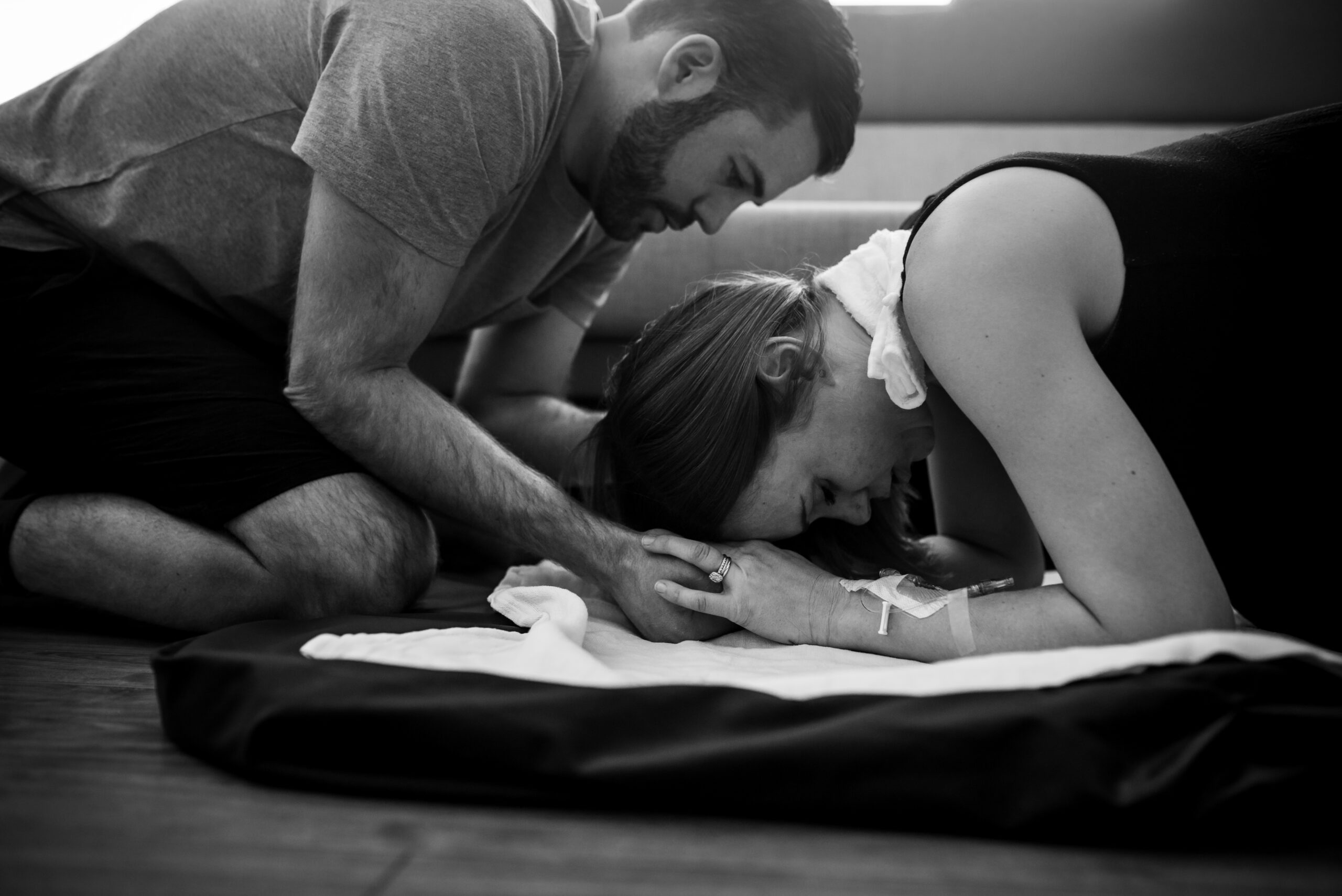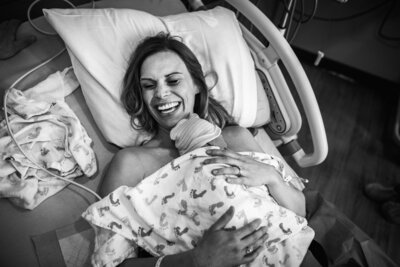


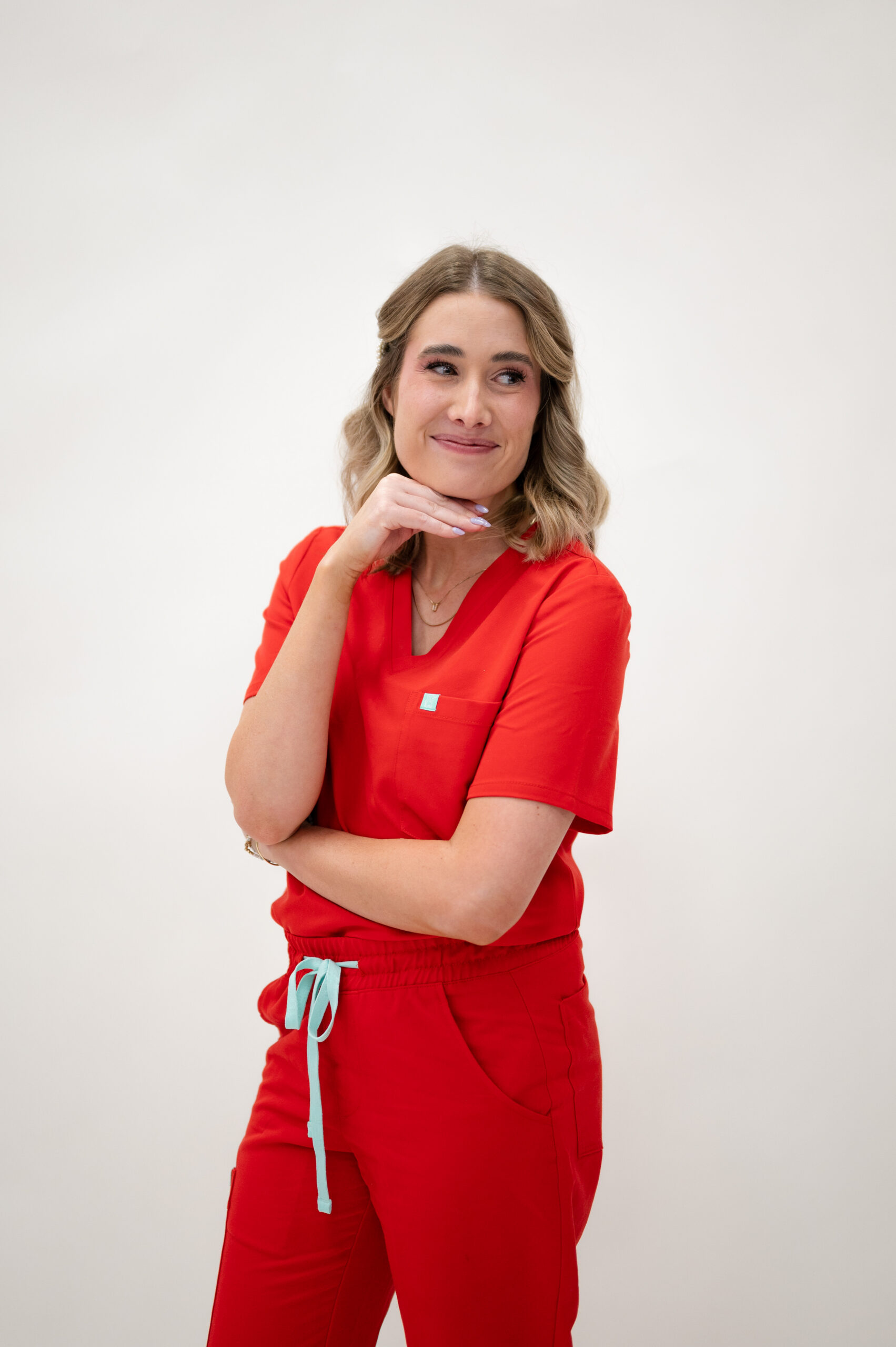


I sat down with Kara the Baby Nurse and it felt like the real postpartum prep chat every new mom needs. We talked about what her real 12-hour mother-baby shifts actually look like – all the assessments, the nonstop education, how she and her team fight to protect your sleep with those do-not-disturb signs and clustering care – because rest really is medicine for your body and your brain. We got into breastfeeding support, what surprises people the most in those fresh postpartum hours, and how clustering care lets you actually get some rest instead of constant interruptions.
Kara also opens up about her own postpartum – she was so prepped for labor and delivery, but had zero prep for what came after, and it was rough. Engorgement, going back to work at six weeks, feeling totally blindsided… it’s why she pours so much into her content now. Her biggest key takeaway: prepare for postpartum like you prepare for birth, advocate for your rest, and know that your mother-baby nurse is in your corner more than you realize. This episode is packed with real talk, practical tips, and so much heart – I hope it leaves you feeling seen and way more ready.
More from Kara the Baby Nurse:
Follow her on Instagram, TikTok, & YouTube: @karathebabynurse
Checkout Afterglow: A Postpartum Recovery & Wellness Class
Helpful timestamps:
- 00:00 Postpartum Prep Matters
- 01:36 Meet Kara Baby Nurse
- 04:44 Her Nursing Path
- 07:52 Postpartum Story Goes Viral
- 14:39 What Mom Baby Nurses Do
- 20:39 Breastfeeding Support Team
- 28:36 What Clustering Care Means
- 33:16 Postpartum Care Surprises
- 36:38 Bring All The Things
- 39:48 Home With Baby Reality
- 40:13 Prepare For Postpartum
- 45:59 Where To Find Kara
About your host:
🩺🤰🏻Lo Mansfield, MSN, RNC-OB, CLC is a registered nurse, mama of 4, and a birth, baby, and motherhood enthusiast. She is both the host of the Lo & Behold podcast and the founder of The Labor Mama.
For more education, support and “me too” from Lo, please visit her website and check out her online courses and digital guides for birth, breastfeeding, and postpartum/newborns. You can also follow @thelabormama and @loandbehold_thepodcast on Instagram and join her email list here.
For more pregnancy, birth, postpartum and motherhood conversation each week, be sure to subscribe to The Lo & Behold podcast on Apple Podcasts, Spotify, or wherever you prefer to listen!
👉🏼 A request: If this episode meant something to you, would you consider a 5 star rating and leaving us a review? Yes, we read them, and yes, they help keep L & B going! ♥️
Connect with Lo more on: INSTAGRAM | TIK TOK | PINTEREST | FACEBOOK
Disclaimer
Opinions shared by guests of this show are their own, and do not always reflect those of The Labor Mama platform. Additionally, the information you hear on this podcast or that you receive via any linked resources should not be considered medical advice. Please see our full disclaimer here.
Additionally, we may make a small commission from some of the links shared with you. Please know, this comes at no additional cost to you, supports our small biz, and is a way for us to share brands and products with you that we genuinely love.
Produced and Edited by Vaden Podcast Services
Transcript
I would say that she is a queen of the mom, baby postpartum world.
:Online.
:I was super prepared for labor and delivery, but no preparation for postpartum.
:Please prepare for postpartum just as much as you would.
:Labor and delivery.
:Motherhood is all consuming.
:Having babies, nursing, feeling the fear of loving someone that much, and there's this baby on your chest, and boom, your entire life has changed.
:It's a privilege of being your child's safest space and watching your heart walk around outside of your body.
:The truth is.
:I can be having the best time being a mom one minute, and then the next, I'm questioning all my life choices.
:I'm Lo Mansfield, your host of the Lo and Behold podcast, mama of four Littles, former labor and postpartum RN, CLC, and your new best friend in the messy middle space of all the choices you are making in pregnancy, birth, and motherhood.
:If there is one thing I know after years of delivering babies at the bedside and then having, and now raising those four of my own, it is that there is no such thing as a best way to do any of this.
:And we're leaning into that truth here with the mix of real life and what the textbook says, expert Insights and practical applications.
:Each week we're making our way towards stories that we participate in, stories that we are honest about, and stories that are ours.
:This is the lo and behold podcast.
Lo:I am really excited to share this conversation, but I know I say that every time I have a guess, but it's true.
Lo:I have Kara with me from Kara, the baby nurse, so I'm gonna guess you've heard of her.
Lo:If you haven't, you have, now you're going to, again, especially if you're in this like baby having season, she is a mom baby nurse.
Lo:She's a mom of three of her own.
Lo:And she's a hospital-based nurse for eight years as well, so she's still practicing at the bedside, which we'll get into a little bit too.
Lo:She loves educating patients about patient respect and advocacy.
Lo:She's on all the social media platforms.
Lo:We will share those with you guys too.
Lo:And she does like to throw a little bit of humor in her education, which I love.
Lo:You're not gonna get like this really rote make teaching.
Lo:Nothing wrong with that.
Lo:But she definitely dashes in who she is and all the real stuff too.
Lo:She is kind, she is empathetic.
Lo:You will see, all of that come across the page and I think you will feel it and hear it in our conversation today too.
Lo:So
Kara:let's get into it.
Lo:Today's guest is someone that I am sure that you have heard of, and if you haven't, well then I'm glad that you have now because I would say that she is a. Queen of the mom, baby, postpartum world, online.
Lo:Just
Kara:sweet.
Kara:Have
Lo:I have Kara with me.
Lo:Better known as Kara, the baby nurse.
Lo:I'm gonna let her introduce herself and then we'll get into our combo.
Kara:Oh, hey, thanks for having me.
Kara:Hey guys.
Kara:I'm Kara, as.
Kara:We already established.
Kara:I'm Kara, the baby nurse.
Kara:You can find me on all the platforms.
Kara:So YouTube, TikTok, Facebook, Instagram, and I do kind of content about everything.
Kara:I talk about labor and delivery, pregnancy, postpartum, child rearing, potty training, sleep training called things, star Wars and I'm a mom.
Kara:Star Wars.
Kara:Yeah.
Lo:Just sometimes
Kara:my other, just my other little random things that I like.
Kara:But yeah, I have three kids.
Kara:They're seven, five, and three.
Kara:So, and I work still bedside at the hospital, so I'm still a working nurse.
Kara:And then, yeah, so that's.
Kara:That's who I'm,
Lo:that's perfect.
Lo:I was just thinking in my head.
Lo:I got to interview Sarah, labor Nurse Junkie as well.
Lo:Oh yeah.
Lo:Who's obviously a best friend of yours and I think I called her the queen of the labor and birth world.
Lo:So now that's like two, two intros of two queens coming up for you guys.
Kara:Oh my gosh.
Kara:Well, that, that's like a high bar, for me to try and, like,
Lo:she's pretty great.
Lo:Well, I, I mean, you obviously are aware of this.
Lo:Maybe not everyone listening, but.
Lo:Kara is kind of a little crew of four people, not some sort of specific members.
Lo:Only thing on birth talk on Instagram and, and I'm sorry, on TikTok and Instagram, I guess technically.
Lo:Oh,
Kara:well you're part of it too.
Kara:Everyone is.
Kara:We say, we kind of say that.
Kara:We're like, I don't even know who started that.
Kara:But I'm like, everyone is in birth talk, like everyone who does content in, in the birth world, like we're all one big family.
Kara:So it's not an exclusive
Lo:thing.
Lo:KARA THE BABY NURSE NEEDS DESCRIPT AND ASSETS: I've
Lo:seen you say that to someone.
Lo:No, I don't want you guys to think it's an exclusive thing, but it has been fun to talk to, all of you guys and also know that you have relationships, you know, like offline as well.
Lo:'cause I think there's a weird parasocial thing that goes on between any educator online and those offline, but then also the friendships and relationships that develop from like, I guess I'll say like creator to creator.
Lo:I just think it's cool.
Lo:Mm-hmm.
Lo:Yeah.
Kara:That is sweet.
Kara:Yes.
Lo:Okay.
Lo:So I wanna jump into, I know you do educate about everything, and I thought this would be kind of a fun question to just clarify for us.
Lo:Mm-hmm.
Lo:You're in mom baby nursing.
Lo:I was curious if you ever did l and d or if your hospital does LDRP or.
Lo:How'd you land specifically in mom?
Lo:Baby for your bedside?
Kara:Yeah.
Lo:Work.
Kara:Yeah, that's a great question.
Kara:No, I do not.
Kara:I'm not on an LDRP unit.
Kara:It's a split unit.
Kara:It's a pretty big hospital, so, labor and delivery is one floor.
Kara:And then I'm on Mother Baby a whole separate other floor.
Kara:I'm also cross trained with the nicu, so I do float there.
Kara:Actually, I work there more than I do mother, baby, which is funny, but that's just 'cause I'm prn so I float.
Kara:It's like always my turn to float when I work.
Kara:But I also sometimes do float to, we have a high risk labor and delivery floor as well, but that floor gets, if there's a patient who's had a loss or any high risk postpartums or.
Kara:Sometimes GYN surgery people, so I can take those patients as well.
Kara:No one who's like actually pregnant with a baby.
Kara:So I'm not trained in any kind of like fetal monitoring or anything like that.
Kara:Not like you, but yes, anyone whose baby has come out of them I can take care of, so,
Lo:yeah.
Kara:Yeah,
Lo:I like, I like the question I did LDRP where you get to do all of it, but we definitely had nurses who were like.
Lo:Do not give me mom, baby.
Lo:Give me the, you know, the charge.
Lo:The charge nurse started to know personalities of certain nurses, and it was like,
Lo:technically we all had to be trained to do anything and step into any room and take Yeah, but take care of whoever.
Lo:But there were definitely some people who ended up mostly being mom, baby.
Lo:Definitely Some people who you.
Lo:I like.
Lo:What's your favorite?
Lo:This sounds cheesy.
Lo:I really like all of it, and that's one of the things I'm most grateful for because I'm not at the bedside anymore.
Lo:But I feel like when I was there, I got to do all of it because I listen to you teach about something and I just think, oh, I like loved that part, or, oh, that part was really hard.
Lo:Like the mom baby, you get more hands on with the baby and no, it's not like you're holding a baby all day.
Lo:But you get to spend time with that family in a different way.
Lo:Mm-hmm.
Lo:Because labor is absolutely so intense in another way.
Lo:Like they're not here yet.
Lo:Everyone's really worried.
Lo:About different things.
Lo:Mm-hmm.
Lo:And so I just think they're just, they both give you access to these families and then the baby and that care in a really different way.
Lo:So I feel like it kind of depended on my mood sometimes even.
Lo:And how, I don't know, like if I felt really relational in one way or the other, like how much time at the bedside, maybe that meant you would, I don't know.
Lo:I think it changed for me.
Lo:I do love.
Lo:Mm-hmm.
Lo:The thrill of actually delivering the baby.
Lo:Like, I'm not gonna pretend that, like that moment will never, ever, ever lose.
Lo:Its Lester.
Lo:I really love delivering someone and then getting to be their postpartum nurse.
Lo:So that to me is a dream.
Lo:So you just do all of it.
Lo:And when you come back the next day you could say, Hey, can I do mom, baby, and can I take 'em back?
Lo:And so that's really cool.
Lo:So I feel like patients, that's awesome.
Lo:Who I got to do like from admin to discharge for two or three shifts is, is kind of, those are like the patients that I almost remember the most.
Lo:'cause you got to do the whole thing with them.
Lo:It's pretty cool.
Kara:That's, that is really sweet.
Lo:Yeah.
Lo:Okay.
Lo:So were you working when you were.
Lo:Pregnant, I'm assuming?
Lo:Yes.
Lo:'cause I know the ages were kids now.
Lo:Oh yeah.
Lo:Were you mom, baby nursing.
Lo:And did that, I mean, how did those two things, your postpartum experiences play mm-hmm.
Lo:Into kind of what you're doing now?
Lo:And did that make you show up online 'cause you thought, hey, we need to for X, Y, Z reasons how that worked?
Kara:Yeah.
Kara:So, okay.
Kara:So I literally found out I was pregnant right before I took the nclex.
Kara:So I graduated in December,:Kara:And then I got pregnant like literally the day after I graduated.
Kara:Yeah,
Lo:you did.
Kara:Which I didn't, I didn't really, I didn't really anticipate it would happen that quickly.
Kara:So that was, but that's on me.
Kara:, on, on like New Year's Day,:Kara:And so that was my first job was in oncology.
Kara:So I did like, it was like med surg oncology.
Kara:And so like literally the first nine months of my pregnancy was my first nine months of my job and it was all med surg and I actually did, I liked, there was a lot of things I liked about it.
Kara:I love oncology patients, but it also wasn't where I always knew I wanted to be for sure.
Kara:So then I had my baby at the hospital where I worked, and I was like, oh my gosh, I need to be here.
Kara:I was like, get me over here now.
Kara:I went back to work six weeks later, which was awful.
Kara:I was still bleeding.
Kara:I mean, that's a whole other story, like maternity leave and how bad it is and everything.
Kara:But yeah, my postpartum experience was honestly like.
Kara:My postpartum recovery at home and just being postpartum was honestly awful.
Kara:Which kind of did end up later how I got into content creation.
Kara:But anyways, so I knew I wanted to be in Mother Baby after I'd had my baby there 'cause I was treated like an absolute queen.
Kara:And people are like, well that's just because you worked there.
Kara:And honestly, no, no one knew that I worked there.
Kara:I didn't tell anyone I was a nurse.
Kara:I think someone did figure it out later, but I never told anyone I didn't wanna be treated differently or anything.
Kara:I was like, I'm just a patient.
Kara:But I was literally treated like an, an angel, like a queen.
Kara:Everyone took amazing care of me.
Kara:I had to work another like seven or eight months in med surg before I eventually could move over into Mother Baby.
Kara:And so I was in MedSurg for about a year and a half, and then I eventually.
Kara:moved over to Mother Baby and I've been there ever since.
Kara:So I've worked, I've been a nurse at the hospital for like exactly eight years now.
Kara:I just hit my eight year anniversary, so I've been in Mother Baby now for like, like whatever.
Kara:So eight, eight minus one and a half, whatever that is, six and a half, whatever.
Kara:So I've been in Mother Baby that long and yeah, that was part of the reason why I, wanted to do content.
Kara:It, it kind of happened by accident.
Kara:I was goofing around on TikTok making videos, and then randomly a video went viral about how I had to go to work in a snowstorm, and was still breastfeeding my second child at the time.
Kara:ne was asking me, it was like:Kara:So people were like, what's the policy right now with this and what's going on with that?
Kara:And like, when I come into the hospital, am I allowed to bring this?
Kara:And I was like, oh my gosh.
Kara:There's so many questions that people have and I was like, I mean, I just had never really thought, I was like, oh, there's already plenty of people already making like videos about this.
Kara:But then I was like, what's stopping me?
Kara:Like why don't I just do it too?
Kara:So then I started making videos, and I look back at the, for early ones and they're so bad, but
Lo:you're not supposed to look back at them.
Kara:They're so cringey.
Kara:I've just been going full force ever since, and I just was doing TikTok.
Kara:I did TikTok for like two years exclusively, and then I was like, I need to be on other places in case TikTok disappear.
Kara:So then I started my Instagram maybe two years ago I think, and then, and then Facebook and YouTube and everything else kind of happened.
Kara:So, but yeah, that, yeah.
Kara:I just wanted to start educating people.
Kara:What about you?
Kara:When did you get started and how'd you do it?
Lo:You're so funny.
Lo:You keep asking me the same questions back.
Lo:Well, I was gonna say, I, I think it's interesting how many people, like around our age, you're a little bit younger than me, but have such a similar story of almost falling into this.
Lo:Because these online platforms exist and they were really, I think, kind of starting to grow.
Lo:ilar to you where it was like:Lo:And I thought if I share this stuff online, maybe someone would wanna listen.
Lo:Like why?
Lo:Why can't I do it too?
Lo:And for me it was just almost more of an outlet of I love all of this so much and I'm home with these two kids and it was still coy.
Lo:And so it was just like, how do I still, if I talk, maybe I'll just throw it online and talk about the things I love and see if anyone wants to listen.
Lo:And it was like, oh, people do.
Lo:And so there was no, that doesn't sound great, like business wise, there was no intention or something behind it.
Lo:It was just like, I really love talking about
Kara:this, but that's probably, that's probably why it did well or does well because it's like you just genuinely.
Kara:You're not trying to like go into it as a business.
Kara:You're like, I just, and feel passionately about it.
Kara:And that comes across to people
Lo:and I think that's almost the hardest part of sometimes is like, oh, well if you're gonna spend that much time doing something, how does it, you know, serve you or serve your family?
Lo:But there's also the, like, I always joke like q and As and my Instagram stories, I could do them for four hours and waste an entire, I just love answering questions like you're saying.
Lo:Everyone's like, Hey, you know, how do I. I don't know, bring my colostrum to the hospital or whatever.
Lo:It's like you should have an answer for that.
Lo:Like why would we, and so I think I do love the really specific ability to just like on TikTok or Instagram now too, how you can answer the question that someone leaves as a comment and it's like, well, that's easy.
Lo:I can just answer that really quickly.
Lo:So I just think, yeah, it's interesting how so many of us just thought, I have all this information.
Lo:I think it could help someone.
Lo:And then things have, you know, grown from there in whatever way, depending on who you're talking about.
Lo:Yeah.
Lo:It's, it's not like some, I think now maybe some creators are, I've heard that, younger children, not younger children, let's say high schoolers, like one of the primary jobs a lot of these kids want is content creators.
Lo:So it's this like thought process of, that will be my career or that will be my job.
Lo:Mm-hmm.
Lo:And maybe this is how I'm gonna do it.
Lo:And I think a lot of us who started these last, let's say five, six years or so, it was almost the opposite.
Lo:Yeah.
Lo:Like, huh.
Lo:Content creation.
Lo:I could teach about this stuff, and then it becomes a career or a part of your career.
Lo:So just, yeah.
Lo:Yeah, just cool to look back, I'm sure 10, 15 years from now, anyone who's a content creator might actually have a little bit more of like, I intentionally stepped into this space and I had a plan for how I would show up.
Lo:Instead of it maybe being quite as organic.
Kara:Right.
Kara:True.
Lo:Okay.
Lo:So when it comes to the nurse stuff, the mom baby stuff, why don't you do a quick rundown that's is really simple of.
Lo:What kind of you do in like your 12 hour shift or how you're serving your moms mm-hmm.
Lo:And their families and these babies.
Lo:So kind of, this is the kind of care I provide, like a what to expect in your postpartum hours.
Lo:And I know that could change if they're four hours fresh versus 36.
Lo:A general idea,
Kara:like just kind of go over like what a typical day looks like for me?
Kara:Yeah.
Kara:Or more
Lo:like a,
Kara:for the patient,
Lo:I would say like a typical 12 hour shift.
Lo:The kind of care that you're providing for mm-hmm.
Lo:Your patients.
Kara:Okay.
Kara:Yeah.
Kara:So usually we have three couplets, so three mom, three babies.
Kara:So when I get onto my shift.
Kara:Of course we're like doing an assessment on everybody that's assessment's on mom and baby and then usually the people that I know when I are discharging.
Kara:So like we just try to wrap up everything for them.
Kara:So that's something I don't know if people.
Kara:I really realize how much control I don't have over that.
Kara:It's so up to like when the doctor's round, so your doctor has to see you and your baby every day before you can discharge.
Kara:I dunno if it's different where you work, but they have to be assessed the day that they leave.
Kara:So even they'll be like, oh
Lo:my, it's the same.
Lo:And I'll, I'll, I'll interrupt and just affirm what she just said.
Lo:You guys, it is so out of the nurse's hands when you can.
Lo:Leave because they have to be rounded on and then the orders have to be put in and maybe they're being like lazy or slow about that from the office or something.
Lo:So yeah, they have to be seen every day.
Lo:And so even day of discharge, even if they were seen at like 6:00 PM the night before, because it was late night before, they still have to be seen that morning before they go home.
Kara:Which I know is very frustrating, but that's usually how it's, and it's just for your safety because they wanna make sure things change even in a very short time.
Kara:So they just wanna make sure everyone's safe before they go.
Kara:But anyway, so usually the people who are discharging, I'm kind of like, my priority is like making sure they get out of there if they're like antsy to get out there.
Kara:but it's a lot of like.
Kara:Just making sure things are done.
Kara:So assessments are done, vitals are done.
Kara:It's very tasky task oriented.
Kara:So make sure their hearing screen gets done, lactation has seen them, or I'm helping them with lactation stuff.
Kara:If they need like donor milk to go home, like I'm facilitating that happening.
Kara:A lot like, I mean, postpartum and mother, baby in general.
Kara:It's like 99% of the job is education, so I'm doing tons of talking and educating to my patients.
Kara:All day long.
Kara:Like if we're in the bathroom and I'm getting somebody up, like I'm helping them do their peri care and stuff, I'm like explaining to them why we're doing it, what it everything does.
Kara:How even when I'm like, okay, for the next six weeks, like yada yada, like I kind of go ahead and give them their.
Kara:I'm kind of putting in the discharge education as I'm teaching them stuff while they're there too.
Kara:So it's not like a bombardment of education when they leave.
Kara:But I'll go ahead and be like, you know, no tampons, no sex, no nothing for six weeks.
Kara:Like I kind of go ahead and go over the spiel.
Kara:So it's just a lot of like talking during, just my whole shift of educating, educating about the baby, about normal skin stuff or not, or how to, like literally something as basic as like changing a diaper from like more complicated stuff.
Kara:Like maybe we have a baby who.
Kara:Has like a unique feeding issue or something and we're trying to like troubleshoot that.
Kara:So it's just a lot of education, but I really like, honestly, I love that.
Kara:I think that's probably why I am okay making videos.
Kara:Like you answered questions all day too, because I love being able to do that.
Kara:But yeah, giving Babies Bath, doing labs, lab work.
Kara:It's very busy.
Kara:I feel like people say postpartum is like where people will joke.
Kara:Like it's where nurses go to die and I'm like, bro, it's, there's days it is.
Kara:It's insane.
Kara:Like it's so busy.
Kara:And we also just got a new charting system at my hospital that literally went live on the 15th, and I don't work again until next week.
Kara:And.
Kara:So my first shift, I go back, we're having an all brand new charting system for everyone.
Kara:And I'm like, I literally don't know what I'm gonna be walking into.
Kara:'cause I've been talking to all my friends and stuff who are, who've been working and they're like, it's awful.
Kara:Like, great.
Kara:So I'm gonna be, having to figure that out.
Kara:And I don't even know how to discharge someone yet.
Kara:Like I didn't, we had a class, like we had to do all this online training.
Kara:In person training.
Kara:So anyways, charting is a big part of our job too.
Kara:And I'm not gonna really know how to do that the next day that I go back to work.
Kara:But anyways, that's that.
Lo:I remember doing the switchover from what we were on to Epic.
Lo:I don't know what you guys are switching too, but I know a lot of people are aware of Epic and it was,
Lo:KARA THE BABY NURSE NEEDS DESCRIPT AND ASSETS: I
Kara:like Epic.
Kara:Yeah,
Lo:it was.
Lo:Yeah, it is so not fun even because even when you get efficient, guaranteed there's gonna be care providers around you or like physicians.
Lo:Mm-hmm.
Lo:Maybe sometimes the older ones, and I'm stereotyping, but like, they are so angry 'cause they can't put in like a discharge order.
Lo:so you're kind of then managing yourself and then maybe the providers around you and it's just, yeah, it's a, it's a special time on a hospital unit I think.
Kara:Yeah.
Lo:Not very fun.
Kara:I kind of am like, it's maybe good and bad that I wasn't there this last week as it went live, but all my friends have been like, I am like gonna explode.
Kara:This gets so bad.
Kara:Like, because it changed for everyone.
Kara:It wasn't just the nurses.
Kara:So yeah, same like you're mentioning, it's like.
Kara:It changed for the doctors and stuff too, for everybody.
Kara:So no one knows where anything is.
Kara:Like we can't find it.
Kara:So anyways, it'll be okay.
Kara:We'll get we'll.
Kara:We'll, eventually It's
Lo:gonna be great.
Lo:It's gonna be great.
Lo:Your patients will never know because you guys are such good professionals.
Kara:I hope so.
Kara:I just feel bad though.
Kara:I'm like, I hope it's not gonna slow people down.
Kara:And us trying to provide good care was just like, be patient.
Kara:We'll figure it out.
Lo:I know, because there is that little bit of like.
Lo:Hey, I know you wanna go home.
Lo:We have a new charting system, and they're like, I don't care.
Lo:I would like to go home with my baby.
Kara:I know.
Lo:I, I respect that and send me home.
Kara:Yeah, for sure.
Lo:When you mentioned, um, breastfeeding, uh, support as well, what do you feel like that looks like for patients?
Lo:Like how much support they're getting from a post, and this probably depends on facility, but how much support they're getting from their mom, baby nurse versus the lc or the I-B-C-L-C that maybe that hospital offers, because I know you do a ton of education, so how does that look like for them with the other professionals around too?
Kara:Yeah, my hospital doesn't have any lactation coverage at night, so for sure on they leave usually around like four or 5:00 PM So for sure I'm doing a lot the late, the last couple hours of my shift when they're not there.
Kara:And then night shift has to do a lot too, but, I'm on day shift, at my hospital, we have to spend quite a bit of time doing education with lactation.
Kara:So we have to spend a day like one or two.
Kara:When you first get hired, you spend I think two days just shadowing lactation.
Kara:So you just follow them and they just like pour so much knowledge into you.
Kara:And then we also have to do yearly, training with the lactation consultants at my job.
Kara:So, I feel like my hospital does a really good job of like really making sure we're pretty educated on everything.
Kara:So I would say like, if it's a complicated thing and my patient's like, can you, I need help with this, I'll try to help them first.
Kara:If I'm, if I'm just in there like, and I have time, I will like help them.
Kara:So anything simple from just like, they just need their baby to latch and I'm just kind of helping them with like positioning and stuff.
Kara:You know, say Maybe like, we're trying to kinda work on, mom has like flatter nipples.
Kara:Like I'm kind of, we're assessing like, do we need to bring like a nipple shield into this?
Kara:Do we just need to do some pumping?
Kara:What do we kind of look, let's kind of like figure this out.
Kara:Is it just like maybe your nipples are more flat right now from some edema.
Kara:We're just trying to, are, are you engorged, like we'll try to troubleshoot all that.
Kara:We can do a lot, like, I feel like just me, like nurse or like nurses and the patient.
Kara:But if.
Kara:Start to get into more complicated stuff where I'm having issues, I'll be like, let me, lemme phone a friend.
Kara:So, and then, I mean, I love lactation consultants because they're miracle workers.
Kara:And even like having my own kids, like you'd think I know, you'd think I know everything.
Kara:And it's like, no, in each baby is so different too.
Kara:Like my first was a very easy like.
Kara:No issues breastfeed or literally could just latch yourself easy.
Kara:But then my second baby, even though I had all this experience, breastfeeding an easy baby, and then worked then and mother baby, my second was like very difficult and I still needed so much help from lactation, even being a mother, baby nurse.
Kara:So yeah, I would say that's kind of like.
Kara:Typical how it is for a hospital, but some places have lactation 24 7.
Kara:They have on at night, on night shift.
Kara:Some don't have as much coverage, and so then it might be more of the nurses.
Kara:So I just feel like it's very hospital dependent.
Lo:It makes me think of that idea sometimes of in labor where the patient might not understand how much the nurse can do too.
Lo:But yes, there is a professional, I'm gonna say above talking about like the IBCC or the md. You're right.
Lo:So you get this kind of like, Hey, let me, let me help you first.
Lo:I actually have a lot of skills on X, Y, Z. You know, when maybe that's in birth, they're like, oh, is the doctor gonna come back and check my cervix?
Lo:And you're like, oh, I can do that.
Lo:Right.
Lo:Like, I don't, we don't have to go directly to, let's say the top.
Lo:I think it's helpful to know that for birth and then also for postpartum too.
Lo:And in this breastfeeding conversation specifically, 'cause we were similar, all trained for a few days, with that lc or I-B-C-L-C only when we started continued education, we didn't have someone at night.
Lo:So very similar to what you just described.
Lo:Hmm.
Lo:Okay.
Lo:And so just the understanding of like, Hey, that postpartum nurse.
Lo:Very likely an excellent breastfeeding resource.
Lo:They're probably going to try and help you first, and then, yes, we're also going to call, you know, the, we'll say more qualified professional.
Lo:Mm-hmm.
Lo:Too.
Lo:And so I think it's good for patients to know that there's a couple different places you can get help and that yes, you can always ask to see that I-B-C-L-C every shift or whatever, but Right.
Lo:Like I just remember shifts where.
Lo:We'd have, I don't know, 12 moms trying to discharge before 1:00 PM and that I-B-C-L-C maybe is trying to see all of them before they go.
Lo:It's like you might get a, a. You know, a quick 10 minutes with them, but they also have to like see every patient being discharged or going home.
Lo:And so, yeah, I guess I'm saying for a patient to, to ideally, fingers crossed you get a mom baby nurse who is interested in helping you breastfeed.
Lo:'cause I know that's not always true and some of you're probably thinking mind did not wanna help me at all.
Lo:And that you then also know, utilize them and also ask for additional help too.
Lo:Just make use of, yeah.
Lo:All of what's available to you in that regard.
Kara:For sure.
Lo:So tell me about in the postpartum care you talked about, I've seen you talk about this online as well.
Lo:Tell, let's talk about, the idea of grouping care, keeping people out, getting sleep, like what's your little spiel on.
Lo:Patients being able to get sleep and how they can kind of advocate for that when they're postpartum.
Kara:Yeah, absolutely.
Kara:That is a huge passion of mine.
Kara:well, we know that clustering care is like evidence-based.
Kara:The research shows it makes nurses like report higher levels of like less, well, I don't, I don't even know how to describe it.
Kara:They feel less like stressed and less burned out.
Kara:When we cluster care better, it provides Greater happiness for our patients, but also keeps them safer.
Kara:I think it like reduces length of stay.
Kara:It's like crazy.
Kara:The research on it is very strong.
Kara:So, I don't know what your hospital policy is, but in labor you're obviously gonna be a lot close, like more monitored.
Kara:There's gonna be a lot more people in there in more frequent checks, but at least for postpartum, where I work, I always apologize.
Kara:I'm like, okay, the first four hours when you get to postpartum.
Kara:We're gonna be in here a little bit more.
Kara:We come in every hour for four hours, and then after that our policy is rounding or kind of checking on you about every two hours.
Kara:However, with that said, if you want to, if you are sleeping, I will not wake you up.
Kara:Or if you wanna decline that, like if it's nighttime, I don't really know what night shift does.
Kara:I know that they'll let people obviously sleep longer, uninterrupted, but, on day shift, I'll be like, you know, if we wanna put a sign, we have do not disturb signs that we, we have it flipped backwards on everyone's door with a magnet, and if they want us to flip it over, we can.
Kara:That says, don't like, don't disturb.
Kara:Mom is sleeping.
Kara:But then it says at the bottom, like, please see nurse.
Kara:If you need something.
Kara:So if that sign is up, then usually like doctors or lab will still go in there because they got things to do that they need to do at a specific time.
Kara:But if it's like a wic person, if it's a hearing screener, if it's food and nutrition, if it's a hearing, did I say hearing screen?
Kara:I don't know if it's somebody who's like, doesn't absolutely need to go in there that moment and they can come back.
Kara:They'll just like.
Kara:They'll come back, they'll circle back another time.
Kara:So I feel like that is really beneficial, for like limiting interactions.
Kara:And yeah, I just tell my patients that like, Hey, if you need to sleep, like we know sleep is important for healing, like rest and sleep, good quality sleep is important for your body healing and for your mental health.
Kara:So like.
Kara:You know, if you need to sleep, just tell me and I will flip your sign over and I will like, try to keep people out as best I can.
Kara:I'll do my best.
Kara:I can't guarantee it, but yeah, I just try to like really make that happen.
Kara:'cause I think it's super important and yeah, just advocate for yourself.
Kara:If you're like, I need, I need to sleep.
Kara:Like, please tell your nurses that like, because some people will be mad, they'll be like, I didn't get any sleep.
Kara:And like, and I know sometimes people just come in there and bother you so much, but sometimes newer nurses or nurses who are just like, really, like particular about.
Kara:That can be hard and I feel like you need, sometimes you need to like relax a little bit and just be like, you know, hey, like they need to sleep.
Kara:You know?
Kara:I don't necessarily need to go in there at this specific time and bother them.
Kara:Like, so if you have a nurse that's kind of bothering you a lot, don't feel bad to ask and be like, Hey, do you mind, like, you know, give me like an X amount of time to really get some sleep and try to not come in here.
Kara:So.
Kara:That's totally valid.
Lo:Will you really quickly kind of define what you mean by clustering care, just in case people don't know what you actually mean or
Kara:Oh,
Lo:yeah.
Lo:Or how that plays in with the sleep conversation.
Kara:Oh yeah, absolutely.
Kara:Yeah, clustering care is like, so for example, if you need to go, let's say that you have a, vital signs.
Kara:We usually do 'em every four hours.
Kara:, so let's say it's:Kara:Like a birth certificate or something.
Kara:So instead of going in there at 10, when I think about that, like, oh, I wanna go get that done.
Kara:I'd be like, you know what, actually I know, I know I need to go in there at 12 anyway for vital signs, so I'm just gonna wait and I'll just cluster everything I need to do then.
Kara:And I'm like, oh, what else do, and I'm just thinking ahead, like, what else do I need to ask her?
Kara:Well, I'm in there like, you know, when was the last time baby ate and didn't have, they had any pees or poops?
Kara:And I'm kind of just like.
Kara:I'll usually write it on my paper, like little things I need to check off to ask them.
Kara:So just trying to think about all the things I need to do so I can just do it all at once, and so I'm bothering them all at one time and not like spreading out all of the interactions, if that makes sense.
Lo:Yeah, that's perfect because in theory you guys.
Lo:a stool softener available at:Lo:Mm-hmm.
Lo:Technically, if you did something exactly when it was due, could look like that for patients.
Lo:And so this idea of, you know, we have the nurse has kind of like ambiguity around when a medicine.
Lo:Most medicines, not every medicine, but like when they, you can give a medicine, right?
Lo:So you can have your stool softener, you know, an hour earlier than it's scheduled, or an hour af you can have any time after.
Lo:But, this idea of the nurse being able to do that for you guys and then you can get that sleep.
Lo:So if you're saying, Hey, I really want sleep, I think it's nice for you guys to understand that.
Lo:That then means they're gonna come in all at once.
Lo:then truly like not come back in Unless you call them.
Lo:Unless you call, yeah.
Lo:Right.
Lo:Because sometimes I think there's the idea of they didn't come in for three hours, like they don't fully know that that might be the goal.
Lo:And I'm sure like Kara would be saying, all right, I'm not gonna come back in until 1:00 PM unless you call me.
Lo:Right?
Lo:Like that education is gonna happen.
Lo:But just knowing that that really does mean they, you're not coming in for the next feed or whatever and trying.
Lo:You know, if you needed a medication, you'd probably need to call and let them know.
Lo:'cause they're, the assumption is like
Kara:mm-hmm.
Lo:We're gonna leave you alone so you guys can, all
Kara:right.
Lo:Take a nap or have some time.
Lo:So
Kara:that's perfect.
Kara:And you're, you're, you're right.
Kara:Your nurse should be communicating that like, call me if you need me, because I know people online a lot will.
Kara:Say that like no one checked on me all night or didn't, and like I'm like, I'm sorry that happened.
Kara:Like, I feel bad if you like, really did need your nurse and you didn't wanna be a bother.
Kara:And so you're like, I didn't call them, but you're like, I wanted them to check on me, like I needed help.
Kara:And like no one came.
Kara:So like, please don't feel bad if you're like.
Kara:If you're like, no one's checking on me, you truly need us.
Kara:Like, please, like, don't feel bad to call.
Kara:That's what the call light's for.
Kara:Like that's okay.
Kara:Like you can call us, you know, like, nursing is a 24 7 job, so absolutely feel the need to call.
Kara:'Cause they're not, maybe not trying to be nefarious, like maybe they think you're sleeping, they don't think you need anything, so they're trying to give you a space or whatever.
Kara:So anyways.
Lo:I did, no, I did work nights my first couple years before I gloriously got to switch to days.
Lo:I did not like working nights.
Lo:It's not good for my personality.
Lo:But I think that happens a lot more at nights.
Lo:That idea of like, I'm not gonna go in there unless.
Lo:You know, they call out for me.
Lo:And so that, that kind of, they didn't check on me the whole time type vibe might happen a little more night.
Lo:I would say, like you said, again, not nefarious, but it's just like, we just assumed, you know, you were sleeping and so if there's kind of mm-hmm.
Lo:Crap, crappy communication between you and nurse.
Lo:Which typically I would say is a little bit their fault.
Lo:'cause they should let you know what the plan is for the night.
Kara:Yeah, that
Lo:is true.
Lo:Yeah.
Lo:That, that can happen where you feel a little abandoned and the nurse is thinking like, man, they must be sleeping great.
Lo:Or whatever.
Lo:Yeah.
Lo:So definitely speak up like Kara said, and, and use that call light and ask for what you need, even if you had made the plan.
Lo:To not need them for three hours.
Lo:Who cares?
Lo:Like if you change your mind, you need help breastfeeding, then call.
Lo:And that's like the nurse knows they're still very much available for you.
Kara:I always say that when I'm leaving, I'm like, do you need anything?
Kara:And they're like, no.
Kara:And I'm like, okay, well then I'll, I'll say like, I'll be back.
Kara:I'll try to be back on all like the even hours.
Kara:So I'll come back at like 10 and I say, but once I leave, if you change your mind in five minutes and you need me again.
Kara:Just call me.
Lo:No, it's true.
Lo:That's, it's like you said, it's 24 7.
Lo:It's not like you write in all these little two hour breaks for yourself.
Lo:If they might not need you, like you're still right there doing whatever with ing, probably you're probably charting, but anyways.
Kara:Yeah, absolutely.
Lo:Okay, so all of this type of care is kind of the things that you are doing.
Lo:What are some things that you would say.
Lo:Let's say a little fresher, right?
Lo:So you receive them from l and d and then you're caring for them for these next 12 hours or 24.
Lo:What are some things you think that maybe most surprise people or your patients that they're maybe most uneducated about?
Lo:Or just, yeah, the things that you would wanna make sure people are aware that they might walk through in those fresh mm-hmm.
Lo:Fresh times.
Kara:Yeah.
Kara:That's a great question.
Kara:For C-sections for sure.
Kara:I don't think they realize.
Kara:Like the peri care involved, I think they just think, oh, it's all stomach related, so I'm not gonna have anything to do down here.
Kara:But we get up our C-sections, like, well, they can get up whenever they want.
Kara:So if they're like two hours post C-section, if they wanna get up, we can for sure.
Kara:We usually wait until after the fourth, bundle, check the last one, and then we get them up.
Kara:We go to the bathroom, we change their pad, change everything.
Kara:If you pushed prior to the C-section, like you still might have swelling, but you're still gonna have bleeding.
Kara:So people are like, oh, I won't have any bleeding, if I have a C-section, but you're still gonna have bleeding from your vagina because your majority of your bleeding is coming from where your placenta came away from the uterus.
Kara:So you're still gonna have some bleeding.
Kara:So that surprises a lot of people.
Kara:So I still show them how to do the whole care thing.
Kara:With vaginal deliveries, what surprises people the most?
Kara:I think it probably still would be like a lot of peri care or just like, especially if they had a tear or swelling, just like some of the discomfort down there.
Kara:I don't think people, you really don't know what it feels like or what you're going through until it's happening.
Kara:And I just want people to know about all of the tools and things that we have to help with that.
Kara:So it's like.
Kara:We have the per care or the spray, the lidocaine spray.
Kara:We have the witch hazel pads, we have ice packs.
Kara:And this could depend on your hospital, so I don't wanna make a promise like, oh, your hospital will have all of this.
Kara:It's like.
Kara:If you're, if you're like, not quite sure, like you can always call your hospital and ask them, or if you take a tour, ask cover, takes you on the tour, or just bring it yourself if you like, really feel strongly about it.
Kara:But, I would say like 99% of hospitals are gonna have that basic stuff.
Kara:I would say if it's important to you to like, bring your own.
Kara:Depends underwear, because I didn't mind the hospital underwear, but sometimes I don't, we don't have a size that fits people correctly, so that can be very frustrating.
Kara:So yeah, just that.
Kara:And then I think, I don't think people also realize just like you have like a lot of adrenaline, like at first, so even if you're so tired and you've been up in labor for days, it can be hard to sleep like the first.
Kara:Day can, you're just so, and you're so excited to be with your baby and you just wanna hold them and just soak it up.
Kara:So that first day is just really hard to sleep, I feel like.
Kara:But yeah, you know, like the next night or two if you, I don't know, however long you stay, just like try to get the sleep if you can, you know, prioritize the clustering care.
Kara:Ask your nurse to limit.
Kara:If at all possible so you can try to sleep, bring a sound machine, bring an eye mask for whatever you use to sleep.
Kara:I always say bring your stuff that you would want at home.
Kara:Like if you were like going on a little girl's trip for like a couple days, like what things would you bring with you?
Kara:Are you someone who likes to have your own blanket and your own pillow?
Kara:Then like, bring it to the hospital.
Kara:Like you can still bring all those same things, your com, your home comfort, so whatever you need to sleep.
Kara:So yeah.
Lo:Aren't you someone who also, I feel like I've seen this, you've shared this, or someone has replied to you about it.
Lo:You're more like, bring whatever you want.
Lo:Stop this whole like minimalism.
Lo:Like you guys are excessive.
Lo:Like if you think you're gonna need it and it's gonna make you feel good, just bring it.
Lo:And I think that's helpful to say though, because sometimes I think we get this idea of like, oh, I don't wanna come in.
Lo:And the nurses are.
Lo:I don't know, maybe laughing 'cause I brought so much stuff or whatever.
Lo:Like
Kara:yeah, who cares.
Lo:Yeah, what you said is true and I think especially postpartum, like if it means you're gonna sleep a little bit or feel better when you're showering or something, that's so valuable right now.
Lo:Yeah.
Lo:In these fresh hours
Kara:it act, it pisses me off so much when I see people complain about like, they're like, Hey Brett, that like, I would say like.
Kara:99% of nurses like really don't care what you bring.
Kara:Like we don't.
Kara:And if they do, then like, that's dumb because I'm like, who cares?
Kara:Like does it stopping me from doing my job?
Kara:I literally don't care what you bring.
Kara:Like no one is judging you.
Kara:And if they do, then that, that's silly.
Kara:Like I've had people bring, I've had people bring like the most like craziest, like so much stuff.
Kara:I've had people bring frock pot.
Kara:I've had people bring.
Kara:Their own coffeemaker from home.
Kara:Like I've had people bring like,
Kara:I've had like one parent, like this one girl, I think she was like some kind of influencer or something, so they brought all these ring lights and like camera equipment, like all of this elaborate equipment to like do a whole photo shoot.
Kara:And I was like, girl, yeah.
Kara:Like hell yeah.
Kara:Like I don't care.
Kara:You know?
Kara:Like I just want you to be comfortable and happy, so do whatever.
Lo:Well, and it's not your birth or your postpartum, right?
Lo:It's theirs.
Lo:Exactly.
Lo:Whatever the crockpot.
Lo:That's hilarious.
Lo:But I actually really love that.
Lo:'cause I'm just thinking even culturally there were certain patients who their mamas were providing like this really specific food that Absolutely they, you know, eat after birth.
Lo:And so sometimes there was like a really specific way that food.
Lo:Needed to be prepared and shared and given, and so, yeah, I just don't know that there really are, I mean, there aren't boundaries.
Lo:I don't know that we should even really put them around because
Kara:mm-hmm.
Lo:What we want need.
Lo:After is obviously going to be incredibly different.
Lo:I did have a patient once, absolutely, and it was only one time, and for some reason it just shocked me.
Lo:And now I think, oh, that's so thoughtful.
Lo:They brought the stroller up into the room and I thought, oh, why?
Lo:Like, why would you bring your stroller?
Lo:But it ended up being.
Lo:Great because they filled up the stroller with all this stuff and that's like what they used to get.
Lo:Oh
Kara:yeah.
Lo:You know, 'cause we were, you know, it's just like you just have to go upstairs down the elevator into your car.
Lo:And I was like, why do you have your stroller?
Lo:You don't need your stroller in my head.
Lo:I promise I didn't say that to them out loud.
Lo:And then thought, oh, what a great way to get all of your stuff down your car.
Lo:So
Kara:that's that Actually funny.
Kara:I have, I have lots of people bring their strollers actually.
Kara:I feel like.
Kara:Yeah.
Kara:But maybe when did you, when did you leave bedside?
Lo:Oh gosh, what year was it?
Lo:20 20 17. So I think that might be more common now.
Kara:Yeah, probably because now I feel like a lot of people have like the douna or like ones that like
Lo:do all the things
Kara:and stuff.
Kara:They're like
Lo:everything.
Lo:Yeah.
Lo:Yeah.
Kara:So yeah, maybe that's why I see them more, if that makes sense.
Kara:Yeah,
Lo:no, it does make sense.
Lo:Yeah.
Lo:Okay.
Lo:So that's kind of some surprising stuff immediately, maybe at the hospital.
Lo:The last thing I wanted to ask you, and this might come from your own personal experience, being a mom and having baby at home, is anything that kind of really surprised you?
Lo:The first couple of.
Lo:Stay at home when it's just, all right, we're home with this baby.
Lo:And, you know, piggybacking on that, any kind of education, support, encouragement for whatever.
Lo:Yeah.
Lo:Whatever you're gonna
Kara:share.
Kara:I, I love that question.
Kara:Yes.
Kara:I was so not prepared for postpartum, which is another big reason why I am online doing content, but I was super prepared for labor and delivery.
Kara:So like I had a doula.
Kara:I did so much.
Kara:Prep for my body and like mentally for my labor with my, well, for all of them, but especially my first, I did so much preparing and then like had a really great birth.
Kara:Everything went so well and then I came home and it was like, oh.
Kara:I literally did not even think, I just thought I'll come home and just have a cute baby.
Kara:The end like, I dunno, I dunno what was going on in my brain, but no preparation for postpartum.
Kara:s also kind of before, it was:Kara:It was no like reels.
Kara:So it was just like pictures and it was just people sharing cute pictures of their baby.
Kara:The end.
Kara:So, there's no education on like.
Kara:Like you never saw like, oh, peri care stuff, like anything.
Kara:So like the whole, like making a peri care basket, like that was not even a concept I'd heard of.
Kara:So I got home and I literally had no peri care stuff.
Kara:I didn't buy anything for postpartum.
Kara:So I got home and I think one of the big things was my milk coming in.
Kara:So I had really, I was really engorged and painful.
Kara:I had nothing for that, like just nothing.
Kara:So I felt very let down.
Kara:I felt very, I was kind of angry at like some of my friends and my sister who'd had babies.
Kara:I was like, why did, literally no one tell me this is terrible.
Kara:Like, and I'm not, to not to say like, you're gonna have a bad experience.
Kara:'cause of them my second and third were great because then I was prepared.
Kara:So I was just really mad at a lot of people because I felt like I got let down.
Kara:So, I kind of had bad.
Kara:Postpartum depression.
Kara:And then it was also the winter and like I didn't really, I wasn't getting any sleep and it was went back to work work
Lo:at six weeks
Kara:back.
Kara:I mean, that's a whole
Lo:other thing.
Kara:Yeah, that's a whole other story.
Kara:And then like, I didn't really know how to advocate for what I needed.
Kara:My husband really didn't know like anything either, which, you know, now he's.
Kara:Awesome.
Kara:But it was like, he didn't know.
Kara:And then there was something else I was gonna say.
Kara:Oh, like the, just like the lack or like the not being able to just do what I wanted anymore, like when I wanted to do it.
Kara:I don't even think I real, like, thought of that concept before.
Kara:Like I was like, oh, I can't just like leave the house, like whenever I want to willy-nilly and like just go meet up with a friend or just go get food or whatever.
Kara:My life is now revolving around someone else.
Kara:And that was really hard, like to just mentally be like, who am I now?
Kara:But anyway, so all I would say is like, please prepare for postpartum just as much as you would labor and delivery.
Kara:And I have a video I made like on YouTube.
Kara:It's, I think it's like 25 minutes.
Kara:And it's literally just like a crash course, like.
Kara:If you do nothing else, at least watch this video that is just like, let's prepare you.
Kara:Like here's all the things to have at home.
Kara:Here's how to prepare yourself mentally.
Kara:Here's how to the people around you.
Kara:Prepare them to tell them how to care for you and take care of your, you, your partner.
Kara:So to make sure that they're on board and know how to support you, here's when you need to seek help.
Kara:And just kind of like a mentally and physically preparation thing.
Kara:So if anything, at least go watch that on my YouTube, because that's just a short and sweet thing.
Kara:But yeah, I would say that was the biggest struggle and that was really hard.
Lo:I think the going home thing is always interesting because there's, I do think there's this bit of like, you don't know until you know, right?
Lo:Mm. And so.
Lo:The wisdom that you mentioned, like that you pulled forward with baby two or three or four is so, so valuable.
Lo:But we don't have to think that we can't be prepared or be ready because it's our first time and we just have to like go through fire and that's, that's how.
Lo:Mm-hmm.
Lo:How.
Lo:This all works.
Lo:And so I think there's this funky balance of educating and preparing is so valuable.
Lo:And I would affirm like everything you said, like specifically engorgement, that first time I was like, no one ever, this is, is this what my patients were going through?
Lo:Like, this is nuts because I'd been bedside, right?
Lo:it's like, oh, they'll feel warm or get hard.
Lo:And it was like, oh.
Lo:I was not educating you guys well at all.
Lo:Like, I apologize for all these patients behind me.
Lo:So that specifically was a huge shock to me.
Lo:But yeah, I think just that idea of you're gonna learn so, so much as you walk through all of this, but that doesn't mean that's like the only way to learn and prepare for postpartum.
Lo:So Exactly.
Lo:Just recognizing that both are true.
Lo:Prepare, don't walk in.
Lo:Just like, ah, I'll just figure it out as I go along.
Lo:Like, I think that can be a setup for a lot of us, for not necessarily postpartum depression, but just for finding it way, way harder than maybe it has to be, that you could ease that with some education and some prep.
Lo:So, I, I love absolute, I love when.
Lo:Nurses have also had the experience of walking through it, because I just think it being able to put those two together is just really valuable.
Lo:'cause you're like, oh, actually I now know what X, Y, Z feels like, and Woo.
Lo:Like there's empathy.
Lo:Empathy and sympathy not to say.
Lo:That if a nurse hasn't had children, she's not an incredible nurse because that was me for many years and I hated when people asked me that question if I had kids.
Lo:Oh yeah.
Lo:And I was like, no, but I'm a really good nurse so don't, don't judge me.
Kara:Oh yeah.
Kara:Some of the best nurses I work with are so funny.
Kara:They're like, oh, I never want kids.
Kara:It's so funny.
Kara:But they're like, some of the best nurses I know is so
Lo:I like usually that is the nurse.
Lo:That I want at my bedside, especially if it hits the fan.
Lo:'cause they're just so good at all of it.
Lo:Oh
Kara:yeah,
Lo:yeah, yeah.
Lo:Yes.
Lo:Anyway.
Lo:Okay, so I know you just mentioned the YouTube video.
Lo:We're gonna track that down and put in the show notes.
Lo:'cause I think that sounds like such a good thing.
Lo:Can you share really quickly where people can find you?
Lo:I know you've kind of mentioned off and on.
Lo:Mm-hmm.
Lo:Just remind us again.
Kara:Yeah.
Kara:If you want to, you can just go to my website.
Kara:It's just Care the baby nurse.com, and then that will have links to all of my pages, but also I'm everywhere and it's the same handle everywhere.
Kara:So, YouTube, Facebook, TikTok, Instagram, it's just at.
Kara:Care, the baby nurse, all one word, all lowercase.
Kara:And then I have a little book.
Kara:You can get it as like, it's on Amazon and it's just the, either you can get as like a Kindle download ebook and it's like a couple dollars.
Kara:Or you can get it in a paper back too.
Kara:But it's very short and sweet.
Kara:I think it's like 45 or 50 pages.
Kara:It's very short and it's just like 20 chapters on basically.
Kara:Just all of the things you need to know for everything, down and dirty education.
Kara:And that is called Why didn't I learn this parent stuff sooner?
Kara:And then I have a baby sleep course and that is why didn't I learn the sleep stuff sooner?
Kara:And that's all like you, it's linked everywhere.
Kara:So if you look on any of my socials, it's in the link in the bio.
Lo:We didn't even get to sleep, I forgot.
Lo:I know you have your course and I wanted to ask you sleep question.
Lo:We didn't get there.
Lo:Oh, okay.
Lo:But that's probably like technically it could be a very full conversation too.
Lo:Oh yeah.
Lo:Sleep is a whole.
Lo:Whole other realm.
Lo:It's a real world for sure.
Lo:Yeah.
Lo:Yeah.
Kara:That's
Lo:totally fine.
Lo:Okay, last question I always ask you before you guys go is, what's something in your life right now that's just bringing you a ton of joy?
Kara:Aw, that's so cute.
Kara:Woo.
Kara:Well, I'm about to go to therapy.
Kara:I'm about to do that literally in like 30 minutes.
Kara:But bringing me joy, honestly.
Kara:Reading, I'm a huge reader.
Kara:I'm a huge fantasy reader, so I've just been reading some really good books lately, so just enjoying that.
Kara:What about you?
Kara:I wanna know for you.
Lo:Well, that's funny.
Lo:I know you're a huge reader.
Lo:I meant to say something in the intro 'cause I feel like.
Lo:That's not how I found you years ago.
Lo:It was this baby mom stuff.
Lo:But I do love all the reading stuff you share now.
Lo:And I did read all She Ever Wanted because of you and loved it.
Lo:Right?
Lo:Is that what it's called?
Kara:Yes.
Lo:Yes.
Lo:And I think when I had my fourth, which has been, it is about a year and a half ago, I really, that's like when I was really getting into.
Lo:The fantasy.
Lo:Yeah.
Lo:Like I hadn't done any of it yet and I was late to the game for some of the big series that people love.
Lo:Oh,
Kara:that's okay.
Lo:Um, so now I feel like I'm just,
Kara:it's never too late to start.
Lo:No, I'm just gobbling up all of them.
Lo:And I think right now I feel lucky 'cause it's like, oh my gosh, look at all these ones behind me that I had no idea about.
Lo:Whereas someone who maybe has been reading it all along is waiting for the next one.
Lo:Mm-hmm.
Kara:Next
Lo:one.
Lo:Yeah.
Lo:And I'm like, wow.
Lo:There's just so much that I haven't, haven't gotten to read
Kara:yet.
Kara:What, what's like your favorite series like.
Kara:If you had to say right now or favorite book you've read.
Lo:Yeah.
Lo:I did really, really love the first, the fourth wing one man.
Lo:That one.
Lo:Mm-hmm.
Lo:I went through like fire less.
Lo:So the second, third one, ill finish reading it, you know, as she continues to release 'em.
Lo:But man, when I read that one I was.
Lo:I could not put that one down.
Lo:I also, I don't know that these are my favorite ever, but I hadn't read any of the aar, and I know everyone talks about these, but I saved them for postpartum, like literally to read when she was two, two days old.
Lo:'cause I'd heard they were so good that I thought like, this will help me stay awake at night when I'm with her.
Lo:Oh yeah.
Lo:And so I have the sweet spot.
Lo:For those because I literally was reading them
Kara:postpartum,
Lo:you know, four days postpartum, 2:00 AM Yeah.
Lo:And I would just be reading 'cause she wouldn't go back to sleep and we were up and stuff.
Lo:Right.
Lo:And so I feel like I have this sentiment attached to those ones.
Kara:Yes.
Kara:You, you never forget your show or
Lo:Yeah.
Kara:Your book that you're reading.
Kara:Yeah.
Kara:When you're postpartum at night, you know.
Lo:Well, and I really didn't wanna be scrolling with my fourth baby.
Lo:I kind of started developing.
Lo:Everything I'm doing online with my third baby.
Lo:And I don't, I wasn't working at night, but I think I was maybe on my phone more with him, like breastfeeding, just because that's where I was.
Lo:Right.
Lo:And I didn't love that.
Lo:And so I, when she came along, I thought like, I don't wanna be on my phone.
Lo:Like, I don't really want, I know they're babies, but I just don't even want them to like see that.
Lo:Happening in theory when they're two weeks old.
Lo:And so I read instead, which obviously you could say, oh, you were reading a Kindle.
Lo:Is that any different than the phone?
Lo:But for me it was so much better because it was just escaping.
Lo:Yeah, it was different.
Lo:And reading and I love, like postpartum is hard and she was.
Lo:My worst sleeper and blah, blah, blah.
Lo:But I loved reading all of those nights.
Lo:Like I would go back to those nights just to be reading all of the books I was reading.
Lo:very sweet.
Lo:But all she, all she ever wanted was really cute.
Lo:The one you recommended too.
Lo:So if you guys want to, yeah, you wanna book Rec?
Lo:Kara and I both endorse, that's what it's called.
Lo:Right?
Lo:All she ever Wanted.
Kara:Yeah.
Kara:All she ever wanted Have that.
Kara:Right.
Kara:Wanted by.
Lo:Yes.
Kara:By, yes.
Kara:By Sarah Lado.
Kara:And she just posted an update that the second one is coming out for the next one in.
Kara:Yeah, the next one is coming out like in just a couple months.
Kara:I think it's still good.
Lo:I love the first one 'cause it was very realistic and then all of a sudden there would be dash in something that's more fantasy and it.
Lo:It was like somehow it fit, even though really it's not, it was mostly real.
Lo:I don't know.
Lo:I liked how she blended in a little bit of like another realm, kind of sneaking it in there.
Lo:Oh yeah.
Lo:But in a really seamless.
Lo:Way.
Kara:I mean,
Lo:yeah,
Kara:I know.
Kara:I love pirates too.
Kara:It's very, so for anyone, it's about
Lo:Pirates
Kara:Pirate.
Kara:It's like Pirates of the Caribbean meet Bridger like vibes.
Kara:But she also, I think she's such a good writer because she has a, I think she has a degree in creative writing or something, so she's like, she knows how to write.
Kara:Mm-hmm.
Kara:So it was like.
Kara:I was just, I ate that book up.
Kara:I love it.
Lo:I read it right as soon as you recommended it.
Lo:I think I read it pretty quick too, so, so thanks for that.
Lo:Thanks for
Kara:today.
Kara:Yeah, I'm honored.
Kara:I'm honored that you, will take my recommendations.
Kara:I'm like, if someone will message, if people message me and they'll be like, I read that book you recommended.
Kara:I'm like, you did.
Kara:I'm like, I'm honored.
Kara:So,
Lo:but equally so I get nervous.
Lo:Too, because I'm like, how do people judge you based on what books you love?
Lo:And it doesn't matter, right?
Lo:Oh, because this is about you.
Lo:But I'm like, oh, don't ask my favorite book.
Lo:Are you gonna be disappointed in my answer?
Lo:I don't know.
Kara:No, no,
Lo:no.
Lo:It doesn't matter.
Lo:Everyone has, yeah,
Kara:everyone has different taste and so whatever you like is great.
Lo:My husband won't even read.
Lo:Fiction.
Lo:So I'm like, but babe, this is so like, why it's the
Kara:best.
Lo:So it's
Kara:like a whole other thing.
Kara:Your husband is like mine.
Kara:Then he read, my husband reads a lot, but he is like a boring reader.
Kara:He reads like atomic habits and like, you know, all these like very self helpy smart people books, and that's my deal.
Kara:I, I hate it.
Kara:I'm like, you're so obnoxious.
Kara:I mean, he's not, he's very like an educated man, but I'm like annoying.
Kara:I think I did convince him, I said, well, I'll read one of your books if you will read one of mine.
Kara:So now I have it so much pressure on me because I'm like, shoot, I gotta pick one that's like so good.
Kara:Otherwise he's gonna be scared away forever.
Kara:So I'm trying to decide which one I'm gonna pick.
Kara:I'm like, do I pick fourth thing?
Kara:Do I pick a guitar?
Kara:Like I don't know, but I gotta choose.
Kara:Well, because this is like a lot hinges on it.
Kara:So.
Lo:Not aar.
Lo:The first one's hard to get into if you want them to like it.
Lo:I would say Fourth wing.
Kara:Yeah.
Lo:Over aar.
Kara:I know, but then I'm, that's funny.
Kara:Where I don't like the second and third, I know.
Kara:Fourth Wing series, but I'm like, shoot, I don't know.
Kara:So it's hard.
Kara:I'm gonna, I'm gonna think about, I might do Red Rising because I haven't read it yet, but I just, from what I know about it, I think he would really like it.
Kara:And I'm gonna read it first.
Kara:I have it, so I'm gonna read it and if it's really good, then we'll see.
Lo:Perfect.
Lo:Sorry guys for our book club chat.
Lo:Yeah, I hope you love that.
Lo:Alright Carol, thank you for your time today and like, not cheesily, but kind of justly, thanks for what you're doing for these moms.
Lo:Like I can't imagine the lives that you are changing both at the bedside and, but of course the thousands and thousands books who don't get to have you as their nurse, so
Kara:Oh, you're so
Lo:doing.
Kara:Back at you.
Kara:Back at you.
Lo:Alright, talk to you soon.
Kara:All right.
Kara:Bye.
:Thank you so much for listening to the Lo and Behold podcast.
:I hope there was something for you in today's episode that made you think, made you laugh or made you feel seen.
:For show notes and links to the resources, freebies, or discount codes mentioned in this episode, please head over to lo and behold podcast.com.
:If you aren't following along yet, make sure to tap, subscribe, or follow in your podcast app so we can keep hanging out together.
:And if you haven't heard it yet today, you're doing a really good job.
:A little reminder for you before you go, opinions shared by guests of this show are their own, and do not always reflect those of myself in the Labor Mama platform.
:Additionally, the information you hear on this podcast or that you receive via any linked resources should not be considered medical advice.
:Please see our full disclaimer at the link in your show notes.