



Join YBYB: www.thelabormama.com/birth & use the code PODCAST to save 20%
Today I’m welcoming my friend, Betsy, to share her incredible journey through the highs and lows of motherhood. From navigating four pregnancies, including challenging miscarriages and serene home births, to facing her son’s childhood cancer diagnosis, Betsy’s story is one of resilience, identity, and the ever-evolving experience of being a mother. Betsy reflects on her shifting perspectives between holistic and western medicine, the importance of community, and the nuanced beauty of holding space for change. Dive into this conversation for rich insights, relatable struggles, and a celebration of the messy, unpredictable path of motherhood.
Helpful Timestamps:
- 01:39 Introducing Betsy: A Real-Life Friend
- 02:31 Navigating Miscarriage and Loss
- 06:04 Betsy’s First Birth Experience
- 14:45 Second Pregnancy and Home Birth
- 20:35 Unexpected Challenges: GTD Diagnosis
- 25:54 Transition to Hospital Birth
- 32:48 Unexpected Hospital Experience
- 37:51 Naming the Baby
- 41:45 Leukemia Diagnosis
- 43:14 Adapting to New Realities
- 46:01 Reflections on Motherhood and Identity
More from Betsy Larrabee:
Visit her blog www.theheavywait.com
About your host:
🩺🤰🏻Lo Mansfield, MSN, RNC-OB, CLC is a registered nurse, mama of 4, and a birth, baby, and motherhood enthusiast. She is both the host of the Lo & Behold podcast and the founder of The Labor Mama.
For more education, support and “me too” from Lo, please visit her website and check out her online courses and digital guides for birth, breastfeeding, and postpartum/newborns. You can also follow @thelabormama and @loandbehold_thepodcast on Instagram and join her email list here.
For more pregnancy, birth, postpartum and motherhood conversation each week, be sure to subscribe to The Lo & Behold podcast on Apple Podcasts, Spotify, or wherever you prefer to listen!
👉🏼 A request: If this episode meant something to you, would you consider a 5 star rating and leaving us a review? Yes, we read them, and yes, they help keep L & B going! ♥️
Connect with Lo more on: INSTAGRAM | TIK TOK | PINTEREST | FACEBOOK
Disclaimer
Opinions shared by guests of this show are their own, and do not always reflect those of The Labor Mama platform. Additionally, the information you hear on this podcast or that you receive via any linked resources should not be considered medical advice. Please see our full disclaimer here.
Additionally, we may make a small commission from some of the links shared with you. Please know, this comes at no additional cost to you, supports our small biz, and is a way for us to share brands and products with you that we genuinely love.
Produced and Edited by Vaden Podcast Services
Transcript
Motherhood is all consuming.
Speaker:Having babies, nursing, feeling the fear of loving someone that much, and there's this baby on your chest, and boom, your entire life has changed.
:It's a privilege of being your child's safest space and watching your heart walk around outside of your body.
:The truth is.
:I can be having the best time being a mom one minute, and then the next, I'm questioning all my life choices.
Speaker:I'm Lo Mansfield, your host of the Lo and Behold podcast, mama of four Littles, former labor and postpartum RN, CLC, and your new best friend in the messy middle space of all the choices you are making in pregnancy, birth, and motherhood.
Speaker:If there is one thing I know after years of delivering babies at the bedside and then having, and now raising those four of my own, it is that there is no such thing as a best way to do any of this.
Speaker:And we're leaning into that truth here with the mix of real life and what the textbook says, expert Insights and practical applications.
Speaker:Each week we're making our way towards stories that we participate in, stories that we are honest about, and stories that are ours.
Speaker:This is the lo and behold podcast.
Lo:I'm not totally sure whether to call today's episode a birth story episode, an education episode.
Lo:Maybe not that fully.
Lo:But a conversation for sure.
Lo:A really rich, good nuanced, and we'll, we'll come back to that word nuanced, but a nuanced conversation too.
Lo:I have my friend Betsy with me today.
Lo:Not just like virtual friend, like a lot of you, but also real life friend, kind of big sister friend if you will, which you're here when she tells us more about herself when she says Hey.
Lo:But Betsy is gonna share her rebirth stories and we are going to use those, or she will, I do a lot of listening in this episode, but she is gonna use this to also tell us more about just how motherhood has changed for her and what that has looked like and where she is now, where she hopes to land or maybe not ever land.
Lo:And we have this conversation kind of with those through lines of birth.
Lo:For sure.
Lo:You're gonna get three birth stories.
Lo:But just so much more too.
Lo:So I really, yeah, I just encourage you to listen to this full thing and listen to that final chapter of Betsy's story that brings us to where she and her family are right now, too.
Lo:I will tell you that Beth's story includes some hard things, some miscarriage stories that can feel pretty hard and pretty heavy, and some childhood or pediatric cancer as well.
Lo:So if any of that feels just extra tender or not something that you feel like you can listen to right now, skip this episode and if, when you feel ready, come back and listen to the full conversation that I get to have with bets.
Lo:I am so excited to talk to you, Betsy.
Lo:Maybe you can share why you're especially special to me, but why don't you go ahead and introduce yourself to everyone and then we'll kind of get into birth and more.
Betsy:Yeah, I will.
Betsy:Hi everybody.
Betsy:My name's Betsy.
Betsy:I am.
Betsy:A woman, a wife, a mother.
Betsy:I have three kids.
Betsy:They are 13, 11, and eight.
Betsy:My 13 and 11-year-old are both boys, so I am deep in the trenches of tween, teen boyhood, which is a whole thing.
Betsy:And then I have this precious little, almost 8-year-old, girl who is a delight.
Betsy:And I know you because I'm friends with your sister Jen.
Betsy:If anyone heard her episode, I'm one of the friends she mentions.
Betsy:We became friends, I think before both of us were pregnant actually with our first, and we were in a Bible study together and navigated, you know, the ins and outs of new motherhood together, which was just such a, I don't know, like crucible of a time that we haven't lived together in the same state in 12 years, probably.
Betsy:Mm-hmm.
Betsy:And I still consider her one of my best friends.
Betsy:We talk.
Betsy:Once a month.
Betsy:It's not like we're in daily communication, but I just feel like those relationships are so solid and I got to know you during that time 'cause you were living with Jen for a portion and then just being one of my good friends, little sisters, I've gotten to know you.
Betsy:So yeah, I'm
Lo:glad to be here.
Lo:And now we share a very mutual love of the podcast.
Lo:Podcast.
Betsy:Oh my gosh.
Betsy:Shout out.
Betsy:Honestly, one of my half for text is you, me and Jen just being able to relate to the podcast if anyone hasn't listened.
Betsy:It's this, this podcast.
Betsy:And then the podcast.
Betsy:Podcast.
Betsy:Those are the only two maybe.
Betsy:Oh yeah.
Betsy:Thank you.
Lo:That's
Betsy:it.
Betsy:Opposite ends of the spectrum.
Betsy:You love them?
Betsy:Oh yeah.
Lo:Okay, Betsy, that's perfect.
Lo:Yeah.
Lo:Jen's first story, that's my older sister who we were talking about is episode two.
Lo:So I shared my, my first birth story in episode one.
Lo:Then Jen came on and sat with me and talked about her first birth story.
Lo:Actually, her only one, she ended up having one kiddo, in episode two.
Lo:And she does mention Betsy in some of her postpartum conversation, especially.
Lo:And I, I mean, we were both kind of in tears.
Lo:'cause the friendship and the community that Bets and Jen both had when they were having these babies is really, really precious.
Lo:I mean, from me, from the outside, it's like what we all kind of probably long for and hope for when we're having babies and in those, months and years.
Lo:So it was fun to watch Jen and Betsy watch to watch you guys have that.
Lo:I, I think it was a cool example of like, oh, watch, like women can really do.
Lo:Some of this community mom stuff together really well.
Betsy:Absolutely.
Betsy:And I mean, my encouragement in that would just be find the moms group.
Betsy:Yeah.
Betsy:Whether it's mothers of preschoolers, if it, if your birth center or your hospital has a moms group, do the awkward thing and join the moms group.
Betsy:Yeah.
Betsy:Because you will not regret it.
Betsy:And your husband in the first weeks and months after your baby is not the trusted source.
Betsy:It's other women that you can like, go to and cry and laugh.
Betsy:Yeah.
Betsy:And be like, what have we gotten ourselves into?
Betsy:I'm so glad that was, you know, it was kind of dropped into my lap, that group of women and Yeah.
Betsy:I'm so thankful for them.
Lo:Yeah.
Lo:It was pretty special.
Lo:So why don't you, we'll use that and we'll just go into kind of first birth and becoming parents and just Yeah.
Lo:Like take us on that story through your birth.
Lo:And you guys will, you're gonna hear that we're gonna kind of weave around between birth and some of the, the choices that Betsy's had to make for her family and her kids and stuff.
Lo:So, Yes, we're gonna hear birth stories and then we're gonna also hear a little bit more too.
Lo:So why don't you just start us Kind of with, yeah.
Lo:The becoming parents and, and kind of stepping onto this road.
Betsy:Yeah.
Betsy:So I, got married when I was 24.
Betsy:My husband was a bit older than me.
Betsy:He was 30, 31.
Betsy:And he had a son from a previous relationship who was living with us full time.
Betsy:So we were like right away parents.
Betsy:We were parenting together and so we figured if we're gonna have kids of our own, let's just start right away.
Betsy:Yeah.
Betsy:'cause we weren't, you know, we weren't in like this child free honeymoon stage.
Betsy:Yeah.
Betsy:So we, got pregnant pretty much right away after getting married.
Betsy:And it was interesting 'cause none of my friends were pregnant.
Betsy:I was 24.
Betsy:I was quite young in my friend group to be pregnant.
Betsy:So I was nervous but excited and I got to 12 weeks.
Betsy:So I was like, okay, I'm gonna start telling people.
Betsy:And I told my parents, I told my friend group, everyone, and.
Betsy:That weekend, the weekend after 12 weeks, I started experience bleeding and right away I just knew, like, I was like, oh crap.
Betsy:I, so the day I started bleeding, I decided to go to the hospital and see, get an ultrasound or just kind of check in.
Betsy:And I went to our local ER and we sat in, you know, it's kind of the cliche, like the cold, sterile waiting room.
Betsy:Mm-hmm.
Betsy:We went to the cold sterile er bay.
Betsy:They took me back solo for an ultrasound.
Betsy:Now I feel like with social media, it's kind of common knowledge.
Betsy:Like the ultrasound tech won't say anything, but I just remember she had this like stone face look on her face.
Betsy:Yeah.
Betsy:And I was just like, oh no, this is not good news.
Betsy:I can just tell We went back into the emergency room and you know, it's an emergency room.
Betsy:I'm sure there's lots of things going on that are more emergent.
Betsy:We waited multiple hours.
Betsy:And finally halfway through the night, a doctor came in and he was very cold and very unkind, and he said, yeah, you've experienced a miscarriage.
Betsy:And actually the fetus was never viable.
Betsy:And I was like, what?
Betsy:What does that mean?
Betsy:What, what is that?
Betsy:You know, it was 2:00 AM There weren't a lot of questions to ask.
Betsy:He was pretty clear, but it just felt so abrupt and harsh to me.
Betsy:Yeah.
Betsy:And so we went home and I remember driving home and just thinking like, I am not gonna do that again.
Betsy:Like, I'm not going into the hospital again for like such tender information.
Betsy:It became so clear to me that like relationship and medical care, western medical care, it felt like we're just in incongruent.
Betsy:I don't know, it just felt like it felt really bad.
Betsy:So I went on to, I decided I was gonna pass the miscarriage naturally, I think in that appointment.
Betsy:He was like, so you should just get a DNC.
Betsy:And I was like, I, I don't, just let me go.
Betsy:And so I went home and I think later that week I had a natural miscarriage and it was horrendous.
Betsy:It was like labor.
Betsy:I was shocked at how painful it was.
Betsy:My midwife at the time was like, take a Tylenol.
Betsy:And I, I was like, this Tylenol's not touching this.
Betsy:It was dilation.
Betsy:It was, it was a really crazy experience, inside of a really traumatic situation.
Betsy:Mm-hmm.
Betsy:And so, that was, I guess like the first go at things.
Betsy:And I really struggled with that, with, I guess knowing like if my body was capable of doing what it seemed like every woman was doing, and.
Betsy:Then how I was gonna find care inside of that, because the Western model felt so harsh to me and how I'd experienced it.
Betsy:I remember going to, work the next week and a gentleman that I worked with who was probably in his fifties, brought me flowers and he said, he said, me and my wife experienced a miscarriage 30 years ago, and it's still painful for me.
Betsy:And I was like, what?
Betsy:It felt, I felt so seen, I felt so connected to like this bigger picture.
Betsy:And I went on to find out, you know, you know the statistics, I think it's one in four or one in five.
Betsy:Right.
Betsy:Women experience pregnancy loss.
Betsy:And it, it helped ground me knowing I was among, you know, good company.
Betsy:Many.
Lo:Yeah.
Lo:Yeah.
Betsy:And I felt like I had checked the box.
Betsy:I was like, okay, yeah.
Betsy:Pregnancy loss, every woman experiences it.
Betsy:Check the box, moving on.
Betsy:Mm-hmm.
Betsy:And I did.
Betsy:So we went on to get pregnant later that summer.
Betsy:And gave birth to a beautiful baby boy, for that pregnancy because of kind of what had happened.
Betsy:And also, I was thinking about this today, like this was in the time, like there was no Instagram, Facebook was relatively unknown.
Betsy:Yeah.
Betsy:The only thing there was was a couple mommy bloggers mm-hmm.
Betsy:Who for like, the ones that I found were all in this natural health space.
Betsy:So it was kind of this Christian homemaking natural health community.
Betsy:So it was home birth.
Betsy:Mm-hmm.
Betsy:And like low medical intervention.
Betsy:And so I was like, okay, well I had a really bad experience at the hospital.
Betsy:I do think my body is created to do this, so I'm gonna pursue that.
Betsy:So we got a midwife, we got this amazing, amazing midwife.
Betsy:And I went through the pregnancy, everything was great.
Betsy:I ended up going to 42 weeks, which in the state of Colorado is like the legal limit.
Betsy:Yeah.
Betsy:At that point you have to be induced.
Betsy:And my, my midwife, I remember at, at my 42 week appointment, she was like, here's what you're gonna do.
Betsy:She gave me some tips and tricks and she was like, do not call me until you're in labor, unless you know if there's an emergency.
Betsy:But like, don't call me.
Betsy:'cause if you call me at 42 weeks, one day I have to transfer care to the hospital.
Betsy:So like, call me if you're in labor and then I get to come deliver your baby.
Betsy:So sure enough, 42 weeks, three days I went into labor, and had a beautiful, very normal, natural 12 hour, labor and delivery.
Betsy:I had a hos of a baby.
Betsy:He was nine pounds, six ounces.
Betsy:He's a big.
Betsy:Tore through me metaphorically and physically.
Betsy:And after the birth, so in a home birth, it's amazing.
Betsy:You're in your bed.
Betsy:They have like cleaned up, they've like taken away.
Betsy:The sheets that you've birthed on, you're in your bed.
Betsy:Cozied up, my husband was making me breakfast.
Betsy:I, they had called in another midwife to suture me because the su, the stitches were pretty, or the, what do you call it?
Betsy:Tear was pretty bad.
Betsy:The tear, yeah.
Betsy:And I was still bleeding significantly.
Betsy:And so they decided to do a dose of Pitocin, which is, I think, common or, you know,
Betsy:you can speak
Betsy:to that, but it's, it wasn't super out of the ordinary.
Betsy:But I did know that, you know, you go through a lot of the legal paperwork with midwifery, and I knew that if they did a second dose of Pitocin, we had to initiate hospital transport.
Betsy:It's another law that they have.
Betsy:Mm-hmm.
Betsy:And so they gave me a shot of Pitocin, and then about half an hour later, maybe.
Betsy:The midwife came to me and she said, you know, you're still bleeding.
Betsy:I, I'm not concerned about it, but it's enough that your recovery is gonna be harder if we let this keep going.
Betsy:And so I would like to give you the second shot of Pitocin.
Betsy:We don't need to initiate emergency transport.
Betsy:Like we're not in that, you know, flow chart.
Betsy:But I do wanna do the second shot mm-hmm.
Betsy:Of Pitocin.
Betsy:And I'm like laying with my baby, oxytocin, pumping through me.
Betsy:I'm like, whatever, do whatever.
Betsy:I don't care.
Betsy:And that was that.
Betsy:So I healed up fine.
Betsy:I, had this beautiful baby.
Betsy:He was, the perfect baby and all the ways that your born is, slept well, ate well.
Betsy:Like, he was just perfect.
Betsy:He was, he was a great baby.
Betsy:But I was starting to toe this line of like identity and image that I thought I had, which was like home birthing attachment, parent co-sleeping, exclusively breastfed nursing on demand.
Betsy:With like, oh, I actually can't function if I don't sleep.
Betsy:Like my mental health is in severe decline because I'm not sleeping uninterrupted hours.
Betsy:I actually maybe wanna go back to work, which I kind of had thought I was not going to.
Betsy:And so I was toggling like, well, who am I then, because I thought I was this and, you know, whatever.
Betsy:And then the going back to work conversation got solved because I got pregnant again at, when our first baby was 11 months old.
Betsy:And so I was like, okay, well I'll just kind of push off that conversation for a little while.
Betsy:So I got pregnant with our second when Boden was 11 months old, and that was a little soon, but with our previous loss, we were kind of like, any, any pregnancy is a good pregnancy, you know, we were excited about it.
Betsy:And around.
Betsy:Probably around 12 weeks, like I still had kind of that fear of grief or of miscarriage.
Betsy:So at around 12 weeks I started really settling in, like, this is happening, we're doing this.
Betsy:And all of this fear came up in my body about home birth and about how the story I told myself was with my first birth, I almost bled out and died.
Betsy:And so I don't think I can do a home birth again.
Betsy:So I was talking to my husband about this and he was like, I don't remember that.
Betsy:Like that, I don't, when do you think you almost bled out?
Betsy:And I was like, well, you know, the second shot of Pitocin, they gave me it.
Betsy:And that's, you know, that's what happens.
Betsy:And he was like, uh, I, I feel like you should call the midwife.
Betsy:You should call her and talk to her about it.
Betsy:'cause that's not how I experienced it.
Betsy:And so I called my midwife and kind of told her what I was working through, and she basically had the same story as my husband.
Betsy:Like, that's not what happened.
Betsy:You know, here's my experience, here's what happened.
Betsy:And she just helped me kind of like bridge the.
Betsy:Like fearful memory I had, which was an incomplete story.
Betsy:Mm-hmm.
Betsy:With like, no, this was the data, like this was the data that was happening in the room.
Betsy:And that kind of like soothed me enough that I was like, okay, let's go ahead and move forward with a home birth.
Betsy:And so we did, and so our second baby was delivered via home birth on December 25th.
Betsy:You may know the day, Christmas Day.
Betsy:And it was the most beautiful, serene birth ever.
Betsy:Both the midwives that were in attendance were like, this was like.
Betsy:Bizarrely peaceful.
Betsy:The lights were dim.
Betsy:It was quiet.
Betsy:I, I didn't cry.
Betsy:I didn't scream.
Betsy:I was just in the zone.
Betsy:Like I was so zen.
Betsy:I was so zen.
Betsy:The only thing was I kept apologizing to, to the midwives because it was Christmas.
Betsy:So
Betsy:I would have a contraction and then I'd be like, I'm so sorry.
Betsy:This is such a bad day for this.
Betsy:And they were just like, you're fine.
Betsy:Could you please?
Betsy:Yeah.
Betsy:Just stay in labor.
Betsy:Yeah.
Betsy:Yeah.
Betsy:And yeah, I just, it was amazing.
Betsy:Like, it was just the, the easiest birth, like it was the easiest birth.
Betsy:And I don't say that lightly.
Betsy:It was a natural home birth.
Betsy:Mm-hmm.
Betsy:Like it was, you know, it was birth, but it was like my body knew what to do.
Betsy:I just was like in the flow.
Betsy:And we gave birth to our second boy, Jude.
Betsy:Abram, and, have been enduring his Christmas birthday ever since.
Betsy:Honestly, it's, it's the worst day.
Betsy:And don't let anyone tell you any different.
Betsy:So yeah.
Betsy:, So that happened.
Betsy:And then we kind of, we were like, are we done?
Betsy:Should we have another?
Betsy:And there was inevitably the cliche, like, do we wanna try for a girl?
Betsy:Mm-hmm.
Betsy:At that point, I had two boys under two and a 13-year-old stepson, and I was like, I can't risk having another boy.
Betsy:Like, I don't know.
Betsy:But inevitably we did.
Betsy:So we, decided to get pregnant again and that, pregnancy ended in a miscarriage.
Betsy:So I, it's so funny.
Betsy:I mean, you can probably imagine or relate to this, like, I was thinking through all of this to prepare for this.
Betsy:I don't even remember the details of how I found out that that was a miscarriage, but it did, and it felt, it felt painful in a new way because I felt like I'd checked the box on that.
Betsy:Like I understand some pregnancies and in miscarriage, but I had done that already.
Betsy:Mm-hmm.
Betsy:And I had like, learned from it and grown through it and leaned into my faith and I was like, I'm not, this is bullshit.
Betsy:Yeah.
Betsy:Like, I'm not going back.
Betsy:Yeah.
Betsy:Turns out it didn't matter what I thought.
Betsy:So that pregnancy ended a miscarriage and I figured, well, I'm not gonna do a DNC.
Betsy:I'm gonna let my body do what it needs to do, just like I did the first time.
Betsy:And a couple weeks later, maybe a month later, nothing had happened.
Betsy:Like, I hadn't passed anything.
Betsy:Which I thought was curious, but I started reading online and there are situations where it just reabsorbs into your body.
Betsy:And I was kind of like, well, no matter.
Betsy:And then, so that was around the holidays.
Betsy:So then into the new year, I started feeling pregnant, like, like morning sickness.
Betsy:Mm-hmm.
Betsy:Bloating, breast tenderness.
Betsy:And I was working with a kinesiologist at the time because we were still kind of outside of the western model of care.
Betsy:Our kids didn't see a pediatrician.
Betsy:They saw a chiropractor if needed.
Betsy:Rarely.
Betsy:You know, we just didn't really have like a entry point into the western medicine model.
Betsy:I was working with a kinesiologist and he was taking, he did some blood tests and he was like, I think you're pregnant, like your HCG is rising.
Betsy:Mm-hmm.
Betsy:We should get it.
Betsy:You know, we, let's get it done in 72 hours.
Betsy:Let's get it done a week later.
Betsy:And sure enough.
Betsy:It was going up as though I was pregnant.
Betsy:And he, so he comes into the room and he's like, I think you're pregnant.
Betsy:And I was like, because I knew short of immaculate conception, I was not pregnant.
Betsy:Yeah.
Betsy:Like, I knew, I knew because we'd been experiencing grief and two under two, and we were, there was no pregnancy.
Betsy:You, you don't have to explain it.
Betsy:So, so he's, the doctor's like all excited and I was like, no, it's not possible.
Betsy:I'm not pregnant.
Betsy:Like what is happening?
Betsy:And so, we decided to go get an ultrasound, like, and I think maybe there was one time we'd been intimate and so I was kinda like, well, let's get an ultrasound and see if, see what's going on.
Betsy:And that night my midwife called me and she said, I've got some bad news.
Betsy:You are not pregnant, but you do have a 10 centimeter tumor in your uterus.
Betsy:And I was like, what?
Betsy:Okay.
Betsy:And she was like, this accounts for the HCG rising and, basically it, it was gestational trophoblastic disease, GTD, which I think can happen in a handful of scenarios.
Betsy:What happened with me was I was pregnant for a moment, and then the pregnancy ended, but that cluster of cells continued to grow as though, you know, they were doing the work as though like, divide, divide, divide, divide, and it turned into a tumor, you know, a mass of rapidly dividing cells without a purpose, I guess, at this point.
Betsy:And so, GTD often happens after miscarriage.
Betsy:It can happen in other scenarios where it is linked to cancer.
Betsy:Mm-hmm.
Betsy:With
Betsy:a miscarriage.
Betsy:It's not usually cancerous, but it's kind of all under that same umbrella.
Betsy:And so, my midwife of course kind of told me this and then was like, so it was, you know, it was later in the evening, she wanted to make sure to get me the news and then was like, we'll handle this this week.
Betsy:Like, call me, call me in a couple days.
Betsy:And I remember getting off the phone and just laying in bed and being like, oh, this is how I'm gonna die.
Betsy:Like, I'm gonna die from this cancer in my t you know, this tumor in my uterus and I'm gonna die and I'm gonna leave my two kids without a mom.
Betsy:And I'm, you know, and I just was like off to the races.
Betsy:Like, I just was like, this is it.
Betsy:This is my story.
Betsy:This is the end of me.
Betsy:And, I'm so thankful I had this woman in my life at that time.
Betsy:I was part of a MOPS group.
Betsy:It's Mothers of Preschoolers, it's a international, mothering community.
Betsy:I would highly recommend if you need community, that's a great place to at least start to find it.
Betsy:I was in a mops group and there were mentor moms, so older women who were past, you know, kind of grandma age who would mentor the new moms in the group.
Betsy:And I called one of the mentor moms and told her what was happening.
Betsy:And I just kept saying like, I'm just so afraid I'm gonna die.
Betsy:I am so afraid.
Betsy:This is like my, I'm gonna leave my kids without a mom.
Betsy:And she was so sweet because she helped me tow this line, which I've walked, I've used so many times now of like, there are a lot of doors we can walk through in this.
Betsy:And one of them is you dying.
Betsy:Like that is absolutely possible and you absolutely need to have that be real.
Betsy:But instead of trying to push away from that and like hold it, like it couldn't happen, why don't you just hold it so close to your heart that if that's the door that we end up walking through, like you're ready and you're close to it.
Betsy:And I am.
Betsy:Not exaggerating when I say like that, that like physical thought of just like, or the, you know, the mental image and then holding my heart, the mental image of like, I'm just gonna hold this close to me until I know what to do next until I know what else is happening.
Betsy:I mean, it was like a phrase she used that I don't think she realizes, like I think about all of the time.
Betsy:So a couple weeks later, I went ahead and had a DNC, so I had a, a surgery to remove the tumor and test it.
Betsy:And it was non-cancerous, thank God.
Betsy:And my HCG started to decline for the first time in six months.
Betsy:Yeah.
Betsy:And I, you know, returned to normal with what felt like a new lease on life.
Betsy:I felt like at that point I was very sure I wanted to have one more baby.
Betsy:'cause it, it was like this six month period of wondering if I was pregnant and just all the thought cycles you go through of like, am I gonna get that?
Betsy:Am I gonna get the baby that I've been trying to navigate for?
Betsy:And so we got pregnant again that spring and, that was probably my hardest pregnancy by way of mental health because mm-hmm.
Betsy:I just really felt like, I wasn't sure if my body knew what to do.
Betsy:Like, I was like, does it understand how this is supposed to happen?
Betsy:What is the assignment?
Betsy:Yeah.
Betsy:Does it get that?
Betsy:Now we're pregnant, so now we're growing in this way.
Betsy:And yeah, it was just super hard.
Betsy:And we decided with our first two births, we had not gotten a gen, we didn't know the gender until birth.
Betsy:And we decided with this one, I kind of joke like I wanted a girl, but if I was having my third boy, I needed to prep.
Betsy:You need to like, I know I needed to know ahead of time.
Betsy:I couldn't have that happen in the hospital room.
Betsy:And so, we had some dear friends of ours find out that, you know, we got the blood test, sent the results to them, and then they, did a gender reveal thing for us at a park.
Betsy:And sure enough, we were having our baby girl.
Betsy:Which like, ugh, we as if you're a mom, you know, you are a hundred percent, it is not, you know, it's not a lie to say you'd be happy with a healthy baby.
Betsy:Yeah.
Betsy:And the fact that it was a girl was what we needed.
Betsy:It was what we needed, both in that moment to like move through the healing of everything we had been through.
Betsy:And, we didn't know what we were gonna need because of what was coming.
Betsy:So yeah, we were gonna go with our same midwife.
Betsy:We were gonna do a home birth, you know, like I was a home birthing woman.
Betsy:That's what I did.
Betsy:And we pursued, we did the initial care with our midwife, and then at 30 weeks pregnant, our midwife called me and said, I, we've had a, I have had a death in the family, like an immediate family member had passed away.
Betsy:And I think it was, it was the dynamic where she had to go back to work right away financially.
Betsy:She had to go back to like a corporate job.
Betsy:She had been doing midwifery, you know, as a kind of divine calling and she had to move immediately into a corporate job for health insurance and financial reasons.
Betsy:And so she said, I have these other people I can hand you off to.
Betsy:They're, they're good, you'll like them.
Betsy:And I just, something in me, I was like, no, I can't.
Betsy:I can't do it.
Betsy:I think anyone who's listening who's had a home birth or who works with midwives and even, I mean hospital births, any kind of birth, the people in the room, like the people helping you birth are suddenly like sacred kin.
Betsy:Yeah.
Betsy:And so, especially with a home birth, because you are just giving so much trust to this person and you do have a different level of relationship since you're in your home.
Betsy:And yeah, visits are being done inside of your own house.
Betsy:And I just knew that.
Betsy:I wasn't gonna be able to like, develop that relationship with someone new in a way that I felt comfortable enough to do the birth at home.
Betsy:Mm-hmm.
Betsy:Because at that point I was kind of like, I'm not sure my body does know what to do.
Betsy:Mm-hmm.
Betsy:Like the first birth I had to get the extra Pitocin.
Betsy:I've had this gestational trophoblastic disease, like I just had these little suspicions or I don't know, these moments where I was just like, maybe, maybe we should go to a doctor, you know?
Lo:Mm-hmm.
Betsy:And luckily we had a hospital near us that was actually just opening and they had a nurse midwife team and I MIT, and went and met with them and they were great.
Betsy:They were, kind of the perfect balance of like patient first like holistic care with like western.
Betsy:You know, all of the science and yeah, I don't know.
Betsy:I don't know how to speak to that well, 'cause I think both sides have everything I just mentioned in certain scenarios.
Betsy:But this, group that I worked with was a really good balance of that.
Betsy:Mm-hmm.
Betsy:And, and I still had to kind of like give and take, like I had to do the, what is it, the glucose test.
Betsy:Mm-hmm.
Betsy:Which in home birth you can do with a blood sugar monitor and like a high carb meal.
Betsy:And at this clinic or at this hospital with the group I was working with, they wouldn't birth me unless I did the.
Betsy:Whatever the process is.
Betsy:Like a more standard
Lo:screening.
Lo:Yeah,
Betsy:yeah, yeah.
Betsy:And things like that where I was like, well, this is tricky.
Betsy:'cause I've mm-hmm.
Betsy:The way that I got comfortable with home birth was by researching every single thing that that could go wrong in a hospital.
Betsy:And like, every single thing the hospital did that would like, intervene in a way that was bad for the baby, or like the glucose test.
Betsy:Like, well, that's a, that's a non-natural way of a glucose would rise.
Betsy:Like, you're never gonna have that many carbohydrates at once.
Betsy:That's, you know, I, I, I grounded myself in proving why that was the wrong way to do it.
Betsy:Mm-hmm.
Betsy:And so then to move into that system and be like, okay, well actually maybe it's wrong, maybe it's neutral, probably.
Betsy:But I have to do it because this is the path I'm on.
Betsy:So I, I had to start kind of like softening myself to all of those things and that was fine.
Betsy:Or, you know, it was, it was what it was.
Betsy:It was interesting because, so ELA was, was born.
Betsy:At 40, she was born on her due date.
Betsy:Mm-hmm.
Betsy:And, the night before I had taken castor oil 'cause I wanted to get things moving and I figured let's just, I had three kids, or you know, a, a stepson, two little kids.
Betsy:I was pregnant.
Betsy:I was like, let's just get this show on the road.
Betsy:And I took castor oil and things started moving.
Betsy:I started having some contractions and then everything stopped and I couldn't feel her at all.
Betsy:And I very quickly went down the like, oh, what has happened?
Betsy:I've done something like, I have intervened in a way that has caused a problem.
Betsy:And we went to the hospital for a stress test, I think, is that what it's called?
Betsy:A stress test?
Betsy:Yeah, a
Lo:non-stress test.
Lo:NST, yeah.
Lo:Mm-hmm.
Betsy:Yeah.
Betsy:So I went, well, we went to the hospital and I was like, I'm due tomorrow.
Betsy:Triage.
Lo:Yeah, yeah,
Betsy:yeah.
Betsy:I think I'm in labor, but it stopped.
Betsy:I can't feel the baby.
Betsy:I've, you know, drank the sugary drink.
Betsy:That's like a way that my midwife would.
Betsy:Sorry, lemme take a step back.
Betsy:During pregnancy, if I got nervous about the baby not moving enough or whatnot, the midwife would say, oh, just, you know, drink something really sugary or go on a walk or kind of, you know, get the baby awake, moving around and surely you'll feel her.
Betsy:So I tried those things.
Betsy:Nothing was working.
Betsy:I could not feel the baby at all.
Betsy:And so I went to the hospital and they did a, the stress test and the baby was fine, like perfectly good cooking, and I didn't wanna tell them I'd done the castor oil.
Betsy:Yeah.
Betsy:Because I was like the hippie mom who was pushing back against everything.
Betsy:And I didn't wanna come in and be like, and I drank castor oil and so I just was like, I don't know, I can't feel the baby.
Betsy:They were like, you're fine.
Betsy:Go home, go back to bed.
Betsy:Come, you know, you'll be in labor soon enough.
Betsy:And soon enough the next day I went into labor naturally and, labored at home for a while.
Betsy:And, was, you know, trying to push off going to the hospital for as long as I could, which.
Betsy:think it's one of the reasons I love listening to you talk about birth so much because when you present that information, it's just logical.
Betsy:Like, stay home for as long as you can.
Betsy:Mm-hmm.
Betsy:When I was doing that, it was because I was afraid to be at the hospital because of the cascade of intervention that would inevitably happen to me because I watched the business of being born.
Betsy:Okay.
Betsy:And I knew, yeah, if I showed up at that hospital too early, bad things would happen.
Betsy:It was fear-based.
Betsy:It was not like empowered.
Betsy:Yeah.
Betsy:Birth plan, kind of like statistically driven, accurate.
Betsy:Mm-hmm.
Betsy:And that's just why I love listening to you talk about it because I feel like I align with you on so many things, but more, it's like the peace at which you deliver it is just soothing to me.
Betsy:So yeah, so I was at home and I'm, I'm laboring at home and it's great.
Betsy:And I had my two little kids like rubbing my back and there came a point where I was like.
Betsy:Don't touch me ever again, either of you.
Betsy:I, I am like feral and I will eat you alive.
Betsy:And I was like, oh, I'm transitioning.
Betsy:Like, how not, not only better do we need to go, we need to go like 10 minutes ago.
Betsy:And so we got into our car, we were actually in our minivan, and I was like on all fours in the back, just like, oh my gosh.
Betsy:Like we are, you know, it was a, I think seven minute drive and it was the longest seven minutes of my life.
Betsy:And, we got to the hospital and it was a brand new, wing of the hospital and like, they didn't do labor and delivery at this hospital until then.
Betsy:And so there was, you know, a full staff and like three women on the whole floor, I think.
Betsy:Mm-hmm.
Betsy:Giving birth or having just given birth.
Betsy:And so I show up and everyone's like, okay, let's go.
Betsy:And I said, this is my third baby.
Betsy:You know, I was here 12 hours ago.
Betsy:This is my third baby.
Betsy:I'm pretty sure I'm pretty far along and I was just talking to them like this.
Betsy:Yeah.
Betsy:Just like, I think I'm pretty far along.
Betsy:And they were like, yeah, okay.
Betsy:Like, hmm, let's go lay down.
Betsy:And so I was like, no, I mean seriously.
Betsy:And then I'd like stop and have a contraction.
Betsy:And then I'd be like, okay, well where should I, like, what room can I be in?
Betsy:Yeah.
Betsy:You know?
Betsy:And, and we got into the bed and the doctor came in to, or the midwife came in to check me and I was like, as she's checking me, I was like, I really wanna go in the shower.
Betsy:I wanna be in the shower for a little while.
Betsy:I hadn't gotten to do a water birth.
Betsy:I, I was pondering water births and my home births and my midwife didn't wanna do, like, she didn't do water births.
Betsy:She didn't feel like they were safe.
Betsy:And so I was like, I at least wanna be in the shower this time.
Betsy:And this hospital had access for really cool, you know, walk-in amazing showers.
Betsy:And the midwife was like, oh, no, no, no, you're not going anywhere.
Betsy:We're gonna start pushing now.
Betsy:Because I was like fully dilated.
Betsy:And she, and it was like, it went from like, ha ha, this silly mom thinks she's passed transition to like, bring in the team.
Betsy:We're gonna put, we're gonna start pushing.
Betsy:And I was like, what?
Betsy:I thought, I thought I had a minute.
Lo:Can I just say, it's actually really wild to me that the team maybe like received you that way initially.
Lo:Because let me tell you, if a third or a fourth time mom comes in front of me and she's like, I'm gonna have this baby, I believe her.
Lo:And this might be an issue if I say like, I maybe don't believe that first time mom quite as much.
Lo:Totally like,
Betsy:sure they don't know the sensations, but those
Lo:mips coming in like you did, like you don't have to be screaming like, you know.
Lo:And I don't, I don't think I've was even there though.
Betsy:I don't think I was at the point where I was like, I'm having this baby.
Betsy:I was just kind like.
Betsy:I'm here.
Betsy:I'm look ready.
Betsy:Ready?
Betsy:Yeah.
Betsy:And they were like, okay, let's, you know, like, and then they were like, oh my gosh, indeed.
Betsy:You are ready.
Betsy:There's,
Lo:yes.
Lo:I was the same with my kids and I don't wanna like steal your story, but it was the same where they're like, what do you think is it?
Lo:Is today the day?
Lo:And I was like, I don't know.
Lo:I mean, I think so.
Lo:Like I still wasn't there either.
Lo:Yeah.
Lo:So I just feel like it still surprises me.
Lo:I feel like the team can look at other stuff and be like, maybe she, the mom doesn't believe it, but like we believe it.
Lo:Yeah.
Lo:So it's just interesting.
Lo:And
Betsy:I think speaking of that, of like does, are you ever Sure.
Betsy:I think, yeah.
Betsy:I think that's like my theme of my whole parenting or my motherhood is like, I didn't wanna be in that hospital to begin with.
Betsy:Like I wanted to be at home with my first midwife doing the home birth that I was designed to do.
Betsy:So I was already in the hospital, I'd already gone in the day before.
Betsy:Right.
Betsy:I was embarrassed by that.
Betsy:Like I felt stupid.
Betsy:And so then I went in again and like I was in labor, I was past transition.
Betsy:Yeah.
Betsy:Like I was there and I still was kind of like, I don't wanna like intrude, but I might need to have a baby.
Betsy:I just, it's so funny.
Betsy:Oh my God.
Betsy:Gosh.
Betsy:It's, it's weird what we
Lo:like, the stories we tell ourselves kind of in the middle of all of it.
Lo:Totally.
Lo:It's, it's, it's wild.
Betsy:Like no one cares.
Betsy:No one cares.
Betsy:Yeah.
Betsy:So at that hospital they had nitrous oxide, uhhuh, which was like kind of newer at the time.
Betsy:Mm-hmm.
Betsy:Or maybe not newer, but I don't know, I was birthing at home.
Betsy:There was nothing.
Betsy:Yeah.
Betsy:So it was new to me.
Betsy:And, I did that.
Betsy:I didn't, I don't know if you understand what I mean by, like, I couldn't find the cadence of like mm-hmm.
Betsy:You have to breathe it in like 30 seconds before the actual contraction for the pain relief.
Betsy:Mm-hmm.
Betsy:And no one really explained that to me.
Betsy:So I was breathing during the contraction.
Betsy:It was not scratching it.
Betsy:So I just was like, this is annoying.
Betsy:It makes a lot of noise.
Betsy:It's, it's cumbersome.
Betsy:I was just like, forget it.
Betsy:Let's just get this thing outta me.
Betsy:So that happened.
Betsy:And yeah, I don't, I, I mean there's not a lot to report.
Betsy:Like it was a pretty straightforward birth.
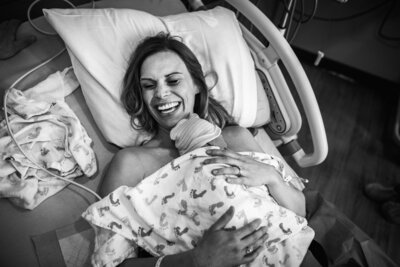
Betsy:And I, the, the one thing I do remember is afterwards I got done, like the baby comes out and they were like, here, mom, hold her.
Betsy:Like here.
Betsy:And I was like, oh, just someone take her.
Betsy:I was so tired.
Betsy:I was so
Betsy:exhausted that I was like, Josh, you hold her.
Betsy:Like, just stop trying to, you know, again, like attachment parent, like co-sleeping hippie.
Betsy:I was just like, get that thing away from me.
Betsy:Like funny someone else
Betsy:hold the damn baby.
Betsy:And they were like, oh, okay.
Betsy:Like we thought you were particular about this.
Betsy:So my husband helper and.
Betsy:We have the most precious pictures from that.
Betsy:So it all, it all worked out.
Betsy:And yes, we, stayed at the hospital at that point.
Betsy:I was like, this is like a hotel.
Betsy:I'm living the lap of luxury.
Betsy:I got two young kids at home.
Betsy:Yeah.
Betsy:Like, I just was like, I'll stay as long as they'll have me, which was only a day, or you know, she was born at night and I think we stayed a full next day or something.
Betsy:and yeah, it was so sweet.
Betsy:She was, a delightful baby.
Betsy:Having a gender that's not the gender you had the time before is its own special uniqueness.
Betsy:So it was just so fun to have two boys and then our precious little baby girl.
Betsy:And we, we named her ela Mariah Ruth ELA is a biblical word.
Betsy:It's, found in the book of Psalms, which, for anyone who's familiar with the Bible, the book of Psalms is a part of the Bible that's meant to be sung.
Betsy:And sah is the word that they put after a passage that you have sung.
Betsy:And it means pause and reflect, like consider what has come before.
Betsy:Mm-hmm.
Betsy:And it was really meaningful for us to give her a name that was kind of encompassing of everything we'd been through to that point.
Betsy:'cause it felt like, you know, at that point I'd had five pregnancies and it just felt like a lot of learning had happened and a lot of kind of, reflection was needed.
Betsy:Mm-hmm.
Betsy:And yeah, she was a great baby.
Betsy:We were, you know, doing all the things.
Betsy:We were attachment parenting.
Betsy:She slept on me for every nap.
Betsy:We, co-slept.
Betsy:She exclusively breastfed like we were.
Betsy:Everything that identity gives you.
Betsy:Mm-hmm.
Betsy:And she was great.
Betsy:And we were, really happy.
Betsy:The boys were old enough to go to preschool, kindergarten, they went back to school.
Betsy:And, we just had this very sweet little happy family.
Betsy:And that is when the story takes a significant left hand turn, which is, when Selo was 11 months old, our oldest Bodin, he was six at the time, he got sick.
Betsy:It was December.
Betsy:And he got sick with what we felt like was a cold.
Betsy:He was very, very sick.
Betsy:And we took him to the doctor and the doctor said, yeah, it's just a bad virus.
Betsy:Take him home and, and keep an eye on him.
Betsy:And I feel like I knew something wasn't right.
Betsy:I knew it wasn't a virus.
Betsy:And after about a week, no one else in the family had gotten sick.
Betsy:No one else was experiencing symptoms, which those of us with multiple kids know, like, not
Lo:typical.
Betsy:Yeah.
Betsy:One kid is sick.
Betsy:Every kid, everyone's sick.
Betsy:Everyone is sick.
Betsy:Yeah.
Betsy:Right.
Betsy:And so I just started getting this pit in my stomach like something is not good and is, you know, is not right.
Betsy:And so we took him back to the doctor and got him some blood work done.
Betsy:And we were working with a Pia pediatrician and a kinesiologist, and they were working together as well.
Betsy:And the kinesiologist called us and she said, do not pack a bag.
Betsy:Like run, do not walk.
Betsy:You need to take him to Children's Hospital immediately.
Betsy:He has blood levels that aren't, like, he won't see the sun tomorrow, he will not wake up if you do not get him to a hospital.
Betsy:On the way to the hospital, my husband was like, I wonder if he has cancer.
Betsy:And I was like, babe, don't be so dramatic.
Betsy:Like he's sick, don't be crazy.
Betsy:And he was like, I just don't know why the doctors would tell us that.
Betsy:And so we, we ended up in the hospital, at the children's hospital and for two weeks, every test under the sun could not figure out what was wrong with him.
Betsy:And the doctors kept saying like, well, we could do a bone marrow biopsy and.
Betsy:In hindsight, it feels hilarious to consider that we were declining that.
Betsy:But you have to imagine in the moment, like we were like home birth unvaccinated.
Betsy:Like none of my children had ever had a shot in their life.
Betsy:They, they had a pediatrician only 'cause we needed one for a school physical.
Betsy:They'd never been to the doctor outside of that.
Betsy:And we had been in the hospital for two weeks and the all the team was like, yeah, we don't know.
Betsy:Who knows?
Betsy:Mm-hmm.
Betsy:Uh, Maybe we could try a bone marrow biopsy.
Betsy:And we were like, no, absolutely not.
Betsy:Yeah.
Betsy:Like, you guys need to figure out what's going on and or like, you guys need to have a plan.
Betsy:Mm-hmm.
Betsy:And not just like, throw stuff at the wall and hope it sticks.
Betsy:And so, actually the next day his blood levels started improving and they were like, who knows?
Betsy:Looks like it was a terrible virus.
Betsy:No one could have expected.
Betsy:You should go home and keep an eye on him.
Betsy:And we did for another two weeks and he was not getting better.
Betsy:And so we took him back to, he got a fever, which was like the big thing.
Betsy:If he gets a fever, bring him back.
Betsy:He got a fever.
Betsy:th,:Betsy:was six years old, January of:Betsy:Salo was 11 months old.
Betsy:And then our middle son Jude, was five.
Betsy:He had just turned five.
Betsy:Mm-hmm.
Betsy:And so, you know, that's kind of like a whole nother podcast.
Betsy:Yeah, obviously we, Bo was diagnosed when he was six.
Betsy:He relapsed when he was eight.
Betsy:We had to seek relapse care in Philadelphia.
Betsy:We live in Denver.
Betsy:So we were, living in Philadelphia.
Betsy:Like part of us, some of us were home.
Betsy:We had an au pair trying to raise the other children while we were in emergency care in Philadelphia.
Betsy:It was a really, really hard, long couple years.
Betsy:Yeah.
Betsy:He has been in remission now for a handful of years after an experimental, trial that he got on in Philadelphia.
Betsy:So as far as like that plot line goes, like, things are good and he's healthy.
Betsy:And you know, it, it's funny 'cause most of the time when I'm asked to speak about things, it's that topic.
Betsy:So to only give it a snippet two minutes is kind of funny.
Betsy:But, yeah, it's just not the point of this, of this talk.
Betsy:So, yeah.
Betsy:The thing I think that's interesting to me is that, you know, the day Boden was diagnosed, like we went from being like this really anti-Western medicine attachment only family.
Betsy:To like overnight.
Betsy:I mean, we lived in the hospital.
Betsy:ELA started full-time, 7:00 AM to 5:00 PM daycare.
Betsy:She was picked up by my mom.
Betsy:She was given bottles by grandma and grandpa.
Betsy:She was like tended to in the night by grandparents and friends who would stay with us while we were living in the hospital.
Betsy:I stopped breastfeeding immediately.
Betsy:I like tried to hold onto that for a minute and my body was just like, absolutely not.
Betsy:Like, we're gonna dry up your milk supply for you.
Betsy:Like the stress of everything was just like, yeah, and I think it's just interesting because I look back on all of it.
Betsy:I mean, as I was thinking about talking with you, I look back on all of it, the miscarriages sitting in the hospital and having the doctor be so crass and unkind to me during my fi first miscarriage, like getting gestational trophoblastic disease.
Betsy:All of it.
Betsy:Like, I'm like, there were all these moments where I started to have to do this dance between like, I need western medicine actually.
Betsy:Like I need it to help me when my body doesn't have the exact right answer.
Betsy:And also I'm not all in on it.
Betsy:Mm-hmm.
Betsy:Like I'm, I'm actually pretty sure of some things about western medicine that I don't want to interact with.
Betsy:And it was like those were all stepping stones that got me to this point where it was like, well, not only do I have to use it because my child is so unwell, but it's gonna keep my child alive and it's gonna cure him from something that would, I mean, 40 years ago was incurable and would've resulted in his death.
Betsy:And, I had to let go of so much of my motherhood.
Betsy:Like I had to let go of being an attachment mom to sayah and exclusively breastfeeding and things that were like
Betsy:so much my identity.
Betsy:I should say like at that time it
Betsy:felt like I was giving up my identity.
Betsy:Yeah.
Betsy:When really, like I realized like the through line is like, I am the best mom that they could have.
Betsy:Like I'm the best mom I could be.
Betsy:That's the identity.
Betsy:Like that's actually my identity.
Betsy:It's not about if I co-slept with Boden, which I stopped after like three months.
Betsy:'cause I was like, this is annoying.
Betsy:You need to sleep.
Betsy:Like here's this dark nursery.
Betsy:Figure it out.
Betsy:Yeah.
Betsy:You know, like with Jude, I thought I would breastfeed multiple years.
Betsy:I was like, I am available.
Betsy:And he stopped breastfeeding after like nine months.
Betsy:He just was like, not interested.
Betsy:You know, there were all these moments where like my identity.
Betsy:Was so what I thought was grounded in these, these tent poles of like, I home birth, I exclusively breastfeed, we don't use western medicine.
Betsy:And life like threw me into this slurry of like crying uncle and being like, okay.
Betsy:And for a, for many years that looked like I don't know what my identity is.
Betsy:Mm-hmm.
Betsy:Like, can I still call myself like a crunchy hippie mom if my kid's getting chemotherapy every week?
Betsy:Like, can I still say I'm at attach an attachment parent if my like one and a half year old doesn't breastfeed and is in daycare 60 hours a week?
Betsy:Like, am I allowed to still claim what I know to be true?
Betsy:Which I realized was I am doing the best job I can.
Betsy:Mm-hmm.
Betsy:Like I am so committed to being a good mom to these kids and it looks nothing like what I thought it would and.
Betsy:It's funny because I often talk about when I share the cancer story, like I would never choose to have the path that I walk.
Betsy:Like I wouldn't choose the miscarriages.
Betsy:I wouldn't choose especially Boden's cancer.
Betsy:Yeah.
Betsy:And I wouldn't choose a life different than like what we have.
Betsy:I would never choose a difference because I have kids that are so aware of like the meaning of family and the fragility and the tenderness, like the trauma, the working through trauma, the healing, like the nuance of like, we take really good care of our bodies and we use an infrared sauna and we drink gross herbal tea in the winter.
Betsy:And like we do all those things.
Betsy:And if you're sick, like.
Betsy:Our middle son, like, this is kind of a funny example, but like our middle son, one last summer was like, my ear hurts.
Betsy:And I'm like, yeah, yeah, yeah.
Betsy:Here's, you know, lay down, here's some garlic oil, like heat pack, lavender.
Betsy:We're gonna figure this out.
Betsy:And he was like, I actually just wanna go to a doctor.
Betsy:Like, I just wanna, I wanna go, I want a doctor to see me.
Betsy:And for him, like he was always just kinda left behind when his older brother was getting so much medical attention.
Betsy:And so I was like, okay, that's probably good.
Betsy:You know, it's probably good to let him see a doctor just to kind of give him, you know, give him that.
Betsy:And we went to the doctor and the doctor was like, oh my gosh, he is like a raging ear infection.
Betsy:Like, you need antibiotics, like all this stuff.
Betsy:And I was just like, what a gift.
Betsy:Like what a gift.
Betsy:To be alive and aware and just like open-hearted that I don't have all the answers and I'm not stuck inside of this like, specific identity.
Betsy:Of what makes me a mom.
Betsy:It's like I'm just here and I keep hoping that every painful experience is like I'm checking the box and I'll never have to go back to this again because I've learned, right?
Betsy:And I'm different and I've moved on.
Betsy:When in reality like it's, I'm just here.
Betsy:Like I just am holding everything close to me.
Betsy:I'm holding close to me that the doors that open might be scary and painful or they might be healing and whole and beautiful and
Betsy:no matter what, like I'm here.
Betsy:Yeah.
Lo:That's Thanks.
Lo:Thank you for sharing all of that.
Betsy:It's
Betsy:funny.
Betsy:That's
Betsy:all I got.
Betsy:I know that.
Betsy:I
Lo:know you kept saying like, I know I came on to talk about birth.
Lo:I will tell you guys, I wanna have Betsy back on to talk kind of more about like navigating having sick kids.
Lo:I've thought about having her come on with my sister Jen.
Lo:'cause Jen has had a sick kid as well, so they've shared.
Lo:Some of those things, they have different stories, so I don't wanna say it's all the same, but, so I am kind of like hopeful to have them both back on.
Lo:And we can get into more of some of this, but I wanted Betsy to come on and talk about like her births as well.
Lo:And of course I knew they led to Bo and what came after having the babies too.
Lo:Because it's this conversation, I think about identity that is so valuable and applies like that.
Lo:We often begin this in pregnancy and birth where we're saying, what, what, side am I choosing?
Lo:Like, and then we put these boundaries around ourselves and sometimes they're helpful because they help us feel strong.
Lo:Like Sure, absolutely.
Lo:And so I don't, I'm not saying like, don't, don't choose and chase the things that you really believe in.
Lo:I want that for you.
Lo:That's my whole Absolutely.
Lo:Platform is like learn and choose.
Lo:But I think that with that we have to do what you did, which is.
Lo:Or you're doing, I would say it's probably still a work in process, which is be willing to accept that we might change our minds, or that the identity that we thought like fit us really well actually didn't, or that we're actually defining our own version of what attachment parenting looks like, or gentle parenting, or, I mean, unmedicated birth, some people are, you know, if you have no epidural, that doesn't count if you still had another medicine.
Lo:You know, like there's all these Yeah.
Lo:In-betweens.
Lo:And so I think ultimately I wanted to hear you talk about that, of the, the freedom to change your mind, the grace to give yourself that freedom, and then the recognition too of like being really careful about what we actually put our identity in.
Lo:Because I think, I personally feel like you're exactly right, that it actually isn't about what parenting style we choose or what birth we have, but simply about the mother we are for our child, like the relationships that we have with him.
Lo:That is what tells us like who we are or what kind of mother we are.
Lo:Not, whether or not they contact, not breastfeed or never go to the doctor or get every vaccine or don't like It doesn't, yeah, it doesn't, we can't, yeah.
Lo:Like those things don't, we don't get to hold onto those so tight forever.
Lo:And I think it just doesn't work.
Lo:And I think it's hard
Betsy:because to your point, especially when you're starting out, you're like, who am I as a mom?
Betsy:Yeah.
Betsy:And you have to grab to something.
Betsy:Yeah.
Betsy:Like we have, no one goes into a home birth like, well I don't know, maybe we'll end up off this sounded cool.
Betsy:Like, yeah, no, everyone is like, I'm gonna do a home birth.
Betsy:And there's fear with that and so I've gotta like ground myself in reasons what I believe to stay here.
Betsy:Yeah.
Betsy:You know, how am I gonna, how am I gonna stay here?
Betsy:And also, yeah, like the tenderness with yourself, that changing your mind doesn't, I don't know, I guess I just always thought I would have it figured out.
Betsy:I would figure it out.
Betsy:I would figure out the sleep schedule, the bedtime routine, how to make enough breast milk.
Betsy:I would just figure it out and it would be done and we would move past it.
Betsy:Mm-hmm.
Betsy:And I think that's the point is like, there's nothing to figure out.
Betsy:There is a million little things to consider.
Betsy:There is nothing to figure out.
Betsy:And the closer sooner that you can get to that, I just feel like it's like that's where the freedom is.
Betsy:Yeah.
Betsy:That really is where like the beauty of just like showing up as, as a mom who loves her children and one day might decide one thing and the very next day might decide something different.
Betsy:And that doesn't make you wishy-washy, it just makes you human.
Lo:Yep.
Lo:Yep.
Lo:And that's like, to me, that that is just the whole thing of all of this is recognizing that there isn't like a, that there's not an end game, like the day where you're like, I've made it.
Lo:Like I've really got this thing figured out.
Lo:Like.
Lo:You have, someone may hate this.
Lo:You don't ever make it every single day.
Lo:Totally.
Lo:Our relationship with our kids are changing.
Lo:If we're in a relationship with someone while we're raising these kids, it's changing.
Lo:If one of our kids gets sick, what we decide about how we feel about something, it will change.
Lo:If one of our kids Absolutely.
Lo:Like something that we thought they wouldn't like, it's constantly changing.
Lo:You're not going to make it.
Lo:You just get to be in it.
Lo:Like I feel like that's ultimately what I hear from you is like, I get to be here.
Betsy:Yeah.
Betsy:That's
Lo:the identity.
Lo:I am here and I'm a mom.
Lo:Right.
Lo:And I
Betsy:think that's it.
Betsy:That's where the like tricky line of like, I would never say I'm grateful for cancer.
Lo:Right.
Betsy:And I'm sure you can relate to this in your own grief story.
Betsy:The closer you get to the fragility of life.
Lo:Yeah.
Betsy:And this side of the veil, that is every moment you wake up.
Betsy:And you take a deep breath and you're like, I cannot believe get this.
Betsy:Mm-hmm.
Betsy:I cannot believe it.
Betsy:And I'm sad at what God is here, and I'm sad for who's not with us, but like the fact that I am here, I like, I don't think I would have that perspective without cancer.
Betsy:And it's a perspective that I literally think I'm luckiest person in the world.
Betsy:Yeah.
Betsy:And it's hard to marry those two.
Betsy:Yeah.
Betsy:It's hard to figure out like, well, what does that mean given I think cancer, I kind of joke cancer ruined our lives.
Betsy:Mm-hmm.
Betsy:And it didn't, it actually made them really robust in a way that I can't, yeah.
Betsy:I just can't imagine not having,
Betsy:yeah.
Lo:Thank you so much for sharing all that with me.
Lo:I know that it's obviously emotional still to go back to some of those places and spaces, so I appreciate it.
Lo:I'm super excited to just, it sounds weird, but like have this out here.
Lo:I just can picture it resonating in a lot of different ways with a lot of different.
Lo:Moms and families who are right where you are, where you're, yeah.
Lo:Changing your minds or wanting to where you feel like people won't let you.
Lo:Yeah.
Lo:Or maybe you actually know, I do wanna stand firm because I am doing the work.
Lo:Like there's just so, yeah.
Lo:There's just so much there.
Lo:And
Betsy:actually, like, if we come back and me and Jen talk together, her and I have a very different approach to, I know medicine.
Betsy:Yeah.
Betsy:And even we were in this mother's group and she, I mean, if you guys will listen to her birth story, like she was coming home, like, I don't know, I haven't researched it.
Betsy:Meanwhile I'm like hours deep in like the vitamin K shot and its efficacy.
Betsy:And I'm just like, what do you mean you haven't researched it?
Betsy:You know, like, I feel like surrounding yourself with people that don't think like you.
Betsy:Yeah.
Betsy:And just being like, and you know what, it's okay.
Betsy:Yeah.
Betsy:We're all gonna get through it and we're gonna have perspectives given to each other that are, you know.
Betsy:They make us whole.
Lo:Yes, they do.
Lo:They do?
Lo:Yeah.
Lo:Okay.
Lo:Why don't you, I'll put it in the show notes 'cause I know your details, but just share them really quickly.
Lo:Like if someone wanted to talk to you about any of this or more on some of the cancer stuff, Instagram handle Yeah.
Lo:Email address, what would that be?
Lo:Yeah,
Betsy:so I, uh, had a pretty cool Instagram following and had to close it down because it, there's a wild, wild world out there of people taking images of cancer kids and trying to get money and doing very, uh, nefarious things.
Betsy:So I actually.
Betsy:In haste one night closed down my Instagram account, so you cannot find me there.
Lo:However,
Betsy:I have written extensively, thousands and thousands of words on my blog about pediatric cancer and everything that goes alongside that.
Betsy:Specifically the clinical trial that Boden was enrolled in, which is called CAR T Therapy, which is a really cool, new science with using immunotherapy, to fight cancer.
Betsy:And so I'm really passionate about that.
Betsy:I, I will talk to you about anything Yeah.
Betsy:Birth, motherhood identity, but if you want me to really go off and you bring up cancer, I am there for it.
Betsy:So I have a blog where you can find my contact information.
Betsy:It's the heavyweight www dot the heavyweight weight spelled WAIT.
Lo:Mm-hmm.
Lo:Perfect.
Lo:And like I said, we'll put that down below.
Lo:And then last thing I just ask everyone before we finish up, what's something in your life right now that's just making you so happy?
Betsy:Hmm.
Betsy:Okay.
Betsy:Well, there's two things I will share.
Betsy:One is we have a lot of trauma to play out in our family because of, Bowden's Cancer journey.
Betsy:And how that showed up for our middle son was that he really struggled accessing public school, or I should say school outside of the home.
Betsy:For many years he has had a really hard time and this year, for the first year since he was five, since Bowen was diagnosed, he is in school full-time out of the house.
Betsy:I am not homeschooling him anymore, which, it's like cancer.
Betsy:It was a gift and I never wanna go back.
Betsy:So I am, truly thrilled for him that he has access to that, at this point in his healing and thrilled for me because
Betsy:I, I have been put through a lot of things that I don't choose to do in my life, and homeschooling is one of them.
Betsy:So, that's one.
Betsy:And then the second is my husband and I just celebrated our 15th wedding anniversary last weekend, and we are going to Spain at the end of the month to walk, to do the pilgrimage on the Camino de Santiago for seven days.
Betsy:And I'm living for that.
Lo:Yeah.
Betsy:So,
Lo:oh, that's gonna be amazing.
Lo:I got to go to Spain once and not do that.
Lo:I've heard of this.
Lo:And it's such a gorgeous, beautiful country.
Lo:Like, it's so colorful.
Lo:It just,
Betsy:oh, it's everything.
Lo:Yeah.
Lo:It's, it's gonna be, yeah.
Lo:It's gonna be great.
Betsy:Yeah.
Betsy:We're so excited.
Betsy:So, yeah.
Lo:Well, thank you for being here.
Lo:Thank you for being vulnerable again.
Lo:I loved hearing it.
Lo:I've never heard you tell that whole story, you know, to me or to to Jen, so it was felt really special to get to hear from, kind of from start to where you are now.
Lo:We won't stay finished 'cause we're still here, but yeah, I mean, I would encourage
Betsy:everyone almost to pretend you're being interviewed for a podcast and tell the story because it's really cool to kind of write down all the details you didn't consider.
Betsy:Yeah.
Betsy:or write down all the details and then see the through lines that you didn't consider.
Betsy:Like, oh, I was actually kind of being prepped for this many years ago, or I was changing my mind about things and didn't even realize it.
Betsy:So yeah.
Betsy:Thanks Betsy.
Betsy:You're so welcome.
:Thank you so much for listening to the Lo and Behold podcast.
:I hope there was something for you in today's episode that made you think, made you laugh or made you feel seen.
:For show notes and links to the resources, freebies, or discount codes mentioned in this episode, please head over to lo and behold podcast.com.
:If you aren't following along yet, make sure to tap, subscribe, or follow in your podcast app so we can keep hanging out together.
:And if you haven't heard it yet today, you're doing a really good job.
:A little reminder for you before you go, opinions shared by guests of this show are their own, and do not always reflect those of myself in the Labor Mama platform.
:Additionally, the information you hear on this podcast or that you receive via any linked resources should not be considered medical advice.
:Please see our full disclaimer at the link in your show notes.